


















Lesson 25 of 42 · Animal Production
Animal Production: Chapter Review
Review animal production with a one-picture summary, a recap table, a formula toolbox you can run and a ten-question quiz on nutrition, breeding, health and welfare.
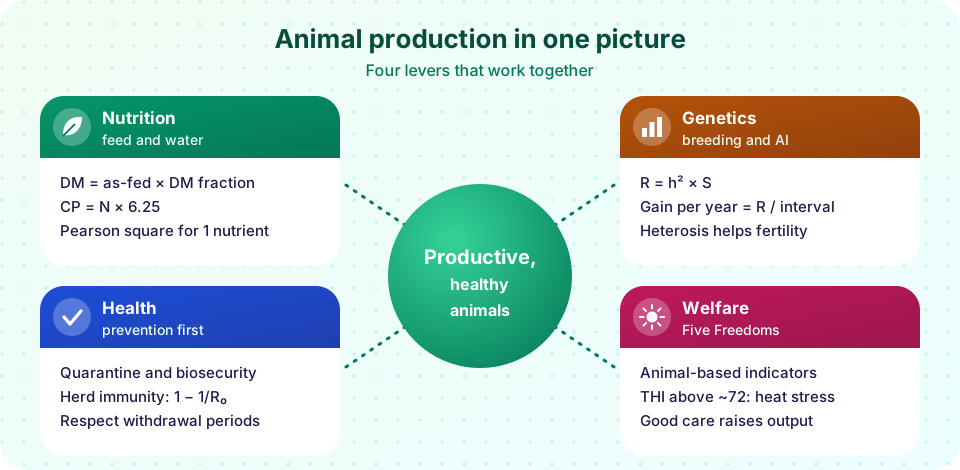
You have now met the four levers of animal production: what the animal eats, which genes it carries, how healthy it stays and how well it is treated. A good farmer pulls all four together. This review puts the chapter's ideas on one page, gives you a toolbox of the formulas to run yourself, and ends with a ten-question check that mixes all four lessons.
Recap
| Topic | Key ideas | Formula or rule |
|---|---|---|
| Overview | Ruminants vs monogastrics; extensive, mixed and intensive systems | FCR = feed / gain; broiler about 1.7, pig about 2.8, feedlot beef about 7 |
| Nutrition | Six nutrient classes, rumen VFAs, balancing rations | DM = as-fed × DM fraction; CP = N × 6.25; Pearson square; basal energy ≈ 70 × W^0.75 kcal/day |
| Breeding | Heritability, EBVs, crossbreeding, AI, reproductive cycles | h² = V_A / V_P; R = h² × S = i × h² × σ_P; gain per year = R / generation interval |
| Health and welfare | Biosecurity, vaccination, withdrawal periods, Five Freedoms | Critical coverage = 1 − 1/R₀; THI = (1.8T + 32) − (0.55 − 0.0055 RH)(1.8T − 26) |
Connecting the ideas
- Nutrition and breeding interact. A high-yielding cow only reaches her genetic potential on a ration that meets her needs, and a ration is only worth its cost if the animal can use it.
- Health and welfare are one system. A crowded, hot, poorly ventilated shed raises stress and disease together. Prevention (biosecurity, vaccines, comfort) is cheaper than cure.
- Efficiency has several meanings. FCR looks at feed per kilogram of gain; a fuller view includes land, water, nitrogen, methane, antibiotics and welfare.
A worked scenario that uses the whole chapter
A farmer keeps 40 dairy cows, each eating about 18 kg of dry matter a day, and wants to raise milk output and cut costs. Walk through the four levers in order.
Nutrition. The ration is 11% crude protein from a mix of silage and maize grain. Tests show the cows would do better at 16%. Using the Pearson square with maize (9% CP) and a 44% CP soybean meal, the concentrate needs about 20% soybean meal and 80% maize on a dry-matter basis. The farmer also checks that long forage is still at least half the ration, so the rumen pH stays above 5.5.
Genetics. The herd average is 8,000 kg a lactation, and the farmer inseminates the best quarter of the cows with semen from a bull whose daughters are expected to give 800 kg more. With a heritability of 0.3, a parental advantage of 1,000 kg gives about 300 kg of progress per generation, but with a five-year generation interval that is only 60 kg a year. Patience, and a breeding index that includes fertility, are part of the plan.
Health. A new heifer is bought and kept apart for three weeks before joining the herd. The vet recommends vaccination against a disease with R₀ near 3, so coverage above 67% is the target, and the farm records withdrawal periods after any antibiotic treatment.
Welfare. On hot afternoons the temperature-humidity index passes 80, so the farmer adds shade, fans over the feed bunk and a second water trough. Intake and milk yield recover.
The lesson of the example is that no lever works alone. Better protein is wasted if the cows are heat-stressed; a good bull is wasted if infertility keeps cows from calving; and a vaccination plan fails if new animals bring in disease unchecked.
How to study this chapter
Make a one-page list of the formulas and, next to each, one number that shows you understand it: FCR of 1.7 for broilers, a heritability of 0.3 for milk, a critical vaccination coverage of 67% when R₀ is 3. Then redo three calculations without looking at the lessons. Finally, explain to someone else, in plain words, why a cow can live on grass and a pig cannot. If you can do that, you have the central idea of animal nutrition.
Try it
This toolbox gathers the chapter's formulas as small functions. Predict each answer first, then run it.
Press Run (or Ctrl + Enter) to see the result here.
Program input · what you'd type while the program runs
Type the answers before you press Run, one per line. Each time the program reads a line (with input()), it gets the next line from this box.
The flashcards below help you rehearse the key terms. Click a card to flip it.
Check your understanding
Quick check · 10 questions
of 10 answered You scored / 10 · perfect!
-
1. Fresh grass has 20% dry matter. How much DM is in 50 kg?
50 × 0.20 = 10 kg DM. -
2. A feed has 3.0% nitrogen. Its crude protein is:
3.0 × 6.25 = 18.75%. -
3. Which statement about the rumen is correct?
The rumen microbes do the digesting. The abomasum is the true acid stomach. -
4. A herd averages 6,200 kg. Selected parents average 7,200 kg with h² = 0.35. What is R?
S = 1,000, R = 0.35 × 1,000 = 350 kg. -
5. Why does shortening the generation interval raise annual genetic gain?
Gain per year = response per generation divided by interval, so a shorter interval gives more progress per year. -
6. What benefit does crossbreeding give most clearly?
Heterosis is largest in lowly heritable traits such as fertility and survival. -
7. For R0 = 2, what is the critical vaccination coverage (perfect vaccine)?
1 - 1/2 = 0.5. -
8. Which is an animal-based welfare indicator?
Body condition is measured on the animal. The others describe resources. -
9. A cow in heat is bred 100 days after calving and conceives. Gestation is 283 days. What is the next calving interval?
283 + 100 = 383 days. -
10. At 32 °C and 50% RH, THI is about 81. What does this indicate for dairy cows?
Stress starts around THI 68 to 72, so 81 is severe and shade, fans or sprinklers are needed.
Summary
- Nutrition, genetics, health and welfare are four levers that work together.
- Feed efficiency is only part of the picture; land, water, nitrogen and welfare count too.
- Key formulas: FCR, DM, CP = N × 6.25, R = h² × S, 1 − 1/R₀ and THI.
- Prevention and management usually beat treatment.
Track your progress
Create a free account to tick off lessons and pick up where you left off on any device.
of Agricultural Science lessons completed