


















Lesson 1 of 42 · Getting Started
Course map: your path through agricultural science
See the whole agricultural science course at a glance: who it is for, how to study it, and what the nine chapters teach, from soil and crops to food security.
Agricultural science is the study of how people grow food, fibre and fuel, and how they can do it for a growing population without wearing out the land. It borrows from biology, chemistry, physics, earth science, economics and engineering, and then asks a very practical question: what should a farmer do in this field, this season, with these resources?
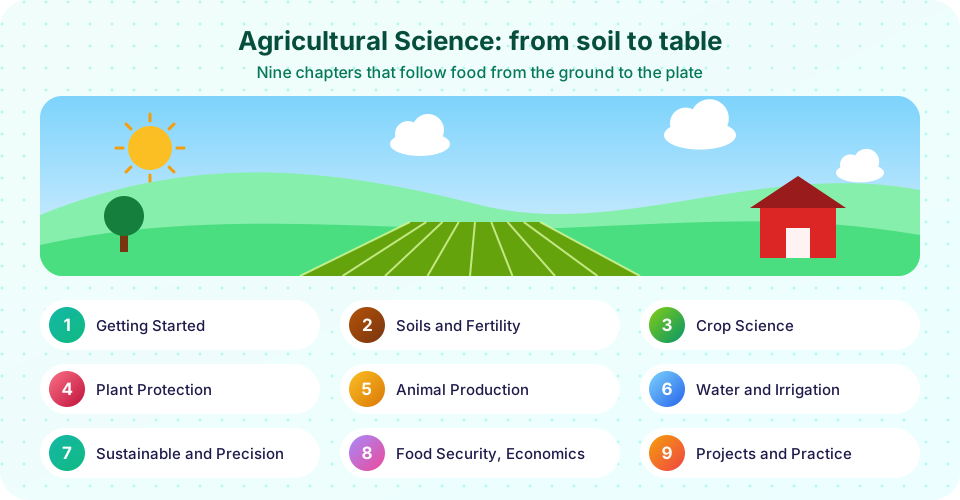
This course walks that question from the ground up. You start with what agriculture is and how to measure a farm, move through soils, crops, pests, animals and water, and finish with sustainability, food security and the economics that decide what actually gets grown. The examples use real units and real calculations, so by the end you can size a fertilizer dose, plan a rotation, estimate a seed rate or judge whether a pest outbreak is worth spraying.
Educational information only. This course explains the science of farming. Local rules, soils, climates and laws differ widely. Before applying any pesticide, fertilizer or veterinary product, read the product label and follow your national guidance or the advice of a local agricultural extension service.
What you will learn
- Who this course is for and what background you need.
- How the nine chapters build on each other.
- A study routine that works for a science subject full of numbers.
- A few headline figures that show the scale of the job farming has to do.
Who this course is for
The course is written for learners aged about 14 and up, for adults changing careers, and for anyone who wants to understand where food comes from. It follows the common core of international school and first-year college courses: Cambridge IGCSE and A Level Agriculture, IB Environmental Systems and Societies, US high-school agricultural science and introductory university crop, soil and animal science. You do not need a farm. You do need school-level biology (what a cell and a leaf are), a little chemistry (what an element and a pH scale are) and comfortable arithmetic. When a formula appears it is explained step by step, in plain text, with units.
How the nine chapters fit together
Think of the course as a journey that follows a grain of wheat or a liter of milk from the field to the table.
Part 1: the foundations
- Getting started
- Soils and fertility
- Crop science
- Plant protection
Part 2: animals and water
- Animal production
- Water and irrigation
Part 3: the big picture
- Sustainable and precision
- Food security and economics
- Projects and practice
Chapters 1 to 4, the first half of the course, give you the plant and its environment: the field, the soil, the crop and the things that attack it. Chapters 5 to 9 add animals, water, technology and the human side. If a later idea feels hard, its explanation almost always lives a chapter or two earlier.
A study routine that works
- Read with a question. Turn one bullet from "What you will learn" into a question you want answered.
- Sketch it. Draw the soil profile, the crop growth curve or the rotation wheel from memory. Drawing exposes gaps.
- Run the numbers. Many examples are small calculators. Change an input, predict the output, then run it.
- Self-test. Use the quiz at the end of every lesson and the longer quiz that closes each chapter. Recalling an answer beats re-reading.
- Look outside. Notice the crop fields, gardens, markets and food labels around you. Every lesson connects to something you can see.
Farming by the numbers
A few approximate figures set the scale. The world has roughly 8 billion people. Crops occupy on the order of 1.5 billion hectares of land, and grazing land is larger still. Agriculture uses about seven-tenths of the fresh water that people withdraw from rivers, lakes and aquifers, and it is also a major source of greenhouse gases and a driver of land-use change. These are rounded estimates from international statistics and they change from year to year, so treat them as orders of magnitude, not exact facts.
Divide cropland by people and you get a sobering number: each person has only a small garden-sized share of the world's cropland, about 0.19 ha or 1,900 m² on average. Feeding everyone from that small plot, with enough left over for wild nature, is the central challenge of the subject.
Try it
Press Run (or Ctrl + Enter) to see the result here.
Program input · what you'd type while the program runs
Type the answers before you press Run, one per line. Each time the program reads a line (with input()), it gets the next line from this box.
Check your understanding
Quick check · 4 questions
of 4 answered You scored / 4 · perfect!
-
1. Which question best describes the core of agricultural science?
Agricultural science applies biology, chemistry, physics and economics to practical decisions on real fields and farms. Methods vary with soil, climate and resources. -
2. Roughly how much cropland is there per person on Earth?
About 1.5 billion hectares divided by about 8 billion people is roughly 0.19 ha per person. -
3. Which chapter would you read to learn about weeds and insects?
Chapter 4, Plant Protection, covers weeds, pests, diseases and integrated pest management. -
4. Why should you treat the headline numbers in this lesson as orders of magnitude?
International statistics are estimates and are updated regularly, so round numbers give the scale without false precision.
Summary
- Agricultural science applies several sciences to growing food, fibre and fuel.
- The nine chapters run from soils and crops through animals and water to sustainability, food security and projects.
- Study by asking questions, sketching, running the calculators and testing yourself.
- Each person has only about 0.19 ha of cropland on average, so using land well matters.
Next: What is agriculture?
Track your progress
Create a free account to tick off lessons and pick up where you left off on any device.
of Agricultural Science lessons completed