


















Lesson 22 of 42 · Animal Production
Animal Nutrition and Feed Rations
Learn the nutrient classes, how the rumen works, why dry matter matters, how to balance a ration with the Pearson square and how to price it at least cost.
Feeding is the single biggest cost on a livestock farm and the biggest lever for output. A cow fed too little protein gives less milk; a pig fed too much wastes money and pollutes with nitrogen; a chicken fed the wrong amino acids grows slowly no matter how much it eats. Animal nutrition is the science of giving each animal the right amounts of the right nutrients at the right time, as cheaply as possible.
In this lesson you will learn what animals need, why a cow and a pig digest feed in completely different ways, and how to balance a ration with arithmetic you can do on paper and with a short program.
What you will learn
- List the six classes of nutrients and what each does
- Convert feeds between as-fed and dry-matter weights and estimate intake
- Explain how rumen microbes supply energy and protein to a cow
- Balance a two-ingredient ration with the Pearson square
- Use the metabolic body weight idea to estimate maintenance energy
Key terms
Dry matter (DM): what remains of a feed after all the water is removed. Rations are compared on a dry-matter basis.
Crude protein (CP): nitrogen content times 6.25, a measure of total protein.
Metabolizable energy (ME): the energy in feed that the animal can actually use, in megajoules (MJ) per kilogram of dry matter.
Volatile fatty acids (VFAs): acetate, propionate and butyrate, the energy compounds that rumen microbes produce from fiber and starch.
Ration: the total feed an animal receives in a day.
The six classes of nutrients
Every animal needs the same six groups of nutrients, in different proportions.
- Water is the most important and the most neglected. Water makes up well over half of an animal's body, and a high-yielding dairy cow can drink more than 100 liters a day. A commonly quoted rule of thumb is that a milking cow needs several liters of water for every liter of milk. Clean, always-available water is the cheapest way to raise output.
- Carbohydrates supply most of the energy: starch and sugars from grain, and fiber (cellulose, hemicellulose) from forage.
- Fats are the most concentrated energy source. Gross energy is about 39 MJ/kg for fat, 24 MJ/kg for protein and 17 MJ/kg for carbohydrate.
- Proteins supply amino acids for muscle, milk, eggs, wool and enzymes.
- Minerals include calcium and phosphorus (bone, eggshell, milk), sodium, potassium and trace elements such as zinc, copper, selenium and iodine.
- Vitamins are needed in small amounts for metabolism, vision, bone and immunity.
Energy is measured in joules. One kilocalorie equals 4.184 kilojoules, so a feed described as 3,000 kcal per kg is about 12.6 MJ per kg.
Dry matter: comparing feeds fairly
Fresh grass is mostly water, hay is mostly dry. To compare them you convert to dry matter:
DM weight = as-fed weight × DM fraction
Silage with 35% dry matter contains 0.35 kg of DM in each kilogram, so 30 kg of silage supplies 30 × 0.35 = 10.5 kg DM. Fresh grass is roughly 15 to 25% DM, silage 30 to 40%, hay and grain 85 to 90%.
Animals do not eat a fixed weight of feed; they eat a share of their body weight in dry matter. A rough figure is 2 to 3% of body weight per day for cattle, with high-yielding dairy cows at the top of that range. A 600 kg cow therefore eats about 12 to 18 kg DM per day. The ration must supply her requirements within that limit, which is why feeds are judged by their nutrient density per kg DM, not by weight alone.
Protein: more than a number on a bag
Laboratories measure nitrogen (N) and multiply by 6.25, because proteins are about 16% nitrogen (100 / 16 = 6.25). A feed with 2.88% N has 2.88 × 6.25 = 18% crude protein. The number is useful but crude: it counts non-protein nitrogen such as urea in the same way as true protein.
Monogastric animals (pigs, poultry) need specific essential amino acids that their bodies cannot make. In maize-and-soy diets, lysine is usually the first one to run short for pigs, and methionine for poultry. Feed mills add small amounts of synthetic amino acids to meet the need without feeding a lot of surplus protein.
Ruminants have a different problem. Rumen microbes break most feed protein down to ammonia and rebuild it as microbial protein, which the cow digests lower down. Nutritionists therefore balance rumen-degradable protein (feeds the microbes) and rumen-undegradable protein (bypasses the rumen, feeds the cow directly). Urea, a cheap non-protein nitrogen source, can supply microbes with nitrogen if enough fermentable energy is available, but is toxic if fed in excess.
The rumen: a living fermentation tank
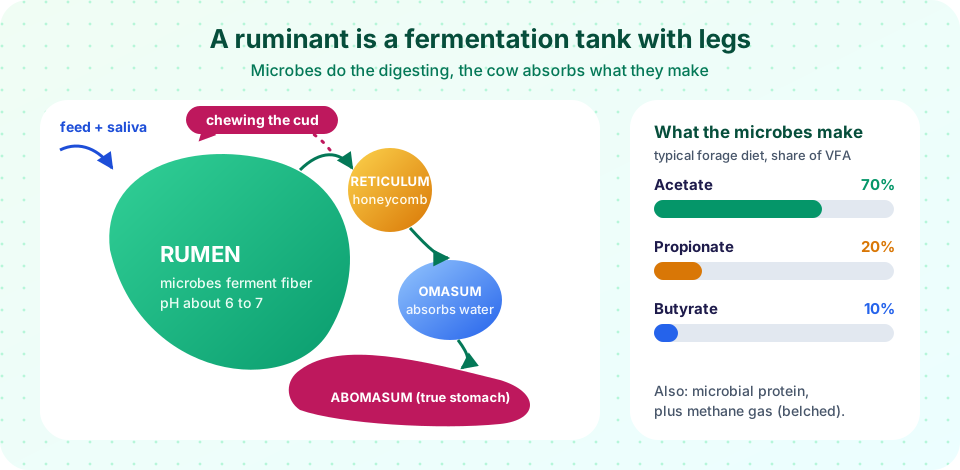
A ruminant stomach has four compartments. Chewed feed and saliva enter the rumen, which holds on the order of a hundred liters in an adult cow and is packed with bacteria, protozoa and fungi. The microbes ferment fiber and starch to volatile fatty acids. On a forage diet the usual proportions are roughly 70% acetate, 20% propionate and 10% butyrate. The VFAs are absorbed through the rumen wall and supply a large share of the cow's energy. Acetate is the building block of milk fat, propionate is the main source of glucose.
The cow regurgitates the coarse material and chews it again (rumination, or chewing the cud) for around eight hours a day. This grinding and the saliva that goes with it neutralize acid and keep the rumen pH around 6 to 7. The reticulum traps heavy objects and sorts particles, the omasum absorbs water, and the abomasum works like our stomach with acid and enzymes.
Because the microbes are alive, ration changes must be gradual. Too much starch too fast makes acid; when the rumen pH falls below about 5.5 the condition is called acidosis, which reduces intake and can damage the rumen wall. That is why dairy rations also include enough "effective fiber" (long forage) to encourage chewing. Microbes also release methane, a greenhouse gas that the cow belches out; research on feed additives and breeding aims to reduce it.
Monogastrics and their tricks
Pigs digest like humans: enzymes in the small intestine, a little fermentation in the large intestine. Poultry have no teeth; the gizzard grinds feed with grit, and the crop stores it. Plants store much of their phosphorus as phytate, which these animals cannot digest well. Adding the enzyme phytase to the feed releases it, which saves mineral supplements and reduces phosphorus in manure. Laying hens also need large amounts of calcium (around 3.5 to 4% of the diet) for eggshells.
Balancing a ration
The Pearson square
The Pearson square mixes two ingredients to reach a target. Suppose maize has 9% CP, soybean meal 44% CP and a pig needs a 16% CP diet.
- Put the target (16) in the middle. Put the ingredient CPs at the left corners (9 and 44).
- Subtract diagonally, always taking the smaller from the larger: soybean meal 44 gives 44 - 16 = 28 parts for the other side, i.e. 28 parts of maize; maize 9 gives 16 - 9 = 7 parts of soybean meal.
- Total parts = 28 + 7 = 35. So maize is 28 / 35 = 80% and soybean meal 7 / 35 = 20%.
Check: 0.80 × 9 + 0.20 × 44 = 7.2 + 8.8 = 16. The square only handles one nutrient at a time and two ingredients. Real rations meet several nutrients together, and that is a job for linear programming.
Least-cost rations
Feed mills choose ingredients to meet all the nutrient needs at the lowest price. This is exactly a linear program: minimize total cost subject to constraints on protein, energy and limits on each ingredient.
Maintenance energy and Kleiber's law
Even an animal that does nothing needs energy for breathing, heartbeat, temperature and tissue turnover. Max Kleiber found in the 1930s that this basal energy scales with body weight to the power 0.75 rather than 1. A common form is basal energy ≈ 70 × W^0.75 kcal per day for W in kilograms. A 600 kg cow needs about 70 × 600^0.75 ≈ 8,500 kcal, a 2 kg hen about 118 kcal. In per-kilogram terms the hen needs roughly four times as much, which is one reason small animals eat more relative to their size. Farm animals need more than basal energy because they walk, eat, grow and produce.
Common misconceptions
"More protein is always better." Protein above the animal's requirement is burned for energy and the nitrogen is excreted as urea and ammonia. That costs money and pollutes.
"Feed is feed: only weight matters." A tonne of fresh grass has far less nutrition than a tonne of grain because of the water. Always compare on a dry-matter basis.
"A cow digests grass with her own enzymes." Mammals cannot make cellulase. The microbes do the work and the cow lives on what they make.
Try it
The first program does the Pearson square and then a least-cost ration with a linear-programming solver. The feed values and prices are illustrative round numbers, not market data.
Press Run (or Ctrl + Enter) to see the result here.
Program input · what you'd type while the program runs
Type the answers before you press Run, one per line. Each time the program reads a line (with input()), it gets the next line from this box.
The second program plots the basal energy of animals from a hen to a cow and shows how it falls per kilogram as body weight rises.
Press Run (or Ctrl + Enter) to see the result here.
Program input · what you'd type while the program runs
Type the answers before you press Run, one per line. Each time the program reads a line (with input()), it gets the next line from this box.
Check your understanding
Quick check · 5 questions
of 5 answered You scored / 5 · perfect!
-
1. Silage has 35% dry matter. How much DM is in 40 kg of it?
40 kg × 0.35 = 14 kg of dry matter. -
2. A feed contains 3.2% nitrogen. What is its crude protein?
Crude protein = N × 6.25 = 3.2 × 6.25 = 20%. -
3. Which VFA is the main source of glucose for a cow?
Propionate is the main glucose precursor. Acetate is the main building block for milk fat. -
4. Using the Pearson square, what share of the mix is the high-protein ingredient (40% CP) when mixing with a 10% CP ingredient to get 16% CP?
High-protein parts = 16 - 10 = 6, low-protein parts = 40 - 16 = 24, total 30. The high-protein share is 6 / 30 = 20%. -
5. What happens when a cow's rumen pH drops below about 5.5 because of too much starch?
Low pH inhibits fiber-digesting microbes and damages the rumen wall. Intake and production fall.
Summary
- Animals need water, carbohydrates, fats, proteins, minerals and vitamins; water is the cheapest way to raise output.
- Compare feeds on a dry-matter basis; cattle eat roughly 2 to 3% of body weight in DM per day.
- Crude protein is nitrogen × 6.25. Ruminants feed microbes first; pigs and poultry need balanced amino acids.
- Rumen microbes produce VFAs (about 70% acetate, 20% propionate, 10% butyrate on forage diets); sudden starch increases cause acidosis.
- Rations are balanced with the Pearson square for one nutrient and with linear programming for least cost.
- Basal energy scales with body weight to the 0.75 power, so small animals use more energy per kilogram.
Track your progress
Create a free account to tick off lessons and pick up where you left off on any device.
of Agricultural Science lessons completed