


















Lesson 17 of 42 · Plant Protection
Weeds and weed control
Learn how weeds reduce crop yield, why the critical period matters, how weed life cycles and seed banks work, and how cultural, mechanical and herbicide tools combine to control weeds.
A weed is a plant growing where it is not wanted. That makes the definition depend on the field: a few wheat plants in a field of oilseed rape are weeds, and so is a thistle in a pasture. Weeds are usually the most widespread and persistent crop problem. They are present in nearly every field in every season, and across crops and regions they have long been estimated as responsible for larger average yield losses than insects or diseases, when left uncontrolled.
The good news is that weeds follow rules. Their effect depends on how many there are, when they appear and how they reproduce. This lesson explains competition and the critical period, then life cycles and the seed bank, and finally the tools farmers combine to keep weeds below a harmful level.
What you will learn
- How weeds reduce yield and why the timing of emergence matters most.
- The difference between annual, biennial and perennial weeds and why seed banks make weeds persistent.
- The critical period for weed control and how it is determined.
- The main control tools, how herbicides are classified and how resistance develops and is managed.
Key terms
Competition: the struggle between plants for limited light, water, nutrients and space.
Seed bank: the store of live weed seeds in and on the soil.
Critical period for weed control: the time window in which weeds must be controlled to prevent yield loss above an acceptable level.
Selective herbicide: a herbicide that kills certain weeds without harming the crop.
Mode of action: the biochemical process a herbicide disrupts in the plant.
How weeds cost yield
Weeds hurt crops in several ways:
- Competition for light: taller or faster weeds shade the crop. Light competition is often the most important in dense stands.
- Competition for water and nutrients, especially nitrogen, for which many weeds are strong competitors.
- Allelopathy, where chemicals released by one plant inhibit another, in some species.
- Harboring pests and diseases, serving as alternate hosts.
- Harvest and quality problems, such as weed seeds contaminating grain, tangled harvesters and poisonous weeds in forage.
Yield loss rises with weed density, but with diminishing steps: the first weeds per square meter cost the most per plant, because dense weeds compete with one another. A common model is the rectangular hyperbola:
yield loss (%) = I × d / (1 + I × d / A)
where d is the weed density (plants/m²), I is the percent loss caused per weed at very low density and A is the maximum loss. With I = 4 % per plant and A = 60 %, a density of 5 plants/m² gives 4 × 5 / (1 + 20/60) = 15 % loss.
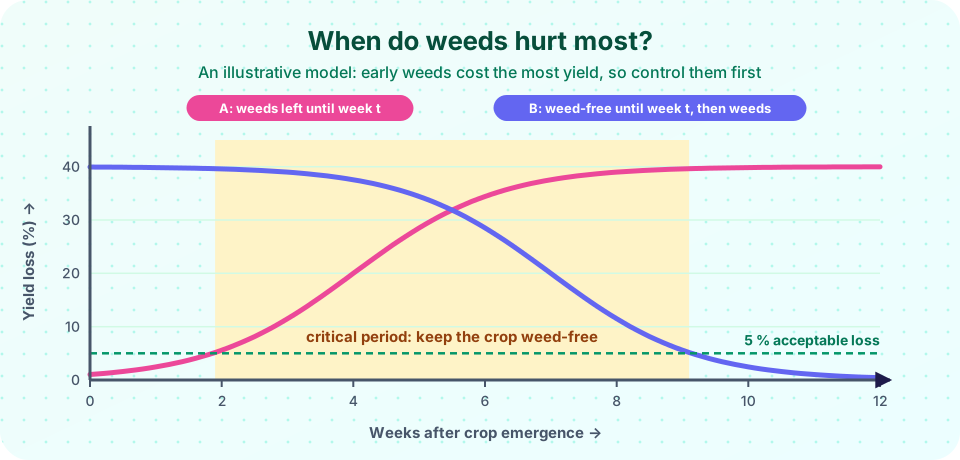
Timing matters more than density. A weed that emerges with the crop is much more damaging than one that emerges when the crop already has several leaves, since the early weed gets the same head start. This is why the critical period for weed control is a central idea. It is found by two experiments. In the first, weeds are allowed to grow with the crop for increasing lengths of time and then removed (curve A in the figure). In the second, the crop is kept weed-free for increasing lengths of time and then weeds are allowed to grow (curve B). If you accept a small loss, such as 5 %, the two curves tell you when weeds can be tolerated early and when they must be controlled. In maize, the critical period is commonly reported as running from about the third to the fourteenth leaf stage, though it varies with the weed species, density, season and cultivar. Weed control before and during this window pays; control after it often does not.
Life cycles and the seed bank
- Annuals complete their life cycle in one year and spread only by seed. Summer annuals (such as pigweed) germinate in spring and die in autumn. Winter annuals (such as chickweed) germinate in autumn.
- Biennials form a rosette the first year and flower in the second.
- Perennials live for many years and spread by seed and by underground parts such as rhizomes, stolons and tubers. Couch grass, bindweed and purple nutsedge are examples. Cutting them into pieces can spread them, so tillage can make the problem worse.
A single weed plant can produce thousands, and in some species hundreds of thousands, of seeds. Many seeds are dormant and persist in the soil for years, building a seed bank that is much larger than the weeds seen above ground. Seed bank dynamics explain why a year of poor control can lead to many years of trouble, and why preventing seed return, rather than killing the plants already in the field, is a key strategy.
Control tools
Prevention. Use clean crop seed, clean machinery between fields, manage field edges and irrigation water, and control weeds before they set seed.
Cultural. Make the crop more competitive than the weeds: choose vigorous varieties, sow at an optimum date, use narrower rows and adequate seed rates, apply nitrogen near the crop, and rotate crops with different weed spectra. Cover crops and mulches suppress weeds.
Mechanical. Tillage before sowing (a "stale seedbed" lets weeds germinate and be removed before the crop), inter-row hoeing, cutting, mowing and hand weeding. Modern robotic and camera-guided hoes are expanding this option.
Biological. Grazing animals, introduced insects or pathogens that attack specific weeds, mainly in rangeland and non-crop land.
Chemical. Herbicides save labor and are very effective, which is why they are widely used. They are classified in several ways:
- Selective or non-selective: a selective herbicide, such as 2,4-D in cereals, controls broadleaf weeds without harming the grass crop, while a non-selective one, such as glyphosate, kills most plants it contacts.
- Contact or systemic: contact products kill the tissue they touch, and systemic products are moved through the plant to roots and growing points.
- Timing: pre-plant, pre-emergence (applied to soil before weeds emerge) or post-emergence.
- Mode of action: each herbicide disrupts a process such as amino-acid synthesis, photosynthesis, cell division or plant hormone balance. Modes of action are numbered by international systems so that farmers can rotate between different groups.
Herbicide resistance
When a herbicide is used repeatedly, rare individuals that survive pass their genes on, and the resistant share of the population grows. Resistance has now evolved in hundreds of weed species worldwide, and in many fields to several modes of action. To slow it:
- Rotate and mix herbicides with different effective modes of action.
- Combine chemical with non-chemical methods (rotation, competitive crops, mechanical control).
- Use full label doses (not reduced doses that select for partial resistance).
- Stop seed return from escapes, and clean machinery.
- Scout fields after spraying and record what survives.
Common misconceptions
"Weeds only matter if they are tall." Small early weeds often cost more yield than larger weeds that emerge later.
"Tillage kills perennial weeds." Cutting rhizomes and root pieces can multiply them.
"If a herbicide worked once, it will keep working." Repeated use of one mode of action selects for resistance.
Try it
Press Run (or Ctrl + Enter) to see the result here.
Program input · what you'd type while the program runs
Type the answers before you press Run, one per line. Each time the program reads a line (with input()), it gets the next line from this box.
Press Run (or Ctrl + Enter) to see the result here.
Program input · what you'd type while the program runs
Type the answers before you press Run, one per line. Each time the program reads a line (with input()), it gets the next line from this box.
Check your understanding
Quick check · 6 questions
of 6 answered You scored / 6 · perfect!
-
1. Which weeds usually cost the most yield?
Early weeds compete from the start and shade the young crop. -
2. With I = 4 % per plant and A = 60 %, what is the yield loss at 5 weeds per m2 using the hyperbola?
4 x 5 / (1 + 20/60) = 20 / 1.333 = 15 %. -
3. Why can cultivating a field full of couch grass make it worse?
Each rhizome piece can regrow, so tillage spreads perennial weeds. -
4. Which tactic best slows herbicide resistance?
Diverse modes of action and non-chemical controls reduce selection pressure. -
5. What is the critical period for weed control?
It is found from the two timing experiments; control inside it prevents most losses. -
6. A stale seedbed technique is meant to:
Tillage triggers weed germination, which is then killed before the crop goes in.
Summary
- Weeds reduce yield by competing for light, water and nutrients, and by harboring pests and spoiling harvests.
- Early-emerging weeds cost the most; the critical period shows when control matters.
- Annuals spread by seed, perennials also by rhizomes and tubers, and persistent seed banks make weeds long-lived.
- Combine prevention, cultural, mechanical and chemical tools; classify herbicides by selectivity, movement, timing and mode of action.
- Resistance evolves under repeated use of one mode of action, so rotate and integrate.
Track your progress
Create a free account to tick off lessons and pick up where you left off on any device.
of Agricultural Science lessons completed