


















Lesson 38 of 42 · Projects and Practice
Practice Set: Agricultural Calculations
Fifteen practice problems on feed, breeding, animal health, irrigation, nutrients, precision agriculture, food and farm economics, with a four-step method and a runnable answer key.
Agricultural science is a numerate subject. Nutritionists balance rations, irrigation engineers size pumps, farm advisers calculate break-even yields. Each task uses a handful of formulas and a lot of care with units. The best way to become fast and reliable is to solve many varied problems by hand, then check them.
This lesson gives you fifteen problems drawn from the whole second half of the course, a method for tackling them, and a program that prints the answers so you can mark your own work. Try each problem on paper first. Only then look at the answer key.
What you will learn
- Apply a four-step method to calculation problems
- Convert reliably between units used in agriculture
- Solve problems on feed, breeding, health, water, nutrients, precision tools and economics
- Check your answers for sensible size
Key terms
Given and unknown: the quantities the problem tells you and the quantity it asks for.
Dimensional analysis: checking that units on both sides of an equation match.
Order of magnitude: a rough size check, such as "about 10, not 1,000".
Significant figures: the digits that carry real information; do not report more than the data justify.
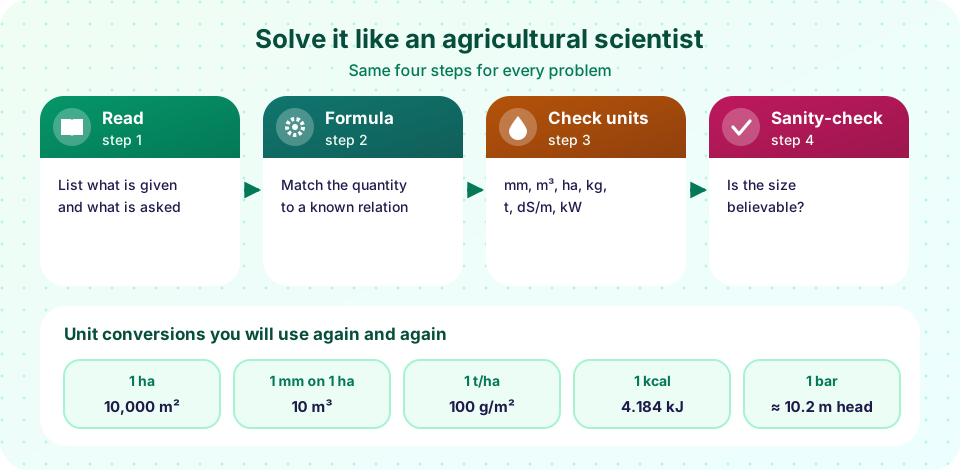
A four-step method
- Read and list. Write what is given and what is asked, with units. Draw a quick sketch if it helps (a bucket for soil water, a chain for food loss).
- Choose the relation. Match the unknown to a formula you know: for example R = h² × S, ETc = Kc × ET₀, gross = net / Ea.
- Check units. Convert everything to a consistent set before you calculate. The most frequent errors are mixing millimeters with meters, kilograms with tonnes, and percentages with fractions (use 0.30, not 30, in a formula that expects a fraction).
- Sanity-check. Is the answer the right size? A drip irrigation depth of 8,000 mm, a feed conversion ratio of 0.2 or an NDVI of 3 is a sign of an error. Estimate roughly in your head first.
Useful conversions: 1 ha = 10,000 m²; 1 mm of water over 1 ha = 10 m³; 1 t/ha = 100 g/m²; 1 kcal = 4.184 kJ; 1 bar ≈ 10.2 m of head; 1 L/s = 3.6 m³/h.
The problems
Animals
- A cow is fed 36 kg of silage with 32% dry matter. How many kilograms of dry matter is that?
- A feed contains 2.72% nitrogen. What is its crude protein content?
- You mix maize (9% CP) and soybean meal (44% CP) to make an 18% CP diet. What percentage of each (Pearson square)?
- A herd averages 6,500 kg of milk. Selected parents average 7,500 kg and h² = 0.28. What is the expected response R per generation, and the gain per year with a 5-year generation interval?
- A disease has R₀ = 3.2. What vaccination coverage is needed for herd immunity with a perfect vaccine?
Water and irrigation
- ET₀ = 5.5 mm/day and Kc = 1.1. What is ETc? How many cubic meters per day does a 20 ha field use?
- A soil has θ_FC = 0.32 and θ_PWP = 0.16 with a rooting depth of 0.9 m. Find TAW. With p = 0.5, find RAW and the irrigation interval at the ETc from problem 6.
- A net irrigation of 72 mm is needed and the system efficiency is 0.85. What gross depth is applied, and what volume for 8 ha?
- Irrigation water has EC 1.5 dS/m and the crop's soil limit ECe is 2.5 dS/m. What is the leaching requirement?
- A pump delivers 30 L/s against 50 m total head at η = 0.70. What power does it need, and what energy per cubic meter?
Sustainability and precision
- A crop removes 160 kg N/ha while 240 kg N/ha is applied. Find the NUE and the surplus.
- A pixel reflects 52% NIR and 10% red. Calculate NDVI.
Food and economics
- Total costs are $1,450/ha and the price is $180/t. What is the break-even yield?
- A project costs $4,000 and returns $700 per year for 10 years at a 7% discount rate. What is its NPV?
- 3,000 kg of maize at 21% moisture is dried to 13.5%. What is the final weight?
Working one problem in full
Take problem 7 and write it out the way an examiner would like to see it.
Given: θ_FC = 0.32, θ_PWP = 0.16, rooting depth Z_r = 0.9 m, depletion fraction p = 0.5, ETc = 6.05 mm/day (from problem 6).
Unknown: TAW, RAW and the irrigation interval.
Relation: TAW = (θ_FC − θ_PWP) × Z_r × 1000; RAW = p × TAW; interval = RAW / ETc.
Units: θ is a fraction (m³ of water per m³ of soil), Z_r is in meters, and the factor 1000 converts meters of water to millimeters.
Calculation: TAW = (0.32 − 0.16) × 0.9 × 1000 = 144 mm. RAW = 0.5 × 144 = 72 mm. Interval = 72 / 6.05 ≈ 11.9 days.
Sanity check: Loam holds roughly 130 to 180 mm per meter of depth, so 144 mm over 0.9 m is reasonable. A bucket of 72 mm that is emptied at about 6 mm a day lasts about two weeks, in line with the usual practice of irrigating every one to two weeks on a loam in summer.
Notice how much of the work is organizing the problem before touching the calculator. Once the given, unknown, relation and units are on paper, the arithmetic is almost an afterthought.
When a problem has several parts
Problems 4, 6, 7, 8 and 10 each ask for more than one quantity, and later parts often depend on earlier ones. Keep intermediate results with their units and a few extra digits, then round only the final answers. If one part of a chain is wrong, every later part is wrong too, so check each part before moving on. Also read the question for hidden steps: "volume for 8 ha" needs the area conversion that 1 mm over 1 ha is 10 m³, and "energy per cubic meter" needs a conversion from seconds to hours.
Common misconceptions
"If I get a number, it is probably right." A calculator happily returns nonsense. Always check the size and the units.
"Percent can go straight into a formula." Convert 18% to 0.18 when the formula needs a fraction, and leave it as 18 when the formula uses percent (like the Pearson square).
"Rounding early is harmless." Keep extra digits during the calculation and round once at the end.
Try it
The program below computes the answers to all fifteen problems. Work them by hand first, then run it and compare. If your answer differs, find where the units or the formula went wrong.
Press Run (or Ctrl + Enter) to see the result here.
Program input · what you'd type while the program runs
Type the answers before you press Run, one per line. Each time the program reads a line (with input()), it gets the next line from this box.
The checker below lets you enter your answer for a chosen problem and tells you whether it is within 1% of the right value.
Check your understanding
Quick check · 5 questions
of 5 answered You scored / 5 · perfect!
-
1. Which step catches an answer of 8,000 mm for one irrigation event?
A size check shows that a single irrigation of 8,000 mm is impossible, which points to a unit error. -
2. How many m³ is 45 mm over 6 ha?
45 × 10 × 6 = 2,700 m³. -
3. A formula needs the depletion fraction p. The crop's value is 55%. What do you enter?
Percent becomes a fraction: 55% = 0.55. -
4. Which unit conversion is correct?
1 t = 1,000,000 g and 1 ha = 10,000 m², so 1 t/ha = 100 g/m². -
5. A pump lifts 15 L/s to 40 m with η = 0.60. About what power?
P = 9.81 × 0.015 × 40 / 0.60 = 9.8 kW.
Summary
- Use four steps: list, choose the relation, check units, sanity-check.
- Memorize a few conversions: 1 ha = 10,000 m², 1 mm per ha = 10 m³, 1 t/ha = 100 g/m².
- Percent versus fraction and kg versus tonnes are the commonest sources of error.
- Predict first, compute second, then explain any difference.
Track your progress
Create a free account to tick off lessons and pick up where you left off on any device.
of Agricultural Science lessons completed