


















Lesson 33 of 42 · Sustainable and Precision Agriculture
Sustainable and Precision Agriculture: Chapter Review
Review sustainability pillars, conservation agriculture, nutrient budgets, soil carbon and precision tools with a one-page summary, formula toolbox and ten questions.
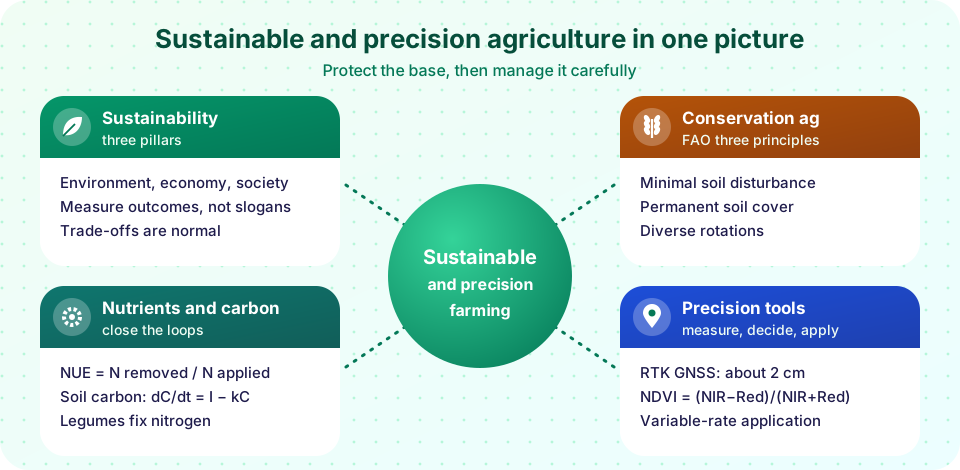
This chapter paired two ideas. The biological half (conservation agriculture, rotations, legumes) protects the soil and recycles nutrients. The digital half (GNSS, sensors, variable-rate machines) manages variation so inputs go where they pay. Both serve the same goal: grow enough food while keeping the land, water and climate in good shape. This review puts the formulas on one page and tests you with ten mixed questions.
Recap
| Topic | Key ideas | Formula or number |
|---|---|---|
| Sustainability | Three pillars; planetary boundaries; diminishing returns to nitrogen | Economic optimum: marginal yield = price ratio |
| Conservation agriculture | Minimum disturbance, permanent cover, diversification; legumes; trade-offs | NUE = N removed / N applied; surplus = inputs − outputs |
| Soil carbon | Slow build, fast loss, decades to equilibrate | dC/dt = I − kC; C* = I / k |
| Precision agriculture | Measure, decide, apply; RTK about 2 cm; zones and prescriptions | NDVI = (NIR − Red) / (NIR + Red) |
Connecting the ideas
- Measure first. Sustainability claims need numbers: surplus nitrogen, soil carbon, water productivity. Precision tools supply the measurements.
- Biology and technology complement each other. Cover crops and no-till build soil; sensors tell you where the soil still limits yield.
- Beware of single answers. No-till can raise herbicide use, legumes cost energy, high NDVI does not guarantee yield. Good agronomists weigh trade-offs.
Seeing the chapter as a system
Imagine a farmer who wants to farm sustainably with limited money. The biological practices come first and cost little: keep the soil covered, rotate crops, include a legume, return residues and manure. They protect the soil, hold water and cut nitrogen losses. Then the farmer measures: a soil test, a nitrogen budget, a yield map from the combine or a simple smartphone record of yields by field.
The measurements show where problems hide. One corner of the field is always weak. A map shows it is low and wet, and the vigor map confirms poor growth there each year. Rather than adding more fertilizer to that corner, the farmer improves drainage or plants a more tolerant crop. In the productive zones, nitrogen may be a bit higher; on the weak patch, it is lower. The same total may be spent, but yield and efficiency rise.
This is the central message of the chapter: sustainable agriculture combines ecological practice with careful measurement, and precision technology is only as good as the agronomic thinking that interprets it.
Questions to ask about any practice
- What does it do to soil cover, soil carbon and erosion?
- What does it do to nitrogen and phosphorus losses and to greenhouse gases?
- Does it save or use more water, and what happens to the water quality?
- What does it cost, and who pays?
- What can go wrong, and how would we know?
If you can answer those five questions for a practice, you can judge whether it is truly more sustainable.
Try it
Press Run (or Ctrl + Enter) to see the result here.
Program input · what you'd type while the program runs
Type the answers before you press Run, one per line. Each time the program reads a line (with input()), it gets the next line from this box.
The flashcards below cover the chapter's main terms. Click a card to flip it.
Check your understanding
Quick check · 10 questions
of 10 answered You scored / 10 · perfect!
-
1. Which pair are two of the three pillars of sustainable agriculture?
The pillars are environment, economy and society. -
2. A field gets 180 kg N/ha and the crop removes 135 kg. What is the surplus?
Surplus = inputs - outputs = 180 - 135 = 45 kg N/ha. -
3. What is the NUE in that case?
135 / 180 = 0.75, or 75%. -
4. I = 4.0 t C/ha/yr and k = 0.05 per year. What is the equilibrium soil carbon?
C* = 4.0 / 0.05 = 80 t C/ha. -
5. The time scale for soil carbon to approach equilibrium is about:
With k = 0.04 per year, 1 / k = 25 years. -
6. Which is NOT a principle of conservation agriculture?
Residues are kept as cover, not burned. -
7. NIR = 0.40 and red = 0.10. NDVI is:
(0.40 - 0.10) / (0.40 + 0.10) = 0.30 / 0.50 = 0.60. -
8. What does RTK improve?
RTK corrections let machines steer and apply inputs with centimeter precision. -
9. Why does precision nitrogen management not always cut total fertilizer use?
The goal is the right rate in each place, which redistributes as well as reduces inputs. -
10. Why is a cloudless radar satellite image sometimes preferred over an optical one?
Radar satellites can image in cloudy weather.
Summary
- Sustainable agriculture balances environment, economy and society and relies on measured outcomes.
- Conservation agriculture protects soil with minimum disturbance, permanent cover and diversity; nutrient budgets and NUE track nitrogen.
- Soil carbon responds slowly (dC/dt = I − kC) and can be lost quickly.
- Precision agriculture measures, decides and applies with GNSS, sensors, NDVI maps and variable-rate machines.
Track your progress
Create a free account to tick off lessons and pick up where you left off on any device.
of Agricultural Science lessons completed