


















Lesson 9 of 42 · Soils and Fertility
Plant nutrients and fertilizers
Learn the 17 essential plant nutrients, deficiency symptoms, the nitrogen cycle, how to read fertilizer grades and calculate rates, and the 4Rs of efficient fertilizing.
A crop is made of air, water and soil. Carbon, hydrogen and oxygen come from carbon dioxide and water. Everything else, from the nitrogen in proteins to the magnesium at the heart of chlorophyll, comes from the soil solution, and it must be there in the right amount at the right time. When the soil cannot supply enough of any one element, growth slows however sunny, wet and weed-free the field is.
Fertilizers close that gap. They are among the most powerful tools in farming: by some estimates, nitrogen fertilizer helps feed roughly half of the world's population. They are also costly and, used carelessly, a source of water and air pollution. The aim of this lesson is to understand what plants need, read a fertilizer bag, calculate a rate, and apply it in a way that feeds the crop and not the river.
What you will learn
- The 17 essential elements, how they are grouped and how plants take them up.
- How to recognize classic deficiency symptoms and what mobile and immobile nutrients mean.
- The main steps of the nitrogen cycle and where losses occur.
- How to read a fertilizer grade, convert between oxide and element, and calculate product amounts.
- The 4Rs of nutrient stewardship and the economics of an optimum rate.
Key terms
Essential nutrient: an element a plant cannot complete its life cycle without and that no other element can replace.
Fertilizer grade: three numbers giving the percentage by mass of N, P₂O₅ and K₂O, such as 10-20-10.
Mineralization: release of plant-available forms from organic matter by microbes.
Leaching: downward loss of dissolved nutrients, mainly nitrate, below the root zone.
Law of the minimum: yield is limited by the scarcest essential resource.
The essential elements
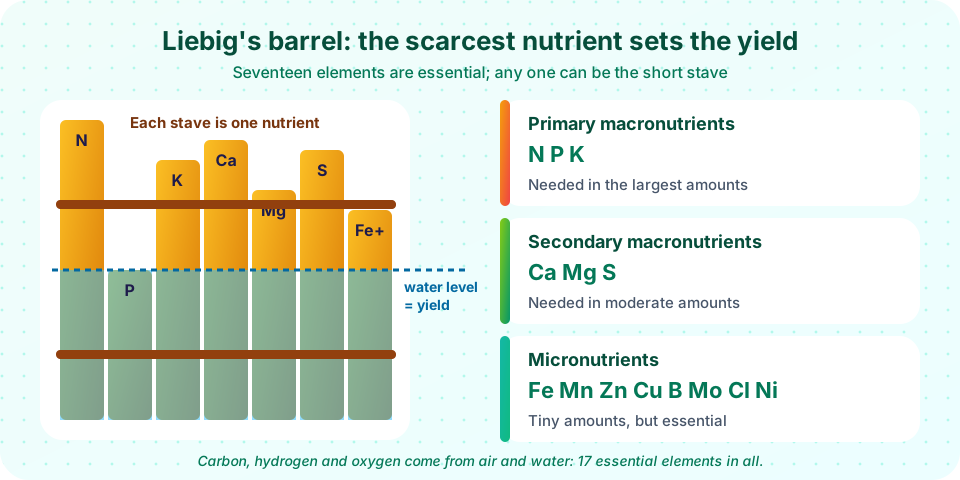
Seventeen elements are essential for most crops. Carbon, hydrogen and oxygen come from air and water. The other fourteen are mineral nutrients, grouped by how much a plant needs:
- Primary macronutrients: nitrogen (N), phosphorus (P) and potassium (K), needed in the largest amounts, often tens to hundreds of kilograms per hectare, and the ones most often added.
- Secondary macronutrients: calcium (Ca), magnesium (Mg) and sulfur (S).
- Micronutrients: iron (Fe), manganese (Mn), zinc (Zn), copper (Cu), boron (B), molybdenum (Mo), chlorine (Cl) and nickel (Ni), needed in tiny amounts, often grams per hectare, but missing any one stops growth.
Roots take nutrients up as dissolved ions: nitrogen as nitrate (NO₃⁻) or ammonium (NH₄⁺), phosphorus as phosphate (H₂PO₄⁻ or HPO₄²⁻), potassium as K⁺, calcium as Ca²⁺ and so on. Soil minerals, organic matter, fertilizer and manure feed this solution, and cation exchange sites on clay and humus buffer it.
Reading the plant: deficiency symptoms
Some nutrients move inside the plant (mobile) and some stay where they were deposited (immobile). When supply runs short, a plant moves mobile nutrients from old leaves to new growth, so symptoms appear first on old leaves for mobile nutrients and on young leaves for immobile ones.
| Nutrient | Mobility | Typical symptom |
|---|---|---|
| Nitrogen | Mobile | Pale green to yellow older leaves, slow growth |
| Phosphorus | Mobile | Dark green or purple tint, stunted young plants |
| Potassium | Mobile | Yellow then brown leaf edges, weak stems |
| Magnesium | Mobile | Yellowing between veins on older leaves |
| Sulfur | Fairly immobile | Pale young leaves (can resemble N deficiency) |
| Calcium | Immobile | Distorted young leaves, blossom-end rot in tomato |
| Iron | Immobile | Yellow young leaves with green veins |
| Zinc | Fairly immobile | Short internodes, small leaves, pale bands in maize |
Symptoms are clues, not proof. Disease, drought and herbicide injury look similar, so confirm with soil and plant tissue tests.
The nitrogen cycle in the field
Nitrogen is the nutrient plants need most and soils lose most easily. Almost all of the planet's nitrogen is N₂ gas in the air, which plants cannot use.
- Fixation: legumes with Rhizobium bacteria in their root nodules, and some free-living microbes, convert N₂ into ammonia. Industry does it with the Haber-Bosch process, which takes about 1 to 2 % of the world's energy by common estimates.
- Mineralization: microbes break down organic matter and release ammonium.
- Nitrification: other microbes oxidize ammonium to nitrate, the form most mobile in soil.
- Uptake by roots, and immobilization into microbes.
- Losses: nitrate leaches with drainage water into groundwater and rivers. In waterlogged soil denitrification converts nitrate to N₂ and the greenhouse gas nitrous oxide (N₂O). Surface-applied urea can lose ammonia gas by volatilization.
Phosphorus works differently. It binds strongly to soil particles, so it rarely leaches but moves with eroded soil into water, where it can feed algal blooms (eutrophication). Potassium is held on exchange sites and leaches mostly in sandy soils.
Fertilizers and their grades
Fertilizers are sold with a grade of three numbers: percent N, percent P₂O₅ and percent K₂O by mass. A 10-20-10 bag contains 10 % N, 20 % P₂O₅ and 10 % K₂O. The oxide convention is historic. To find the actual elements:
P = P2O5 × 0.436 K = K2O × 0.830
Common products include urea (46-0-0), ammonium nitrate (about 34-0-0), triple superphosphate (0-46-0), potassium chloride, also called muriate of potash (0-0-60), and compound NPK blends such as 15-15-15. Organic sources, such as manure, compost and green manures, supply smaller and variable amounts, release nutrients slowly and add organic matter. Their nutrient content should be measured or taken from a local table.
Calculating a rate. Suppose a soil test and the crop plan call for 120 kg N/ha and you will use urea:
urea needed = 120 / 0.46 = 261 kg/ha
If the crop also needs 40 kg P₂O₅/ha from triple superphosphate (46 % P₂O₅), that is 40 / 0.46 = 87 kg/ha, and 60 kg K₂O/ha from potassium chloride (60 % K₂O) is 60 / 0.60 = 100 kg/ha.
The 4Rs of nutrient stewardship
- Right source: match the product to the crop and soil (for example, avoid surface urea on warm, wet, alkaline soil, or choose a slow-release form on leaky sandy soil).
- Right rate: apply what the crop needs, accounting for soil supply, previous crops, manure and expected yield.
- Right time: apply when the crop can use it, splitting nitrogen into several doses rather than one large early dose.
- Right place: place nutrients where roots can reach them, such as banding near the seed row, and keep them out of waterways with buffer strips.
Response curves and the economic optimum
Yield rises quickly at first as a nutrient is added, then flattens. A common model is the Mitscherlich curve y = y0 + (ymax − y0)(1 − e^(−c × N)). The yield-maximizing rate is rarely the profit-maximizing rate, because each extra kilogram costs money. The economic optimum is where the extra yield per extra kilogram of fertilizer, times the crop price, equals the fertilizer price. Where the curve is flat, the last kilograms of fertilizer earn nothing and mostly become pollution.
Common misconceptions
"If a little fertilizer is good, more is better." Beyond the optimum, yield stops rising, costs rise and losses to air and water grow. Excess can also burn seedlings.
"Organic fertilizers are not chemicals." Plants take up the same ions from any source. Manure and compost release them slowly and add organic matter, but they can still pollute if over-applied.
"The 'P' in 10-20-10 is 20 % phosphorus." It is 20 % P₂O₅, which contains only 43.6 % elemental P.
Try it
Press Run (or Ctrl + Enter) to see the result here.
Program input · what you'd type while the program runs
Type the answers before you press Run, one per line. Each time the program reads a line (with input()), it gets the next line from this box.
Press Run (or Ctrl + Enter) to see the result here.
Program input · what you'd type while the program runs
Type the answers before you press Run, one per line. Each time the program reads a line (with input()), it gets the next line from this box.
Check your understanding
Quick check · 6 questions
of 6 answered You scored / 6 · perfect!
-
1. A fertilizer is graded 10-20-10. How many kg of P2O5 are in a 50 kg bag?
20 % of 50 kg is 10 kg of P2O5. -
2. How much urea (46 % N) supplies 138 kg N/ha?
138 / 0.46 = 300 kg of urea per hectare. -
3. Yellowing of the OLDEST leaves, with pale growth, most suggests a shortage of:
Nitrogen is mobile, so the plant moves it to young leaves and the old ones yellow first. -
4. Which nutrient loss pathway is mainly responsible for nitrate pollution of groundwater?
Nitrate is negatively charged and moves freely with drainage water. -
5. Which of the 4Rs best describes splitting nitrogen into several applications?
Splitting matches supply to crop demand over time. -
6. Why is the profit-maximizing nitrogen rate usually below the yield-maximizing rate?
At the economic optimum, extra revenue from the last kilogram just equals its cost.
Summary
- Seventeen elements are essential: C, H and O from air and water, plus N, P, K, Ca, Mg, S and eight micronutrients.
- Mobile nutrients show deficiency first on old leaves, immobile ones on young leaves.
- Nitrogen moves through fixation, mineralization, nitrification, uptake and losses by leaching, denitrification and volatilization.
- Grades are %N-%P2O5-%K2O; convert with P = P2O5 x 0.436 and K = K2O x 0.830, and divide a nutrient target by the product percentage to get the rate.
- Use the 4Rs, and remember that the last kilograms of fertilizer give the smallest returns.
Next: Chapter 2 review
Track your progress
Create a free account to tick off lessons and pick up where you left off on any device.
of Agricultural Science lessons completed