


















Lesson 16 of 42 · Plant Protection
Plant protection overview: keeping the crop healthy
See the big picture of crop protection: which organisms attack crops, how the disease triangle works, how large losses can be, and the families of control methods used in farming.
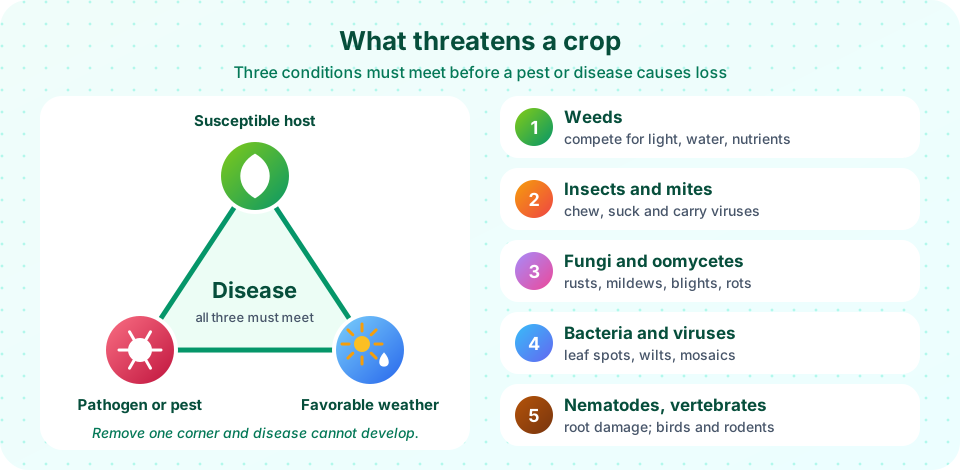
Every crop has competitors and enemies. Weeds take light, water and nutrients. Insects chew leaves, suck sap and spread viruses. Fungi, bacteria and viruses rot roots, spot leaves and block the plant's water pipes. Nematodes feed on roots, and birds and rodents eat seed and grain. Plant protection is the science of limiting the damage these organisms cause, at a cost that makes sense and with as little harm as possible to people, wildlife and the environment.
This chapter treats protection as a decision problem. You will learn who the attackers are, when they matter, how to measure them and how to choose between tools that range from planting dates to biological control to sprays. This overview gives the map.
What you will learn
- The main groups of organisms that damage crops.
- The disease triangle and why it points to prevention.
- How large crop losses can be, and why numbers vary.
- The six families of control methods and how they combine.
Key terms
Pest: any organism that damages crops or stored products enough to matter economically. The word is often used for insects, but the same logic covers weeds and pathogens.
Pathogen: a microorganism that causes disease, such as a fungus, bacterium, virus or oomycete.
Inoculum: the pathogen material, such as spores, that can start an infection.
Resistance: a plant's ability to limit infection or damage. It is also the word for a pest's ability to survive a pesticide.
Quarantine: legal measures to stop pests moving into new areas.
Who attacks crops
- Weeds are plants growing where they are not wanted. They compete with the crop and can harbor pests.
- Insects and mites damage crops by chewing, sucking, boring and spreading diseases (for example, aphids carry many plant viruses).
- Fungi and oomycetes cause rusts, mildews, smuts, blights and rots. Oomycetes, such as the potato blight organism, look like fungi but are a separate group.
- Bacteria and viruses cause leaf spots, soft rots, wilts and mosaics. Viruses depend on vectors such as insects, on infected seed or on tools.
- Nematodes are microscopic roundworms; some feed on roots and cause stunting and galls.
- Vertebrates: birds, rodents, deer and others, especially at sowing and ripening, and in storage.
The disease triangle
Plant disease needs three things at once: a susceptible host, a pathogen able to infect it and an environment that favors infection (often moisture and a suitable temperature). Take away any one and disease stops or slows. This is the basis for many control measures: resistant varieties alter the host; clean seed and crop rotation reduce the pathogen; spacing, drainage and irrigation timing change the environment around the leaf.
A famous example is potato late blight, caused by Phytophthora infestans. Cool, wet weather favors it, and in the 1840s, a susceptible potato crop, widely grown as a single variety, and wet seasons together produced the Irish potato famine, with a devastating loss of life and mass emigration. It shows how crop uniformity, pathogen and weather combine.
How much is lost?
International bodies such as the FAO commonly state that pests and diseases destroy up to roughly 20 to 40 % of potential global crop production each year, with plant diseases alone costing the world economy tens or hundreds of billions of dollars annually. Estimates differ because losses vary by crop, region, season and how well farmers protect their crops. The numbers matter less than the message: protection is worth the effort, and an unprotected crop in a bad year can fail completely.
Potential versus actual yield. The loss to a pest is loss % = (yield without the pest − actual yield) / yield without the pest × 100. A good protection plan aims at the best economic outcome, not at zero damage, because the last few percent can cost more than they save.
Families of control
| Family | Examples | Strengths | Limits |
|---|---|---|---|
| Genetic (resistance) | Resistant varieties, pest-resistant traits | Built in, cheap for the farmer | Pests evolve; needs breeding |
| Cultural | Rotation, sowing date, spacing, sanitation, cover crops | Low cost, prevents problems | Needs planning and knowledge |
| Physical and mechanical | Hoeing, tillage, mulch, traps, nets, flaming | No chemical residues | Labor, timing, soil effects |
| Biological | Natural enemies, parasitoid wasps, Bacillus thuringiensis (Bt) | Targeted, sustainable | Slower, sensitive to sprays and weather |
| Chemical | Herbicides, insecticides, fungicides, seed treatments | Fast, effective, scalable | Resistance, off-target harm, cost, safety |
| Regulatory | Quarantine, certified seed, inspection | Stops spread across borders | Depends on enforcement |
No single family is enough over time. Successful programs combine several, which leads to integrated pest management, the subject of a later lesson in this chapter.
The threats
The disease triangle
Six families of control
Plus two more
What the next lessons cover
| Lesson | Focus |
|---|---|
| Weeds and weed control | Competition, life cycles, critical period, herbicides and resistance |
| Insect pests and plant diseases | Life cycles, damage types, pathogen groups and scouting |
| Integrated pest management | Thresholds, EIL, biological control, pesticide safety |
| Chapter 4 review | Recap and a longer quiz |
Common misconceptions
"The goal is to kill every pest." The goal is to keep damage below the level where the cost of loss exceeds the cost of control. Some pests are tolerated and some beneficial insects depend on them.
"Pesticides are the only protection." Resistant varieties, rotation, timing and hygiene prevent many problems before any spray is needed.
"A spotted leaf means disease." Nutrient shortage, weather damage, herbicide drift and insects can all cause similar symptoms. Identify first.
Try it
Press Run (or Ctrl + Enter) to see the result here.
Program input · what you'd type while the program runs
Type the answers before you press Run, one per line. Each time the program reads a line (with input()), it gets the next line from this box.
Check your understanding
Quick check · 5 questions
of 5 answered You scored / 5 · perfect!
-
1. Which three factors form the disease triangle?
Disease needs a susceptible host, a pathogen and a favorable environment together. -
2. Which organism caused the Irish potato famine of the 1840s?
Potato late blight, caused by the oomycete Phytophthora infestans. -
3. Planting a resistant variety changes which corner of the triangle?
Resistance makes the host less susceptible. -
4. A crop would have yielded 7.5 t/ha but made 6.0 t/ha. What is the percentage loss?
(7.5 - 6.0) / 7.5 = 0.2, which is 20 %. -
5. Which control family includes crop rotation and sowing date?
Cultural controls change how the crop is grown to prevent problems.
Summary
- Crops face weeds, insects and mites, fungi, bacteria, viruses, nematodes and vertebrates.
- Disease needs host, pathogen and environment together; remove one corner to stop it.
- Losses to pests and diseases are large, often cited as up to 20 to 40 % of potential production, but vary widely.
- Six families of control (genetic, cultural, mechanical, biological, chemical, regulatory) work best combined.
- The goal is economic, safe protection, not zero pests.
Next: Weeds and weed control
Track your progress
Create a free account to tick off lessons and pick up where you left off on any device.
of Agricultural Science lessons completed