


















Lesson 23 of 42 · Animal Production
Animal Breeding and Reproduction
Understand heritability, the breeder's equation, crossbreeding and inbreeding, artificial insemination, and the reproductive cycles that drive farm animal output.
Farmers have been breeding animals for ten thousand years, and the results are dramatic. A modern broiler reaches market weight in roughly a third of the time that a chicken needed in the 1950s, and the average dairy cow in many countries gives several times the milk of her grandmother's generation. Part of that gain comes from better feed and care, but a large part is genetic: choosing the best parents, generation after generation.
This lesson explains how that works with arithmetic you can do by hand, why some traits respond to selection and others do not, and how reproductive biology sets the pace of everything a livestock farm can do.
What you will learn
- Define heritability and explain why it limits genetic progress
- Use the breeder's equation to predict the response to selection
- Compare pure breeding, crossbreeding and inbreeding
- Describe artificial insemination and why it changed dairy and beef breeding
- Use gestation lengths and the estrous cycle to plan a breeding calendar
Key terms
Phenotype: what you can measure in an animal (milk yield, weight, number of eggs).
Heritability (h²): the fraction of the variation in a trait that is due to additive genetic differences between animals.
Selection differential (S): the difference between the mean of the animals chosen as parents and the mean of the whole herd.
Estimated breeding value (EBV): a statistical estimate of an animal's genetic merit, combining its records, its relatives' records and (today) its DNA.
Heterosis: hybrid vigor; crossbred offspring outperform the average of their parents.
Phenotype, genes and environment
Every measurement on an animal is the sum of genes and environment: P = G + E. A cow gives 9,000 kg of milk partly because of her genes and partly because of what she was fed, where she was kept and how she was treated. Breeders care about the part they can pass on. That is the additive genetic part, the sum of the average effects of each gene copy, because a parent passes on gene copies and not its whole genotype.
Heritability measures how much of the differences between animals in a herd come from this additive part:
h² = V_A / V_P
where V_A is the additive genetic variance and V_P is the total phenotypic variance. If h² = 0.3, then 30% of the variation in the herd is additive genetic, and the other 70% is environment and non-additive genetics. Heritability is a property of a trait in a population and environment, not of an individual animal, and it is always between 0 and 1.
Roughly typical values are 0.25 to 0.35 for milk yield, 0.3 to 0.4 for growth rate and 0.4 to 0.5 for backfat thickness in pigs, but only about 0.1 for litter size and about 0.05 or less for most fertility traits. Low-heritability traits respond slowly to selection, but they respond strongly to improved management and to crossbreeding.
The breeder's equation
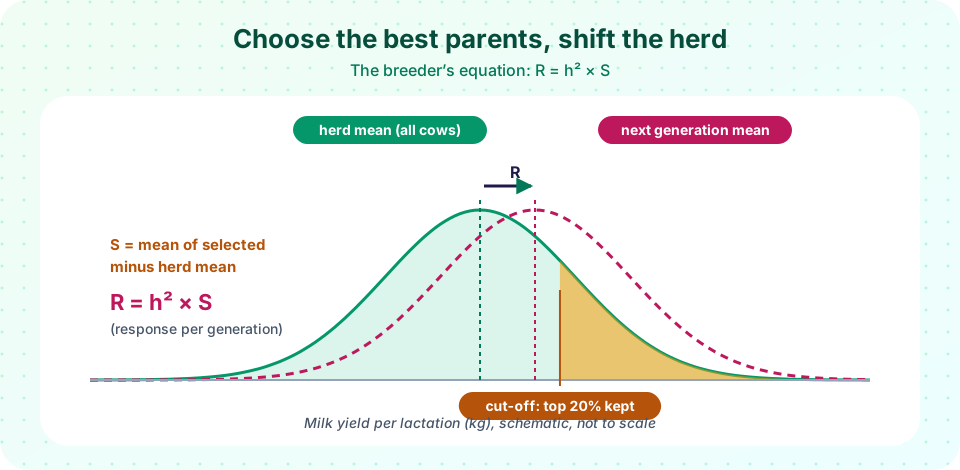
Suppose the herd averages 7,000 kg of milk per lactation, and you select cows (and sire daughters) averaging 8,000 kg as parents. Then the selection differential is S = 8,000 − 7,000 = 1,000 kg. The expected improvement of the next generation, the response to selection R, is
R = h² × S
With h² = 0.3, R = 0.3 × 1,000 = 300 kg. The offspring average about 7,300 kg, because only the additive part of the parents' advantage is passed on; the rest was good luck or good care.
You can also write S in terms of the selection intensity i (how strict you are) and the standard deviation of the trait, σ_P: S = i × σ_P, so R = i × h² × σ_P. Selecting the top 20% of a normally distributed trait has i ≈ 1.40. With σ_P = 1,000 kg and h² = 0.3, R = 1.40 × 0.3 × 1,000 = 420 kg per generation. That is larger than the 300 kg above because a top-20% cut-off is a stricter selection than a mean of 8,000 kg.
Genetic gain per year
Progress per year divides the response by the generation interval L, the average age of parents when their offspring are born:
ΔG per year = (i × h² × σ_P) / L
Cattle have a long interval (about 5 to 6 years), pigs around 1.5 to 2 years, poultry about 1 year. Shortening L is as powerful as raising i or h². That is why genomic selection, which reads thousands of DNA markers on a young animal and predicts its breeding value in the first weeks of life, has accelerated progress in dairy cattle so much: bulls can be chosen at one year old instead of waiting about five years for their daughters' milk records.
Estimated breeding values
An animal's own record is a noisy guide. A cow may have given a lot of milk because she is genetically good or because she had a lucky year. An EBV uses all the information available: the animal's own records, its relatives' records and its DNA markers, and corrects for herd, year and age effects. Breeding programs publish EBVs and combine them into an index, for example one that weighs milk yield, fertility, health and longevity. This avoids breeding for a single trait, which is what has caused some of the fertility problems in high-yielding dairy herds.
Systems of mating
Pure breeding mates animals of the same breed. It keeps the breed's character and is the basis of breed registries.
Crossbreeding mates different breeds or lines. Offspring show heterosis (hybrid vigor) in traits that are lowly heritable and sensitive to inbreeding, such as fertility, survival and litter size. A common pig system crosses two maternal breeds to make a hybrid sow, which is then mated to a terminal sire breed that gives fast, lean growth. Most commercial broilers and layers are also hybrids from specialized male and female lines.
Inbreeding is mating of relatives. The inbreeding coefficient F is the probability that the two copies of a gene in an animal are identical copies from a common ancestor. Offspring of full siblings or of parent and offspring have F = 0.25; of half siblings, F = 0.125. Inbreeding exposes harmful recessive genes, which leads to inbreeding depression: lower fertility, survival and growth. Breeders therefore track pedigree relationships and avoid mating close relatives.
Reproduction sets the pace
A farm cannot sell more calves than cows can produce, so reproductive biology matters as much as genetics.
| Species | Estrous cycle | Gestation or incubation |
|---|---|---|
| Cow | about 21 days | about 283 days |
| Ewe (sheep) | about 17 days, seasonal | about 147 days |
| Goat | about 21 days, seasonal | about 150 days |
| Sow (pig) | about 21 days | about 114 days (3 months, 3 weeks, 3 days) |
| Mare | about 21 days, seasonal | about 340 days |
| Hen | an egg about every 25 hours | 21 days incubation |
A cow is receptive ("in heat") for only about 12 to 18 hours of each cycle, so detecting heat accurately decides whether a cow conceives this month or next. A dairy farm aims for one calf per cow per year. The calving interval equals gestation plus the days open (calving to the next conception): 283 + 85 days open = 368 days, which is already slightly over a year. Every extra open day costs milk and a calf.
Artificial insemination
In artificial insemination (AI), semen from a selected male is collected, diluted, packaged in straws and frozen at −196 °C in liquid nitrogen. A technician thaws a straw and places the semen in the cow's reproductive tract at the right time. One bull can father thousands of calves each year, and the best bulls in the world are available on any dairy farm. Farmers do not need to keep a bull (which can be dangerous), the risk of venereal disease falls, and the best genetics spread very quickly. Sexed semen (sorted by chromosome content, about 90% accurate) lets dairy farms produce more heifer calves from their best cows. Embryo transfer takes the idea further: embryos from an elite cow are placed in other cows.
Common misconceptions
"High heritability means the environment does not matter." Heritability describes how variation divides, not how important feed or care are. A cow with excellent genes and poor feed will still give little milk.
"Selecting for yield alone is safe." Yield and fertility are genetically antagonistic in some breeds. Selection on yield alone has lowered fertility in dairy cattle, which is why modern indexes include health and fertility.
"Crossbred animals are always better." Heterosis helps most in low-heritability traits; crossbred offspring cannot be used as parents without losing part of the advantage.
Try it
The first program simulates selection. Each generation, the top 20% of 2,000 animals (by phenotype) become the parents. It compares h² = 0.1, 0.3 and 0.5 and prints the average gain per generation. This is a simulation under simple assumptions, not data from a real herd.
Press Run (or Ctrl + Enter) to see the result here.
Program input · what you'd type while the program runs
Type the answers before you press Run, one per line. Each time the program reads a line (with input()), it gets the next line from this box.
The second demo is a breeding calendar. Choose the species and the service (mating) date to see the expected due date and how many days away it is, using the typical gestation lengths in the table.
Check your understanding
Quick check · 5 questions
of 5 answered You scored / 5 · perfect!
-
1. A herd averages 5,000 kg and the selected parents average 6,000 kg. If h² = 0.25, what is the expected response R?
S = 6,000 - 5,000 = 1,000 kg, and R = h² × S = 0.25 × 1,000 = 250 kg. -
2. Which trait usually has the lowest heritability?
Fertility traits are strongly affected by environment and have heritabilities near 0.05 or lower, so selection alone changes them slowly. -
3. Why has genomic selection speeded up progress in dairy cattle?
Genomic EBVs are available on young animals, so bulls need not wait years for daughter records. Shorter intervals raise gain per year. -
4. Offspring of full siblings have an inbreeding coefficient of about:
Full-sibling matings give F = 0.25, half-sibling matings 0.125. -
5. A cow calves, and 85 days later conceives. Gestation is 283 days. What is the calving interval?
Calving interval = gestation + days open = 283 + 85 = 368 days.
Summary
- Phenotype = genes + environment; heritability h² = V_A / V_P is the additive genetic share of variation.
- Response to selection is R = h² × S = i × h² × σ_P; gain per year divides by the generation interval.
- EBVs and genomic selection combine records, relatives and DNA; breeding indexes balance yield with health and fertility.
- Crossbreeding gives heterosis in low-heritability traits; inbreeding raises F and causes depression.
- Estrous cycles and gestation lengths set the breeding calendar; AI spreads elite genetics widely and safely.
Track your progress
Create a free account to tick off lessons and pick up where you left off on any device.
of Agricultural Science lessons completed