


















Lesson 10 of 42 · Soils and Fertility
Chapter 2 review: soils and fertility
Review chapter 2 of agricultural science: soil profile, texture and structure, pH and liming, organic matter and carbon, nutrients and fertilizer rates, with a ten-question quiz.
Chapter 2 gave you the working knowledge of soil that every later chapter assumes. You met the profile and what soil is made of, learned how texture and structure control water and roots, saw how pH and organic matter control chemistry and biology, and finished with the nutrients plants need and the fertilizers that supply them. This review ties it together with one picture, a recap table, practice calculations and a ten-question quiz.
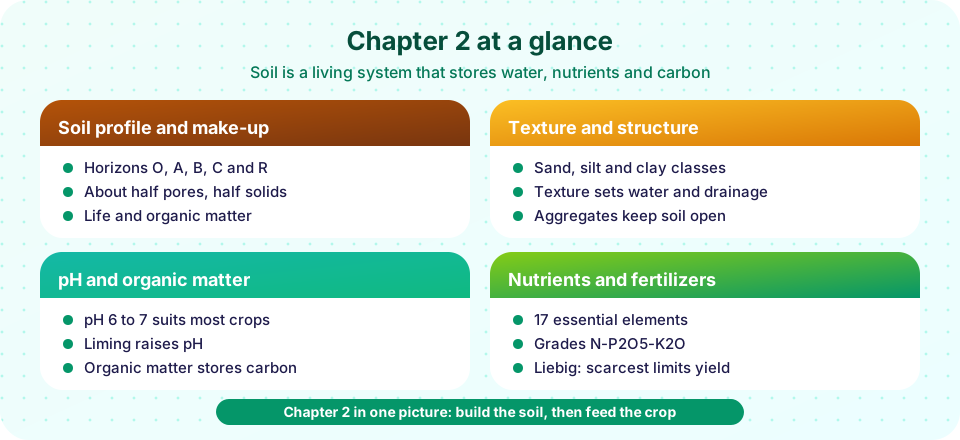
What you will learn
- A quick recall of each lesson's key facts and formulas.
- How the four lessons connect into a single fertility plan.
- Practice with the chapter's calculations.
The chapter in one table
| Lesson | Key ideas | Formulas and numbers |
|---|---|---|
| Soils overview | Profile O, A, B, C, R; five soil-forming factors; soil functions | Typical topsoil about 45 % minerals, 5 % organic matter, 50 % pores; porosity = 1 - BD/2.65 |
| Soil texture and structure | Sand, silt, clay; USDA triangle; aggregates and compaction | AW = AWC x rooting depth |
| Soil pH and organic matter | pH is logarithmic; liming; humus; C:N ratio | SOC stock = C % x BD x depth in cm |
| Plant nutrients and fertilizers | 17 essential elements; N cycle; grades; 4Rs | P = P2O5 x 0.436; K = K2O x 0.830; rate = target / (grade/100) |
One fertility plan from four lessons
Start with the soil's physical state: texture tells you how much water and nutrient storage there is, and structure tells you whether roots and water can use it. Next check the chemistry: pH, because lime corrects acidity and unlocks nutrients, and the cation exchange capacity that holds them. Then consider the biology: organic matter feeds microbes and releases nitrogen, phosphorus and sulfur, and the C:N ratio of your residues tells you whether to expect a boost or a pause in nitrogen supply. Finally, supplement what is still short, using the 4Rs (right source, rate, time and place) and the response curve to decide how far to go.
A farmer who skips the first three steps often applies more fertilizer to a soil that cannot use it, because it is compacted, acid or short of water. The cheapest nutrient is often the one the soil already holds but the plant cannot reach.
Practice problems
- A core of 5 cm diameter and 10 cm length contains 270 g of oven-dry soil. Bulk density? (Volume 196.3 cm³, so 1.38 g/cm³.)
- A silt loam holds 195 mm/m of available water. How much is stored in a 1.0 m root zone, and for how many days at 6 mm/day? (195 mm, 32.5 days.)
- A clay soil at pH 5.3 needs raising to 6.3, at about 3 t/ha per pH unit. How much lime? (3 t/ha.)
- A recommendation is 90 kg N/ha. Using ammonium nitrate (34 % N), how much product? (90 / 0.34 = 265 kg/ha.)
Try it
Press Run (or Ctrl + Enter) to see the result here.
Program input · what you'd type while the program runs
Type the answers before you press Run, one per line. Each time the program reads a line (with input()), it gets the next line from this box.
Check your understanding
Quick check · 10 questions
of 10 answered You scored / 10 · perfect!
-
1. Which sequence lists soil horizons from the surface downward?
From the top: organic layer O, topsoil A, subsoil B, weathered parent material C and bedrock R. -
2. A soil core has bulk density 1.325 g/cm3. With particle density 2.65 g/cm3, porosity is:
1 - 1.325/2.65 = 0.50. -
3. Which texture drains fastest but holds the least water and nutrients?
Large pores drain fast, and sand has little surface area or charge to hold water and nutrients. -
4. A loam stores 170 mm/m. A crop with a 0.9 m root zone uses 6 mm/day. About how many days of stored water are there?
170 x 0.9 = 153 mm, and 153 / 6 = 25.5 days. -
5. How much more acidic (in H+ concentration) is pH 4.5 than pH 6.5?
Two pH units is a factor of 100. -
6. Soil with 1.5 % carbon, bulk density 1.2 g/cm3 and a 20 cm layer holds how much SOC?
1.5 x 1.2 x 20 = 36 t C/ha. -
7. Which is the main risk when you incorporate wheat straw just before sowing a cereal?
Straw has a high C:N ratio, so microbes take soil nitrogen while decomposing it. -
8. A 15-15-15 compound fertilizer is applied at 200 kg/ha. How many kg of N does it supply?
15 % of 200 kg is 30 kg N. -
9. Which pair is correctly matched?
Nitrogen is mobile, so deficiency shows first on older leaves. Calcium is immobile. -
10. According to Liebig's law of the minimum, adding more of an abundant nutrient to a field limited by phosphorus will:
Yield follows the scarcest resource, so the limiting factor must be corrected first.
Summary
- Soil has physical, chemical and biological jobs, and each lesson of this chapter addressed one.
- Key formulas: porosity, plant-available water, SOC stock, fertilizer rate and oxide conversions.
- Fix limiting factors in order: structure and water, pH, organic matter and then nutrients.
- The 4Rs and the economic optimum keep fertilizer profitable and clean.
Track your progress
Create a free account to tick off lessons and pick up where you left off on any device.
of Agricultural Science lessons completed