


















Lesson 12 of 42 · Crop Science
Photosynthesis and crop growth
Learn how photosynthesis builds yield, how C3, C4 and CAM crops differ, how growth stages and growing degree-days work, and how yield splits into light, efficiency and harvest index.
Every grain of wheat, every potato and every cup of milk from a grass-fed cow is, at bottom, sunlight turned into sugar. Photosynthesis is the engine of agriculture. A crop's yield is the part of that sugar a farmer can harvest. If you understand what limits the engine, you understand most of what an agronomist does: choose varieties, set sowing dates, space plants, manage water and nutrients, and time the harvest.
This lesson covers the chemistry in plain terms, the three photosynthetic pathways, the stages a crop passes through, how heat is counted as thermal time, and a simple equation that splits yield into light captured, efficiency and harvest index.
What you will learn
- What photosynthesis does and which inputs limit it.
- How C3, C4 and CAM plants differ and why it matters for crops.
- The stages of crop development and how growing degree-days predict them.
- How to estimate yield from light interception, radiation use efficiency and harvest index.
Key terms
Photosynthesis: using light energy to turn carbon dioxide and water into sugars and oxygen.
Stomata: pores in leaves that let CO₂ in and water vapor out.
Growing degree-days (GDD): a heat sum used to measure crop development.
Leaf area index (LAI): leaf area per unit of ground area.
Harvest index (HI): the harvested fraction of total above-ground dry biomass.
What photosynthesis does
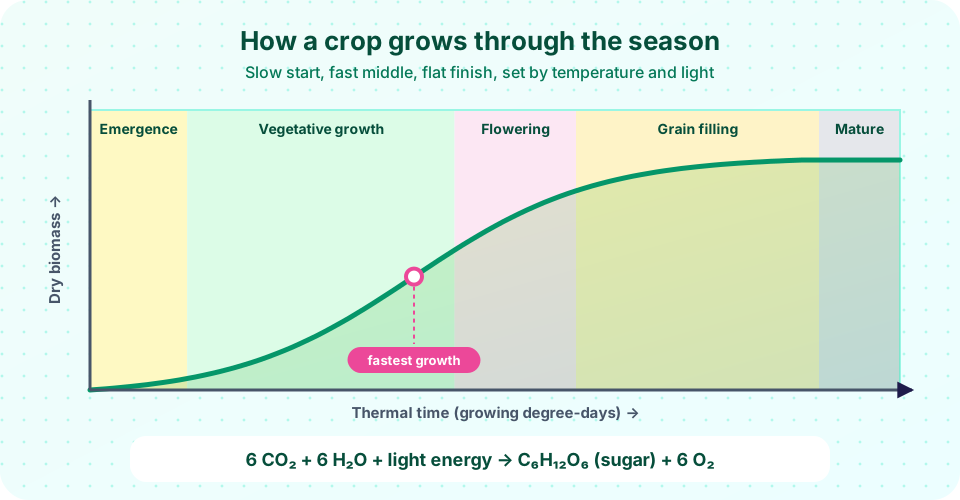
The overall reaction is:
6 CO2 + 6 H2O + light energy → C6H12O6 (sugar) + 6 O2
In the leaf's chloroplasts, pigments (mainly chlorophyll, which absorbs red and blue light and reflects green) capture light energy and split water, releasing oxygen. The energy drives the Calvin cycle, which fixes carbon from CO₂ into sugars. The plant uses some of the sugar for respiration and builds the rest into leaves, stems, roots, grain and fruit.
Leaves take in CO₂ through stomata, and the same pores lose water. That is the basic trade-off of crop life: opening stomata feeds the plant and dries it out. When the soil is short of water, the plant closes stomata and photosynthesis slows, which is why drought cuts yield (Chapter 6).
Five things limit photosynthesis at any moment: light, CO₂, temperature, water and nutrients (nitrogen especially, because leaves are rich in nitrogen-containing enzymes and chlorophyll). As in Chapter 2, the scarcest one sets the pace.
C3, C4 and CAM
Plants fix CO₂ with the enzyme Rubisco, which is also happy to grab oxygen in a wasteful process called photorespiration. It gets worse in heat and when stomata are closed. Plants have evolved three solutions:
| Pathway | How it works | Crops | Best conditions |
|---|---|---|---|
| C3 | CO₂ fixed directly by Rubisco | Wheat, rice, barley, soybean, potato, most trees | Cool to warm, moist; efficient at low light |
| C4 | A special leaf anatomy concentrates CO₂ around Rubisco | Maize, sugar cane, sorghum, millets | Hot, bright, drier; more efficient with less water per kg of biomass |
| CAM | Stomata open at night, CO₂ stored and used by day | Pineapple, agave, some cacti | Very dry; low growth rates but extreme water saving |
C4 crops reach a higher maximum photosynthetic rate and do not saturate at full sunlight, as C3 crops do. C4 crops generally use less water for each kilogram of dry matter. C3 crops respond more strongly to higher atmospheric CO₂, which has risen from about 280 ppm before the industrial era to over 420 ppm today.
Growth and development
Growth is an increase in size or mass (biomass). Development is progress through stages. A typical annual crop passes through germination and emergence, vegetative growth (leaves, tillers or branches), flowering, grain or fruit filling and maturity. Growth stages have standard scales, such as the BBCH and Zadoks scales, which give each stage a code so that advisers and farmers use the same language.
Biomass over time follows an S-shaped curve: slow while the seedling has little leaf area, fast once the canopy covers the ground, slow again as leaves age and the crop matures.
Temperature drives the clock. Plants develop faster in warm weather. Instead of counting days, agronomists count growing degree-days, adding up the heat above a crop-specific base temperature:
GDD for a day = (Tmax + Tmin) / 2 − Tbase (never below 0)
With a base of 10 °C (a typical value for maize), a day with a high of 28 °C and a low of 14 °C gives (28 + 14)/2 − 10 = 11 GDD. Varieties are rated by the GDD from planting to flowering or maturity, so a farmer can choose one that finishes before autumn frost. Many models also cap the maximum temperature (for example at 30 °C), since growth stops increasing beyond an optimum.
Day length and cold also matter. Photoperiod controls flowering in many species: rice and soybean are short-day plants (they flower as nights lengthen), wheat and barley are long-day plants. Winter wheat needs weeks of cold, called vernalization, before it flowers, which is why it is sown in autumn.
From light to yield: a simple equation
Many yield models use three terms:
Yield = (light intercepted) × (radiation use efficiency) × (harvest index)
- Light intercepted depends on leaf area and how long the canopy stays green. A canopy with an LAI of 3 to 5 intercepts most incoming light, so extra leaf beyond that adds little. Early sowing, adequate nitrogen and water, weed control and disease protection keep leaves green longer.
- Radiation use efficiency (RUE) is biomass made per megajoule of intercepted light, for wheat roughly 1.2 to 1.5 g per MJ of total intercepted solar radiation, and somewhat higher (about 1.6 to 1.8) for maize, a C4 crop. Values vary with conditions.
- Harvest index is the share of total biomass that becomes the part you sell. Plant breeding raised the HI of cereals from about 0.3 in old varieties to about 0.5 in modern semi-dwarf wheat and rice, which is a large part of the Green Revolution's yield gain.
Common misconceptions
"Plants get their mass from the soil." Most dry mass comes from carbon in CO₂ taken from the air. Soil supplies water and minerals, a small fraction of dry mass.
"More leaves always means more yield." Beyond LAI 4 or so, shaded lower leaves respire more than they produce.
"Counting days predicts maturity." The same variety matures in different numbers of days in cool and warm seasons. Thermal time is more reliable.
Try it
Press Run (or Ctrl + Enter) to see the result here.
Program input · what you'd type while the program runs
Type the answers before you press Run, one per line. Each time the program reads a line (with input()), it gets the next line from this box.
Press Run (or Ctrl + Enter) to see the result here.
Program input · what you'd type while the program runs
Type the answers before you press Run, one per line. Each time the program reads a line (with input()), it gets the next line from this box.
Check your understanding
Quick check · 6 questions
of 6 answered You scored / 6 · perfect!
-
1. In photosynthesis, where does most of the dry mass of a plant come from?
Plants fix carbon from atmospheric CO2 into sugars, and carbon makes up about half of dry mass. -
2. Which crop uses the C4 pathway?
Maize, sugar cane and sorghum are C4 crops. -
3. A day has Tmax 30 C and Tmin 12 C. With a base of 10 C, how many GDD?
(30 + 12) / 2 - 10 = 11 GDD. -
4. Winter wheat needs weeks of cold before flowering. This process is called:
Vernalization is the cold requirement that triggers flowering in winter cereals. -
5. Intercepted light 1200 MJ/m2, RUE 1.2 g/MJ and harvest index 0.45 give a grain yield of about:
1200 x 1.2 = 1440 g/m2 biomass; x 0.45 = 648 g/m2, which is 6.5 t/ha. -
6. Why does drought lower photosynthesis?
Closed stomata reduce water loss but also CO2 entry.
Summary
- Photosynthesis turns CO₂, water and light into sugar; stomata trade CO₂ gain against water loss.
- C4 crops (maize, sugar cane, sorghum) do better in heat and bright light; C3 crops (wheat, rice, soybean) respond more to extra CO₂.
- Crops pass through emergence, vegetative growth, flowering, filling and maturity, timed by thermal time (GDD = (Tmax + Tmin)/2 - Tbase).
- Yield = light intercepted x radiation use efficiency x harvest index.
- Raising harvest index was a major part of the Green Revolution.
Next: Seeds and planting
Track your progress
Create a free account to tick off lessons and pick up where you left off on any device.
of Agricultural Science lessons completed