


















Lesson 24 of 42 · Animal Production
Animal Health and Welfare
Learn how farms prevent disease with biosecurity and vaccination, how herd immunity works, and how the Five Freedoms and animal-based indicators measure welfare.
A sick animal grows slowly, produces little and can infect the rest of the herd. A stressed or uncomfortable animal does the same, and it also raises an ethical question: do we owe the animals we keep a decent life? Health and welfare are therefore linked. In practice they are managed together, through prevention first and treatment second.
In this lesson you will learn how disease enters and spreads on a farm, how vaccination protects a whole herd, how antibiotics are used responsibly, and how welfare is defined and measured with evidence rather than opinion.
What you will learn
- Explain how disease spreads and which biosecurity measures break the chain
- Use R₀ and vaccination coverage to explain herd immunity
- Describe responsible antibiotic use, withdrawal periods and antimicrobial resistance
- Name the Five Freedoms and the Five Domains, and tell animal-based indicators from resource-based ones
- Calculate a temperature-humidity index for heat stress
Key terms
Biosecurity: the set of measures that keep disease out of a farm and stop it spreading within it.
Notifiable disease: a disease that must be reported to the authorities by law (for example foot-and-mouth disease).
R₀ (basic reproduction number): the average number of animals one infected animal infects in a fully susceptible herd.
Herd immunity: protection of unvaccinated animals because enough others are immune to break the chain of infection.
Withdrawal period: the time after a treatment during which milk, eggs or meat must not enter the food chain.
How disease reaches and spreads on a farm
Infection needs a source (an infected animal, a carrier, contaminated water or equipment), a route and a susceptible animal. The common routes are:
- Direct contact between animals, including new purchases and animals at shows or markets
- Indirect contact through vehicles, boots, equipment, feed, water, bedding and manure
- Airborne spread over short or long distances
- Vectors such as ticks, flies and mosquitoes, and wildlife such as wild birds and wild boar
- Vertical spread from mother to offspring
Biosecurity blocks these routes. The main measures are:
- Control movements. Buy from known, healthy sources and keep new animals in quarantine (commonly two to four weeks) before mixing them in.
- Separate and clean. Divide the farm into clean and dirty areas, use footbaths and clean clothing, wash and disinfect vehicles and equipment, and keep visitors to a minimum.
- All-in, all-out. In pig and poultry houses, move a whole batch in and out at once, then clean, disinfect and rest the house before the next batch.
- Control pests and wildlife. Keep wild birds away from poultry feed and water, and control rodents and flies.
- Dispose of dead animals and manure safely.
Some diseases are so damaging that they are notifiable and are controlled by the state. Examples are foot-and-mouth disease (a highly contagious viral disease of cloven-hoofed animals), highly pathogenic avian influenza, African swine fever (which kills pigs and has no widely used vaccine) and rabies. The response is usually movement restrictions, culling of infected herds and compensation, because the economic and trade losses of an outbreak can be enormous.
Vaccination and herd immunity
A vaccine trains the immune system to recognize a pathogen without causing the disease. Vaccinated animals are protected, and so, indirectly, are others in the herd, because the infection runs out of susceptible hosts. This is herd immunity.
The basic reproduction number R₀ is the average number of animals a single infected animal infects in a fully susceptible herd. If R₀ is 3, each case causes three new ones and the outbreak grows. Once a fraction p of the herd is immune, each case infects only R₀ × (1 − p) animals on average. The outbreak dies out when that falls below 1, which gives the critical vaccination coverage:
p_c = 1 − 1 / R₀
For R₀ = 3 this is 1 − 1/3 ≈ 67%; for R₀ = 2 it is 50%; for R₀ = 5 it is 80%. These numbers assume a perfect vaccine and well-mixed animals; real vaccines are imperfect and herds are not uniform, so the real target is higher.
Parasites and everyday disease
Parasites cause chronic losses that are less dramatic than an epidemic but add up. Internal parasites such as roundworms (for example the barber's pole worm in sheep and goats) feed on blood and gut tissue; external parasites such as ticks, lice and mites irritate the skin and carry disease. Routine treatment of the whole flock leads to drug resistance, so modern practice treats only animals that need it. In goats and sheep, the lower-eyelid color (the FAMACHA chart) is a quick indicator of anemia caused by worms.
Other common problems are mastitis, inflammation of the udder. It is detected by changes in milk and by the somatic cell count (SCC), the number of white blood cells per milliliter. Healthy quarters usually have well under 100,000 cells/mL, and a count above 200,000 suggests infection; many countries set legal limits on bulk milk, for example 400,000 cells/mL in the European Union. Lameness in dairy cows is another major issue, often affecting a fifth or more of cows in a herd if foot care is neglected.
Medicines, withdrawal periods and resistance
Antibiotics treat bacterial infections in animals, but they also select for resistant bacteria. Resistant bacteria can spread to people through food, water and contact, which is why antimicrobial resistance is treated as a One Health problem that links animals, people and the environment. The European Union banned antibiotics as growth promoters in 2006, and many countries now limit routine preventive use. Good practice is to treat only on veterinary advice, use the right drug, dose and duration, and keep records.
After a treatment the drug stays in the body for a while. The withdrawal period is the time to wait before milk, eggs or meat can be sold, so that residues fall below legal limits (the maximum residue limit). Selling too early is both illegal and a food-safety risk.
Welfare: from freedoms to domains
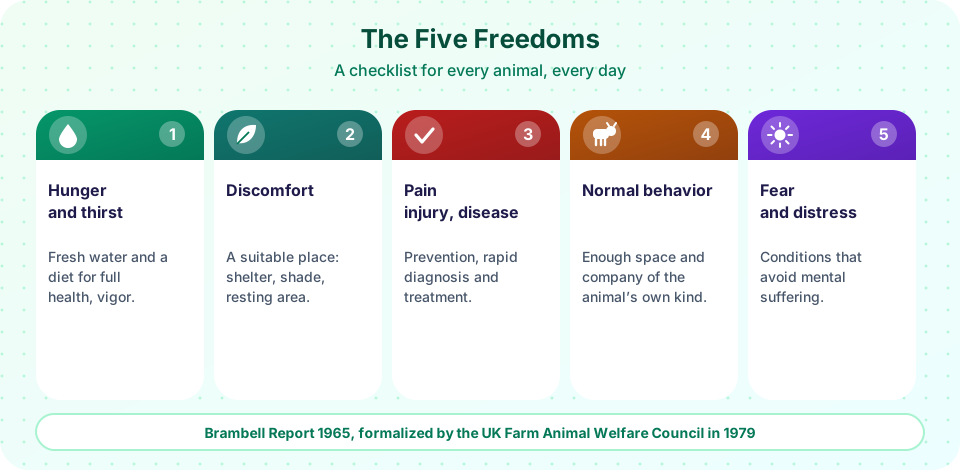
Welfare means how an animal is coping with its conditions. The idea of formal standards began with the British Brambell Report of 1965 and was condensed by the UK Farm Animal Welfare Council in 1979 into the Five Freedoms:
- Freedom from hunger and thirst
- Freedom from discomfort
- Freedom from pain, injury and disease
- Freedom to express normal behavior
- Freedom from fear and distress
Researchers later emphasized that welfare is not only the absence of suffering but also the presence of positive experiences. The Five Domains model (developed by David Mellor and colleagues) looks at five areas: nutrition, environment, health, behavioral interactions and, as the outcome, the animal's mental state.
Measuring welfare
You can inspect the farm's resources (space per animal, bedding, water points, ventilation), or you can inspect the animals themselves. Animal-based indicators are generally more reliable because they show how the animals are actually doing. Common examples are body condition score (for dairy cows, a 1 to 5 scale, with a target of roughly 3.0 to 3.5 at calving), lameness, injuries and skin lesions, cleanliness, mortality, and behavior such as lying time, feather pecking or tail biting. Stocking density limits are set in law in many countries; for example, EU broiler rules start from a limit of 33 kg of live weight per square meter.
Heat stress
Hot, humid weather lowers feed intake and milk yield long before an animal looks distressed. The temperature-humidity index (THI) combines the two:
THI = (1.8 × T + 32) − (0.55 − 0.0055 × RH) × (1.8 × T − 26)
where T is air temperature in °C and RH is relative humidity in percent. For T = 30 °C and RH = 60%, THI = 86 − (0.55 − 0.33) × (54 − 26) = 86 − 0.22 × 28 ≈ 79.8. Dairy cows are commonly considered to begin experiencing heat stress when THI rises above about 68 to 72, so 80 is a serious stress. Shade, fans, sprinklers and water make a visible difference.
Common misconceptions
"Healthy-looking animals cannot carry disease." Many infections are carried without signs, which is why quarantine and testing matter.
"Good welfare means expensive buildings." Welfare depends on how animals are managed (feed, water, space, handling, health care) as well as the housing.
"Vaccinating 50% of animals protects 50% of the herd." Vaccinated animals are protected directly, but when coverage passes the critical level the outbreak cannot spread, so unvaccinated animals are protected too.
Try it
The first program is a simple SIR (susceptible, infected, recovered) model of a 500-animal herd with R₀ = 2.5. It shows how vaccination coverage changes the outbreak. The model is a teaching simplification with made-up parameters, not a prediction for any real disease.
Press Run (or Ctrl + Enter) to see the result here.
Program input · what you'd type while the program runs
Type the answers before you press Run, one per line. Each time the program reads a line (with input()), it gets the next line from this box.
The second demo is a heat-stress calculator. It applies the THI formula above to the temperature and humidity you choose.
Check your understanding
Quick check · 5 questions
of 5 answered You scored / 5 · perfect!
-
1. A disease has R0 = 4. What vaccination coverage is needed for herd immunity, assuming a perfect vaccine?
p_c = 1 - 1/R0 = 1 - 1/4 = 0.75, or 75%. -
2. Why is quarantine used for newly bought animals?
Some animals carry infection without signs. Keeping them apart for a couple of weeks reveals problems before the herd is exposed. -
3. A milk bulk tank has 450,000 somatic cells per mL. What does this suggest?
High SCC reflects inflammation (mastitis). Healthy herds are usually well below 200,000 cells/mL. -
4. Which is an animal-based welfare indicator?
Lameness is measured on the animal itself. The others are resource-based measures of the environment. -
5. What is the purpose of a withdrawal period?
Residues of antibiotics and other drugs must be below the maximum residue limit before products are sold.
Summary
- Disease spreads by contact, contaminated objects, air, vectors and wildlife; biosecurity blocks each route.
- Herd immunity needs coverage of about 1 − 1/R₀ for a perfect vaccine; real targets are higher.
- Antibiotics are used on veterinary advice, with withdrawal periods, to limit residues and resistance.
- The Five Freedoms (1965/1979) and the Five Domains frame welfare; animal-based indicators are more reliable than resource checks.
- Heat stress can be estimated with the THI, and shade, ventilation and water reduce it.
Track your progress
Create a free account to tick off lessons and pick up where you left off on any device.
of Agricultural Science lessons completed