


















Lesson 34 of 42 · Food Security and Economics
Food Security and Economics: The Big Picture
Learn what food security means, why hunger persists although the world grows enough calories, and how farm economics, markets and risk connect to feeding people.
For most of history the question was whether there would be enough to eat. Today the world grows more than enough calories for everyone, yet hundreds of millions of people go hungry, and close to a third of humanity cannot afford a healthy diet. At the same time, millions of farmers earn too little to invest in better seed, tools or soil. Hunger and farm poverty are two sides of one system: how food is produced, moved, priced and eaten.
This chapter connects the farm to the table and to the market. The first lesson explains food security and the food chain; the second explains how a farm earns money, why prices behave oddly and how farmers manage risk.
What you will learn
- State the FAO definition of food security and its four pillars
- Explain why hunger exists even when global production is enough
- Describe the main forms of malnutrition
- Link food security to farm incomes, prices and markets
- Preview the lessons of this chapter
Key terms
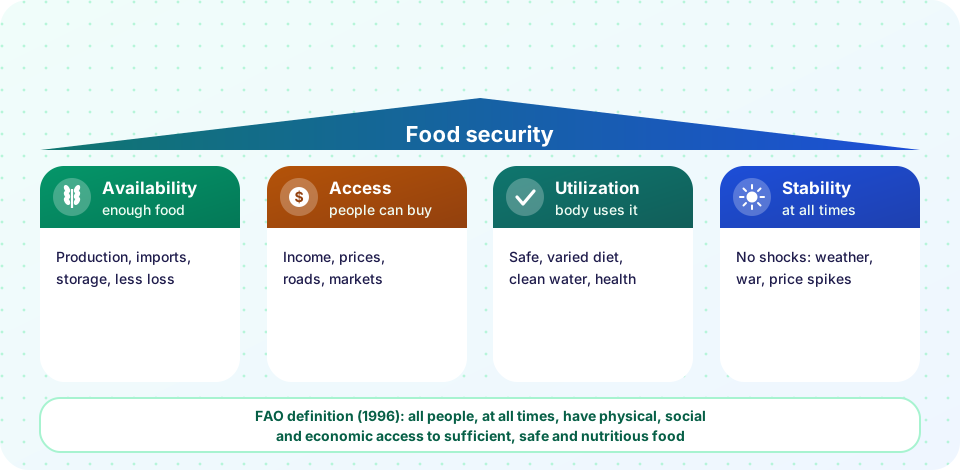
Food security: all people, at all times, have physical, social and economic access to sufficient, safe and nutritious food that meets their needs for an active and healthy life (World Food Summit, 1996).
Undernourishment: not getting enough dietary energy over a long period.
Malnutrition: poor nutrition in any form, including undernutrition, micronutrient deficiency and overweight.
Food system: everything from producing, processing and distributing to buying, preparing and eating food.
Entitlement: the set of foods a person can legally command through production, trade, work or transfers (Amartya Sen).
What the four pillars mean
The FAO definition has four dimensions, which together form the framework used worldwide:
- Availability. Is there enough food in the country or region, from farms, imports and stocks? Production, storage and trade matter.
- Access. Can people actually get it? Even a country with plenty of food has hungry households if incomes are low, prices are high, or roads and markets are missing.
- Utilization. Can the body use the food? That needs a diet with enough protein and micronutrients, safe food, clean water, sanitation and health care. A child with chronic diarrhea may not benefit from enough calories.
- Stability. Is food secure at all times? Droughts, floods, conflict, pandemics and price spikes can break the other three pillars suddenly.
Experts have recently added two more dimensions, agency (people's power to make food choices) and sustainability (food systems that can last). Hunger is typically a failure of access and stability rather than of global availability, which is why the next section matters.
Enough food, still hunger
Hunger is mostly about access
Forms of malnutrition
From farm to market
Enough food, so why hunger?
Do a rough count. An adult needs on the order of 2,000 to 2,500 kilocalories per day. A kilogram of cereal grain provides roughly 3,500 kilocalories. With a world population of about 8 billion, feeding everyone on 2,300 kilocalories a day from cereals alone would take about 1.9 billion tonnes of grain a year. The world harvests around 2.8 billion tonnes of cereals annually. In reality, a large part of that grain is fed to animals or turned into fuel and industrial products, and a share is lost on the way. But the arithmetic shows that hunger is not mainly a shortage of calories in the world; it is a problem of who can get them.
The economist Amartya Sen made this argument in Poverty and Famines (1981). Studying famines such as Bengal in 1943, he showed that people starve when they lose their entitlements (jobs, wages, land or the ability to buy), even in years when food supply is not particularly low. Policies that protect incomes, markets and social safety nets can be as important as policies that increase production.
Recent reports by the UN agencies estimate that roughly 700 to 750 million people were undernourished in the early 2020s, and that around three billion could not afford a healthy diet. About one in five children under five is stunted (too short for their age), a sign of chronic undernutrition. At the same time, overweight and obesity are rising in almost every country: malnutrition now has a double burden.
Production still matters
Population is projected by the UN to reach about 9.7 billion by 2050, and diets change as incomes rise, with more meat, dairy and oils. Meeting that demand without clearing more forest requires higher yields on existing land, less loss and waste, and a shift in diets. The Green Revolution of the 1960s, led by plant breeders such as Norman Borlaug (Nobel Peace Prize 1970) with short-strawed wheat and high-yielding rice varieties, combined with fertilizer and irrigation, raised grain yields dramatically in Asia and Latin America. Its legacy includes both large gains in food supply and concerns about water, soil and inequality. The sustainable and precision tools from the previous chapter aim to achieve the next round of gains with fewer harmful side-effects.
Common misconceptions
"Hunger exists because the world cannot grow enough." Production is roughly sufficient at world level; poverty, conflict, prices and poor infrastructure leave people without access.
"More production always solves hunger." More grain does not help households that cannot buy it, and can lower prices for small farmers, hurting their incomes. Production and access must improve together.
"Malnutrition is the same as hunger." Hunger is lack of energy. Malnutrition also includes missing micronutrients and excess energy, so a person can be overweight and malnourished.
Try it
The first program does the arithmetic from the section above. All values are rounded estimates, used to show the order of magnitude and not as official statistics.
Press Run (or Ctrl + Enter) to see the result here.
Program input · what you'd type while the program runs
Type the answers before you press Run, one per line. Each time the program reads a line (with input()), it gets the next line from this box.
The second demo is a quick sorting exercise. Click an event to see which food-security pillar it hits first.
What is in this chapter
| Lesson | What it covers |
|---|---|
| Food security and food systems | Food loss and waste, malnutrition measures, yield gaps, early warning and policy |
| Farm economics and markets | Costs, gross margin, break-even, prices, risk and investment |
| Chapter review | A one-page summary and ten questions |
Check your understanding
Quick check · 4 questions
of 4 answered You scored / 4 · perfect!
-
1. Which pillar of food security is about people being able to obtain food through income, markets and roads?
Access covers physical, social and economic ability to get food. -
2. A child gets enough calories but suffers repeated diarrhea and does not grow well. Which pillar is mainly failing?
Utilization covers how well the body uses food, which depends on health, water and sanitation. -
3. What did Amartya Sen argue about famines?
Sen showed that people starve when they lose the means to command food, such as income and jobs. -
4. About how much grain would 8 billion people need if all energy (2,300 kcal/day) came from cereal at 3,500 kcal/kg?
8e9 × 2,300 × 365 / 3,500 = about 1.9e12 kg = 1.9 billion tonnes.
Summary
- Food security means availability, access, utilization and stability for all people at all times.
- The world's calorie production is roughly enough; hunger mostly reflects poverty, conflict, poor infrastructure and unstable prices.
- Malnutrition has several forms: stunting, wasting, micronutrient deficiency and overweight.
- Farm income and market conditions are part of food security because they determine whether farmers can keep producing.
Track your progress
Create a free account to tick off lessons and pick up where you left off on any device.
of Agricultural Science lessons completed