


















Lesson 37 of 42 · Food Security and Economics
Food Security and Economics: Chapter Review
Review the four pillars of food security, food loss, malnutrition, yield gaps, gross margin, break-even, NPV and price swings with a summary picture and ten questions.
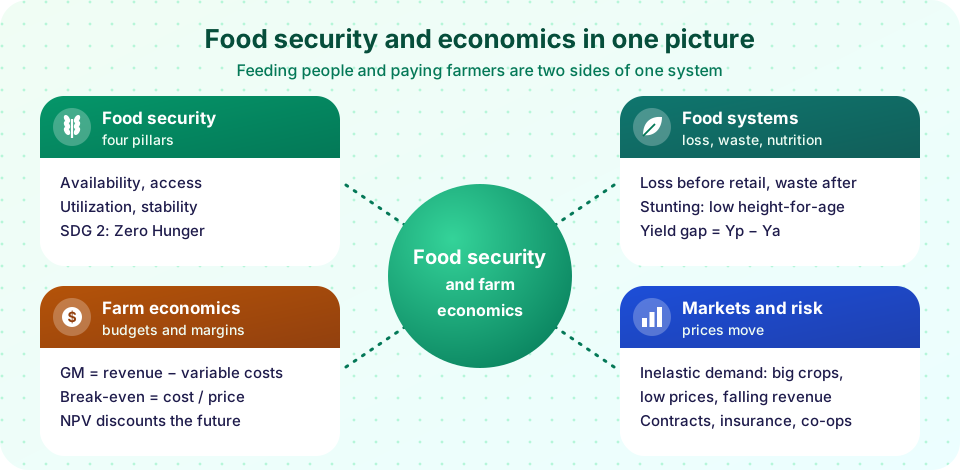
This chapter followed food from the field to the plate and from the farm gate to the market. Food security needs availability, access, utilization and stability. Production alone does not feed people: losses, poverty, health and unstable prices all stand in the way. And farmers need profitable, manageable businesses to keep producing. This review gathers the formulas, lets you run them and ends with a ten-question check.
Recap
| Topic | Key ideas | Formula or number |
|---|---|---|
| Food security | Four pillars: availability, access, utilization, stability; hunger mostly about access | 8 billion × 2,300 kcal ≈ 1.9 billion t cereal equivalent |
| Food systems | Loss before retail, waste after; stunting, wasting, hidden hunger; yield gaps; early warning | W₂ = W₁ (100 − MC₁) / (100 − MC₂); Yg = Yw − Ya |
| Farm budgets | Variable vs fixed costs; marginal thinking; NPV | GM = revenue − variable costs; break-even yield = cost / price |
| Markets and risk | Inelastic demand, farmer's paradox, cobweb cycle, risk tools | % price change ≈ % quantity change / elasticity |
Connecting the ideas
- Farm income is a food-security issue. When prices collapse, farmers cut inputs and next year's supply falls.
- Yield gaps and losses are the cheapest sources of food. Closing part of the gap and storing grain safely add food without new land.
- Numbers keep arguments honest. A budget, a break-even yield or an NPV turns "it should pay" into something you can check.
Reading the chapter as one story
Start in a village after a poor harvest. Food prices rise, and a family that earns by farm labor can no longer afford enough. The country may have grain in stock, but the family cannot reach or buy it. This is a problem of access and stability, not of world supply. The response combines short-term help (cash transfers or food aid) with long-term resilience: irrigation, drought-tolerant seed, storage, savings and diversified income.
Now follow a bag of maize. Poor drying leaves the grain at 18% moisture, so molds and insects eat into it in storage; this is food loss, and aflatoxin may also make the remainder unsafe. Better drying, hermetic bags and a short, clean supply chain keep more of the harvest available. Meanwhile, a child in the same household eats enough calories but suffers repeated infections, and utilization fails. Clean water and a varied diet help more than extra grain would.
Finally follow the farmer's money. Revenue minus variable costs gives the gross margin; fixed costs come off to leave net profit. The farmer's break-even yield tells how bad a year can be before the farm loses money. A price collapse after a bumper harvest, caused by inelastic demand, can wipe out the margin. Insurance, forward contracts, a cooperative or a second income source reduce the risk, and investment in a better drying floor or an irrigation pump pays back only if the NPV is positive.
What examiners and employers look for
- A clear definition with the correct pillar or formula.
- Units written and checked.
- A sanity check on the answer.
- An honest statement of assumptions and limits.
Try it
Press Run (or Ctrl + Enter) to see the result here.
Program input · what you'd type while the program runs
Type the answers before you press Run, one per line. Each time the program reads a line (with input()), it gets the next line from this box.
Test yourself with the matching game below: pick the pillar that each situation affects.
Check your understanding
Quick check · 10 questions
of 10 answered You scored / 10 · perfect!
-
1. Which pillar of food security does clean water and sanitation mainly support?
Clean water and sanitation help the body use food, which is utilization. -
2. Why does the world have hungry people even though calories produced are roughly enough?
Access and stability problems explain most hunger. -
3. What is food loss, by the FAO definition?
Loss covers production to wholesale; waste covers retail and consumers. -
4. 1,000 kg of grain at 18% moisture is dried to 14%. What is the final weight?
1,000 × 82 / 86 = 953.5 kg, about 953 kg. -
5. A child's weight-for-height z-score is -3.1. This is:
Below -3 on weight-for-height is severe wasting. -
6. Yw is 6.0 t/ha and Ya is 2.4 t/ha. The yield gap is:
6.0 - 2.4 = 3.6 t/ha. -
7. Gross margin is 700 $/ha and fixed costs are 450 $/ha. The net profit is:
700 - 450 = 250 $/ha. -
8. Total cost is $1,320/ha and the price is $220/t. Break-even yield?
1,320 / 220 = 6 t/ha. -
9. Why can a bumper harvest cut farmers' revenue?
With inelastic demand, a 10% rise in quantity can cause a much larger fall in price. -
10. What makes a cobweb cycle explode instead of fading?
When supply is more price-responsive than demand, each correction overshoots by more than the last.
Summary
- Food security rests on four pillars; hunger is mostly about access and stability, not world production.
- Reducing loss and waste, closing yield gaps and measuring malnutrition properly are central to action.
- A budget, break-even yield and NPV let farmers judge decisions; marginal thinking guides input use.
- Inelastic demand, the farmer's paradox and cobweb cycles explain price swings; contracts, insurance and cooperatives share the risk.
Track your progress
Create a free account to tick off lessons and pick up where you left off on any device.
of Agricultural Science lessons completed