


















Lesson 19 of 42 · Plant Protection
Integrated pest management (IPM)
Learn the steps of integrated pest management, how to calculate an economic injury level, how biological control and Bt work, and how to use pesticides safely and slow resistance.
Imagine two farmers with the same aphid outbreak. One sprays on a calendar, every two weeks, whether or not aphids are present. The other walks the field every week, counts aphids, checks whether ladybirds are arriving, and sprays only when the numbers justify it and the product will not wreck the ladybirds. The second farmer spends less on chemicals, loses fewer pollinators, delays resistance and often gets the same or better yield.
That second approach is integrated pest management (IPM): using all suitable tools in a coordinated way to keep pests below damaging levels while minimizing risks to people and the environment. It is the standard approach taught worldwide and is built into many national regulations. This lesson walks through its steps, the economics of thresholds, biological control and the safe use of pesticides when they are needed.
What you will learn
- The core steps of IPM and how they fit together.
- How to calculate an economic injury level and set an action threshold.
- The three main forms of biological control, and how Bt works.
- How to read a pesticide label, protect people and pollinators, and slow resistance.
Key terms
Economic injury level (EIL): the pest density at which the damage costs as much as the control.
Economic threshold (ET): the density at which control should start, set below the EIL so that action takes effect in time.
Biological control: using living organisms, such as predators, parasitoids and pathogens, to reduce pests.
Pre-harvest interval (PHI): the minimum days between the last spray and harvest.
Mode of action (MoA): how a pesticide disrupts the pest's biology, used to group products for resistance management.
The IPM pyramid
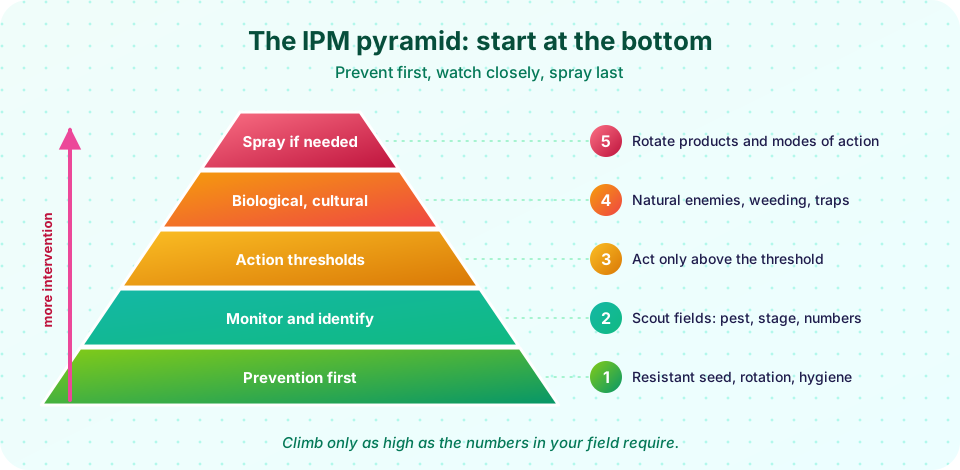
IPM is often shown as a pyramid. The base is the broadest and cheapest layer, and the tip is the narrowest.
- Prevention. Choose resistant or tolerant varieties, rotate crops, plant clean certified seed, manage sowing date and spacing, control weeds that host pests, drain wet spots, clean machinery and remove infected residues.
- Monitoring and identification. Scout regularly, identify the pest and its stage correctly, note beneficial organisms and the weather. Wrong identification leads to wrong control.
- Action thresholds. Act only when numbers reach a level justified by the economics.
- Biological and cultural tools. Conserve and release natural enemies, hand-weed, use traps, mating disruption, cover crops and mulches.
- Targeted pesticides. If the threshold is crossed and other tools are not enough, choose the product with the least harm to non-target organisms, the right mode of action and the right timing and dose.
After each season, evaluate what worked and update the plan.
Economic injury level and threshold
Pests do not need to be at zero. A few aphids per plant reduce yield by an amount too small to matter. At some density, the value of the lost yield equals the cost of controlling the pest. This is the economic injury level:
EIL = C / (V × I × D × K)
Cis the cost of control per hectare (product, application and labor).Vis the market value per unit of yield (for example, per tonne).I × Dis the yield loss per unit of pest density, for example tonnes of yield lost per hectare for each aphid per plant (Iis the injury per pest andDis the damage per unit of injury).Kis the fraction of the pest damage prevented by the control (its efficacy).
Worked example: control costs 25 per hectare, the crop is worth 220 per tonne, each aphid per plant costs 0.02 t/ha and the spray is 90 % effective.
EIL = 25 / (220 × 0.02 × 0.90) = 25 / 3.96 = 6.3 aphids per plant
Because pests keep multiplying while you decide and spray, the economic threshold is set lower, perhaps at 70 to 80 % of the EIL, so control takes effect before damage reaches the EIL. The EIL is lower when the crop is more valuable, when control is cheaper or when each pest does more damage. It is a good reminder that the threshold is not a biological law but an economic decision that moves with prices.
Thresholds exist for many crop and pest combinations, published by agricultural extension services. Use local ones: they reflect local crops, varieties and prices.
Biological control
- Classical biological control: introducing a natural enemy from the pest's native region to control an invasive pest, after careful safety testing. The aim is lasting control without further releases.
- Augmentative control: mass-rearing and releasing enemies, such as parasitoid wasps in greenhouses or Trichogramma wasps against moth eggs, when natural populations are too small or too late.
- Conservation control: protecting the enemies already present by planting flower strips and hedgerows, avoiding broad-spectrum sprays and leaving some refuge areas.
Bt (Bacillus thuringiensis) is a soil bacterium that produces crystal proteins toxic to certain insect groups, for example caterpillars, but harmless to most other animals. It is used as a spray in organic and conventional farming, and genes for these proteins are built into some crop varieties (Bt maize and cotton, widely grown since 1996). Because the toxin is selective, it spares many beneficial insects, but pests can evolve resistance, so refuge areas of non-Bt plants are used to slow it.
Other biological tools include mating disruption with pheromones, which confuses male moths so they cannot find females, and biopesticides based on fungi, viruses and nematodes that infect specific pests.
Using pesticides safely
When a pesticide is the right tool, treat it as a regulated, hazardous product.
- Read the label every time. It is the law in most countries. It lists the crops, pests, dose, timing, PHI, re-entry interval (REI), protective equipment and environmental precautions. Using a product outside the label is illegal and can cause crop injury, residues above legal limits and harm.
- Protect yourself. Wear the personal protective equipment (gloves, coverall, boots, eye and face protection, respirator if required). Mix in a ventilated place, never eat or smoke while spraying, and wash thoroughly afterwards. Keep children and animals away.
- Calibrate the sprayer (Chapter 1, Lesson 4) so the dose per hectare is right. A uniform spray with the correct nozzle and pressure wastes less product and drifts less.
- Avoid drift and runoff. Do not spray in wind, before rain or near water. Keep buffer strips along ditches and streams.
- Protect pollinators. Do not spray open flowers. If a spray must be made, apply in the evening when bees are not foraging, and choose products with low bee toxicity.
- Mind the intervals. Observe the pre-harvest interval so that residues fall below the legal maximum residue limit (MRL), and the re-entry interval for workers.
- Store and dispose properly. Keep products in their original containers, locked and away from food and feed. Triple-rinse empty containers and follow local collection rules.
Hazard is not risk. Toxicity measures like LD50 (the dose that kills half of test animals, where a lower number means higher toxicity) describe the hazard of the chemical. Risk depends on the hazard and on exposure, which is why correct handling matters.
Resistance management
Every use of an insecticide, fungicide or herbicide selects the survivors. Slow the process by:
- Using non-chemical tools first and spraying only above thresholds.
- Rotating modes of action across the season, using the group codes (IRAC for insecticides, FRAC for fungicides, HRAC for herbicides) on labels.
- Using full label doses and spreading applications across the crop's growth.
- Preserving refuges and natural enemies so that susceptible pests survive to dilute resistant ones.
Common misconceptions
"IPM means no pesticides." IPM allows pesticides when thresholds are crossed. It means they are chosen and timed deliberately.
"A natural pesticide is always safe." Natural products can be toxic to people, bees and fish and are also regulated. Always follow the label.
"Spray more often, just in case." Calendar spraying wastes money, kills natural enemies and speeds resistance.
Try it
Press Run (or Ctrl + Enter) to see the result here.
Program input · what you'd type while the program runs
Type the answers before you press Run, one per line. Each time the program reads a line (with input()), it gets the next line from this box.
Press Run (or Ctrl + Enter) to see the result here.
Program input · what you'd type while the program runs
Type the answers before you press Run, one per line. Each time the program reads a line (with input()), it gets the next line from this box.
Check your understanding
Quick check · 6 questions
of 6 answered You scored / 6 · perfect!
-
1. Control costs 30 per ha, the crop is worth 250 per tonne, each pest per plant costs 0.03 t/ha and the product is 80 % effective. What is the EIL?
30 / (250 x 0.03 x 0.80) = 30 / 6 = 5 pests per plant. -
2. Why is the economic threshold set below the EIL?
The lower threshold leaves time for the control to work before damage equals cost. -
3. Which is conservation biological control?
Conservation means protecting and encouraging the enemies already present. -
4. Which item on a label sets the minimum days between the last spray and harvest?
The PHI makes sure residues fall below legal limits at harvest. -
5. Which practice best delays insecticide resistance?
Diversity of modes of action and fewer sprays reduce selection. -
6. What is true of Bt?
Bt proteins are toxic to specific insect groups and spare most other organisms.
Summary
- IPM combines prevention, monitoring, thresholds, biological and cultural tools and targeted pesticides.
- EIL = C / (V x I x D x K); set the action threshold below it.
- Biological control can be classical, augmentative or conservation, and Bt is a selective biological insecticide.
- Use pesticides only as labeled, with protective equipment, calibrated sprayers and care for pollinators and water.
- Rotate modes of action and keep refuges to slow resistance.
Next: Chapter 4 review
Track your progress
Create a free account to tick off lessons and pick up where you left off on any device.
of Agricultural Science lessons completed