


















Lesson 4 of 42 · Getting Started
Measuring farms and yields
Learn the units farmers use, how to convert hectares and acres, estimate yield from sample quadrats, adjust grain moisture, calibrate a sprayer and compute a gross margin.
Farming runs on numbers. How big is the field? How much did it yield? How much fertilizer, seed or spray goes on each hectare? Is the crop profitable once costs are paid? Almost every decision in this course ends with a calculation, and most mistakes in the field come from unit slips: kilograms where tonnes were meant, square meters mistaken for hectares, wet grain weighed as if it were dry.
This lesson gives you the measuring toolkit once, so later chapters can concentrate on the science. You will convert areas, estimate a yield from a handful of sample squares, correct grain for moisture, calibrate a sprayer and work out a gross margin.
What you will learn
- The standard units for area, yield and application rate, and how to convert between them.
- How to estimate field yield from sample quadrats and describe the uncertainty.
- How to adjust grain yield to a standard moisture content.
- How to calibrate a sprayer and compute a simple gross margin.
Key terms
Hectare (ha): 10,000 m², a square 100 m by 100 m.
Yield: harvested mass of product per unit area, such as t/ha.
Quadrat: a frame of known area (often 1 m²) placed in the field to take a sample.
Moisture content (MC): the percentage of a grain's wet mass that is water.
Gross margin: revenue minus the variable costs of producing the crop.
Area, yield and rate units
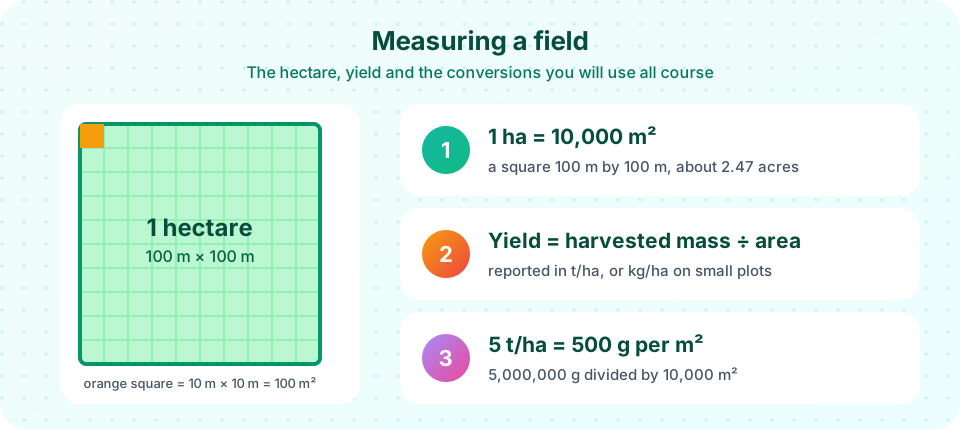
The hectare is the standard farm area. Use these conversions again and again:
| Quantity | Conversion |
|---|---|
| Area | 1 ha = 10,000 m² = 2.471 acres; 1 acre = 0.4047 ha |
| Large areas | 100 ha = 1 km² |
| Mass | 1 t = 1,000 kg = 1,000,000 g |
| Yield | 1 t/ha = 1,000 kg/ha = 100 g/m² = 0.1 kg/m² |
| US bushels | wheat 1 bu = 27.2 kg; maize 1 bu = 25.4 kg; soybean 1 bu = 27.2 kg |
The shortcut worth memorizing is 1 t/ha equals 100 g per square meter. If you clip a square meter of wheat and the grain weighs 650 g, the field is yielding roughly 6.5 t/ha.
Application rate says how much of an input goes on each hectare: seed in kg/ha, fertilizer in kg of nutrient per hectare, spray in L/ha. When you read a label, check whether the rate is for the product or for the active ingredient, and whether it is per hectare or per acre.
Estimating yield from quadrats
You rarely weigh a whole field before harvest, but you can estimate its yield from samples. The method:
- Choose 8 to 10 sampling points spread across the field in a zigzag or "W" pattern, avoiding the edges, so every part has a fair chance of being sampled.
- At each point throw or place a quadrat of known area (for example 1 m²). Cut and bag the plants (or just the heads and grain, depending on the crop).
- Dry and weigh the grain, then divide by the quadrat area to get grams per square meter.
- Average the samples, then convert to t/ha by dividing by 100.
The average alone hides how much the samples varied. Take the standard deviation s of the samples and the standard error SE = s / √n, where n is the number of samples. A rough 95 % interval for the true field mean is about mean ± 2 × SE. Fields are never uniform (soil, slope and drainage vary), so more samples give a narrower interval but with diminishing returns: halving the interval needs four times as many samples.
Correcting for moisture
Grain gains and loses water with the air, and buyers pay for dry matter, not water. Yields are therefore reported at a standard moisture content, such as about 14 % for many cereals and a slightly different figure for each market and crop. To convert a measured wet yield to the standard:
adjusted yield = wet yield × (100 − measured MC) / (100 − standard MC)
Worked example: a plot of wheat yields 6.8 t/ha at a measured moisture of 18 %. At a standard of 14 %:
6.8 × (100 − 18) / (100 − 14) = 6.8 × 82 / 86 = 6.48 t/ha
The same grain is worth less per tonne when wet, because the buyer must dry it (which costs energy) and storage above about 14 % invites mold. Wet grain also overstates the yield you really harvested.
Calibrating a sprayer
If you spray too little, the pest survives and may become resistant. Too much wastes money and harms the environment. Calibration checks how much liquid the sprayer applies per hectare. The standard formula for a boom sprayer is:
Application volume (L/ha) = nozzle flow (L/min) × 600 / (speed (km/h) × nozzle spacing (m))
For example, nozzles that each deliver 1.2 L/min, spaced 0.5 m apart at 6 km/h:
1.2 × 600 / (6 × 0.5) = 720 / 3 = 240 L/ha
If the label says to apply 2 L of product per hectare, the 240 L/ha spray tank needs 2 L of product for every 240 L of mixed spray. Always measure the real nozzle flow by catching output for one minute, because nozzles wear and pressures drift.
Gross margin: is it worth growing?
A gross margin is revenue minus variable costs (seed, fertilizer, chemicals, hired labor, fuel for field work, drying, transport). It leaves out fixed costs such as machinery depreciation, rent and your own labor, so it is best for comparing crops, not for judging the whole business.
gross margin per ha = yield (t/ha) × price (per t) − variable costs per ha
Break-even yield is the yield at which the gross margin is zero: break-even yield = variable costs per ha / price per t. If your variable costs are 700 per hectare and the price is 220 per tonne, break-even is 3.18 t/ha. Compare that to what the field can realistically deliver to see how safe the crop is.
Common misconceptions
"A 5 t/ha average means every part of the field gave 5 t/ha." An average hides variation. One patch may give 3 t/ha and another 7.
"More samples always fix the error." Sampling error shrinks with the square root of n, and sampling in the wrong places (for example only the best patches) creates a bias that no number of samples fixes.
"Moisture only matters at the grain store." It matters at every price and every yield comparison. Compare yields at the same moisture.
Try it
Press Run (or Ctrl + Enter) to see the result here.
Program input · what you'd type while the program runs
Type the answers before you press Run, one per line. Each time the program reads a line (with input()), it gets the next line from this box.
Check your understanding
Quick check · 5 questions
of 5 answered You scored / 5 · perfect!
-
1. A square meter of wheat yields 650 g of grain. What is the field yield?
1 t/ha equals 100 g/m2, so 650 g/m2 is 6.5 t/ha. -
2. Wheat at 18 % moisture yields 6.8 t/ha. What is the yield at a 14 % standard?
6.8 x 82 / 86 = 6.48 t/ha: wet grain contains extra water weight. -
3. How many hectares are in 100 square kilometers?
1 km2 = 100 ha, so 100 km2 = 10,000 ha. -
4. Nozzles deliver 1.0 L/min at 5 km/h with 0.5 m spacing. What volume per hectare is applied?
1.0 x 600 / (5 x 0.5) = 600 / 2.5 = 240 L/ha. -
5. Quadrat samples in one field range widely. Which action gives a tighter estimate of the mean?
More samples, well spread, reduce the standard error. Choosing only good patches adds bias.
Summary
- 1 ha is 10,000 m², and 1 t/ha equals 100 g/m².
- Estimate field yield from 8 to 10 quadrats spread across the field, and report mean and uncertainty.
- Convert grain yields to a standard moisture before comparing.
- Calibrate sprayers with
L/ha = L/min × 600 / (km/h × m). - Gross margin is revenue minus variable costs, and break-even yield is cost divided by price.
Next: Chapter 1 review
Track your progress
Create a free account to tick off lessons and pick up where you left off on any device.
of Agricultural Science lessons completed