


















Lesson 31 of 42 · Sustainable and Precision Agriculture
Conservation Agriculture and Agroecology
Learn the three principles of conservation agriculture, how cover crops and rotations build soil, how to calculate nitrogen use efficiency, and how soil carbon changes over decades.
For most of agricultural history, preparing the field meant tilling it: turning the soil over to bury weeds, loosen the ground and make a seedbed. It works, but it exposes bare soil to rain and wind, burns up organic matter and breaks soil structure. In the 1930s the Dust Bowl in the United States, where drought and plowed prairie turned millions of tonnes of topsoil into dust storms, showed how costly this can be. Since then farmers and scientists have developed ways to grow crops while disturbing the soil as little as possible and keeping it covered.
Conservation agriculture and agroecology are the biological side of sustainable farming. They work with soil life, plant diversity and nutrient cycles rather than replacing them with machines and chemicals. In this lesson you will learn the main principles, see where they help and where they cost, and use two simple models to reason about nitrogen and soil carbon.
What you will learn
- State the three principles of conservation agriculture
- Explain how cover crops, rotations and legumes support soil and nutrient cycles
- Compute nitrogen use efficiency and a simple nutrient budget
- Use a one-pool model to show how soil carbon responds to management over decades
- Weigh the benefits against the trade-offs of conservation practices
Key terms
No-till (direct seeding): planting through the residue of the previous crop without plowing.
Cover crop: a crop grown mainly to protect and improve soil, not to be harvested.
Crop rotation: growing different crops in a planned sequence on the same field.
Biological nitrogen fixation: conversion of atmospheric nitrogen to plant-usable forms by bacteria living in legume root nodules.
Soil organic carbon (SOC): carbon in soil organic matter, an indicator of soil health.
The three principles
The FAO describes conservation agriculture (CA) with three linked principles.
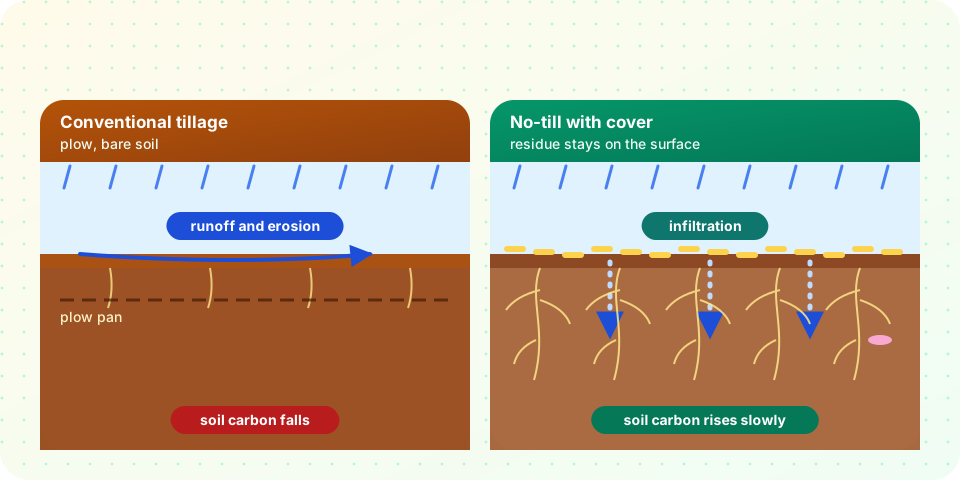
- Minimum mechanical soil disturbance. Seeds are placed directly through the residue by special planters. Soil structure, channels made by roots and earthworms, and fungal networks stay intact. Water soaks in instead of running off.
- Permanent soil organic cover. Crop residues, mulch or living cover crops protect the surface. A rule of thumb is to keep at least 30% of the ground covered after planting, which greatly reduces erosion by raindrop impact and runoff and keeps the soil cooler and moister.
- Diversification of crop species. Rotations and intercrops break the life cycles of weeds, insects and diseases, spread risk and use different rooting depths.
Roughly 200 million hectares worldwide are now managed with CA principles, a little over a tenth of all cropland, with large areas in South America, North America and Australia.
What changes in the soil
Soil is a living system. When tillage stops, earthworm burrows and old root channels persist and become pathways for water and air. Residues feed fungi and bacteria that glue soil particles into stable aggregates. Soil carbon often rises slowly in the top layers because more organic matter enters and less is oxidized. How much it rises is still debated: sampling depth matters, since carbon can fall deeper down, and the gains stop when the soil reaches a new balance. Typical changes are modest, fractions of a tonne of carbon per hectare per year, and they reverse if the field is plowed again.
Other benefits are well documented: less erosion, better water infiltration and storage (drought resilience), fewer tractor passes (saving fuel and labor), and more biological activity.
Honest trade-offs
- Weeds. Without tillage, weed control often relies on herbicides such as glyphosate or on dense cover crops and rollers, which raises concerns over resistance and chemical use.
- Yield dips. In the first years yields may fall, especially on cold, poorly drained or compacted soils; later they are often equal or higher, particularly in dry years.
- Equipment and knowledge. No-till seeders cost money and the system needs careful management of residues, nutrients and pests.
- Pests that live in residue can be a problem in some regions.
Conservation agriculture is therefore a package to adapt locally, not a switch.
Cover crops, rotations and legumes
A cover crop such as rye, oats, clover or radish occupies the field between cash crops. Its roots hold the soil, its leaves shade it, it scavenges leftover nitrate before it leaches, and when it is killed it becomes mulch. Legumes (clover, vetch, beans, peas, alfalfa) host rhizobia bacteria in root nodules that convert atmospheric nitrogen to ammonia. Depending on the species and conditions, legumes can fix anywhere from a few tens to a few hundred kilograms of nitrogen per hectare per year, and part of it becomes available to the next crop.
A good rotation, for example maize, then soybean, then wheat with a clover cover, reduces pest build-up, spreads workload and gives nitrogen credit. Wider agroecological designs add hedgerows and agroforestry (trees with crops), integrate livestock that graze cover crops and return manure, and encourage habitats for pollinators and natural enemies of pests. Agroecology stresses local knowledge and farmer participation as well as science.
Nutrient budgets and nitrogen use efficiency
A nutrient budget compares what goes onto a field with what leaves in the harvest:
surplus = inputs − outputs
NUE = nitrogen removed in the crop / nitrogen applied
Take 10 t/ha of maize grain containing about 1.3% nitrogen. The crop removes 10,000 × 0.013 = 130 kg N/ha. If the farmer applies 200 kg N from fertilizer and atmospheric deposition adds about 10 kg, inputs are 210 kg. NUE = 130 / 210 ≈ 62% and the surplus is 80 kg N/ha, which sits in soil organic matter or is lost to water and air. A rotation with soybean that fixes nitrogen and receives less fertilizer can lower the surplus, as long as the legume's N is counted properly. Global averages for cereals are much lower than good farm values, around half, so many places have room to improve.
A simple model of soil carbon
Soil carbon changes slowly because inputs (roots, residues, manure) are balanced by decomposition. A one-pool model writes this as
dC/dt = I − k × C
where C is soil carbon (t C/ha), I is annual carbon input (t C/ha/yr) and k is the decomposition rate per year. At equilibrium dC/dt = 0 and C* = I / k. With I = 3.0 and k = 0.040, C* = 75 t/ha. If better management raises I to 3.3 and lowers k slightly to 0.039, C* = 84.6 t/ha, about 13% higher. The time scale is set by 1/k, around 25 years, so the soil needs decades to approach a new level, and tillage can undo years of gain quickly.
Common misconceptions
"No-till automatically stores lots of carbon." Gains are real but usually modest and slow, may be mostly near the surface, and reverse when tillage returns. Do not count on no-till to offset all farm emissions.
"Legumes make nitrogen from nothing." They take it from the air, but fixing costs the plant energy, and fixation falls when soil nitrogen is high. The nitrogen also needs phosphorus and other nutrients to work.
"Conservation agriculture means no inputs." It changes how inputs are used. Fertilizer and herbicides may still be needed, but often at lower or smarter amounts.
Try it
The first program builds nitrogen budgets for three illustrative systems and prints surplus and NUE for each. Edit the numbers to see which levers matter. These are assumed values for teaching, not data from specific farms.
Press Run (or Ctrl + Enter) to see the result here.
Program input · what you'd type while the program runs
Type the answers before you press Run, one per line. Each time the program reads a line (with input()), it gets the next line from this box.
The second program uses the carbon model to compare a conventional system with a conservation system that starts in year 0. It prints the equilibrium values and the share of the gap closed after 25 years.
Press Run (or Ctrl + Enter) to see the result here.
Program input · what you'd type while the program runs
Type the answers before you press Run, one per line. Each time the program reads a line (with input()), it gets the next line from this box.
Check your understanding
Quick check · 5 questions
of 5 answered You scored / 5 · perfect!
-
1. Which is NOT one of the three principles of conservation agriculture?
Conservation agriculture avoids deep plowing; the three principles are minimum disturbance, permanent cover and diversification. -
2. A crop removes 120 kg N/ha and 180 kg N/ha was applied. What is the NUE?
NUE = 120 / 180 = 0.667, about 67%. -
3. In dC/dt = I − kC, what is the equilibrium C when I = 2.4 t C/ha/yr and k = 0.03 per year?
C* = I / k = 2.4 / 0.03 = 80 t C/ha. -
4. Why do legumes reduce the need for nitrogen fertilizer?
Rhizobia bacteria in the nodules convert N2 from the air to ammonia that the plant can use. -
5. Which is a genuine trade-off of no-till?
Without tillage, weeds must be controlled by herbicides or by cover crops and rollers; yields often recover after the early years.
Summary
- Conservation agriculture rests on minimum soil disturbance, permanent cover and crop diversification.
- Cover crops, rotations and legumes build soil, recycle nutrients and reduce pest pressure.
- NUE = N removed / N applied; surplus = inputs − outputs shows where nitrogen may be lost.
- Soil carbon follows dC/dt = I − kC, so it changes slowly and can be lost quickly.
- Benefits come with trade-offs, so practices need local adaptation.
Track your progress
Create a free account to tick off lessons and pick up where you left off on any device.
of Agricultural Science lessons completed