


















Lesson 39 of 42 · Projects and Practice
Project: Plan a Whole Farm
Design a 20-hectare mixed farm: allocate land, balance feed and water, estimate gross margin, check sustainability and present a plan, with a runnable farm model.
Real farms do not run on separate chapters. The cattle eat what the fields grow, the fields need irrigation water the pond may not supply, and the profit decides whether the farmer can keep going. A farm plan puts these pieces together and shows which constraint binds first: land, feed, water, money or labor.
In this project you will design a 20-hectare mixed farm. A starting plan and a small model are provided. Your job is to understand the numbers, test changes and write a short plan that a bank manager or an extension officer could read.
What you will learn
- Break a whole-farm plan into land, rotation, feed, water, money and sustainability
- Calculate the feed balance and water budget of a mixed farm
- Estimate gross margin by enterprise and net farm income
- Test how changes ripple through the system
- Write a clear, honest plan with risks
Key terms
Enterprise: one productive activity on a farm, such as maize or beef cattle.
Feed balance: the comparison of feed supply from the farm with the herd's needs.
Water budget: the comparison of crop irrigation demand with the water available.
Rotation: the planned order of crops on each field over years.
Constraint: a limit, such as land, water or capital, that stops further expansion.
The brief
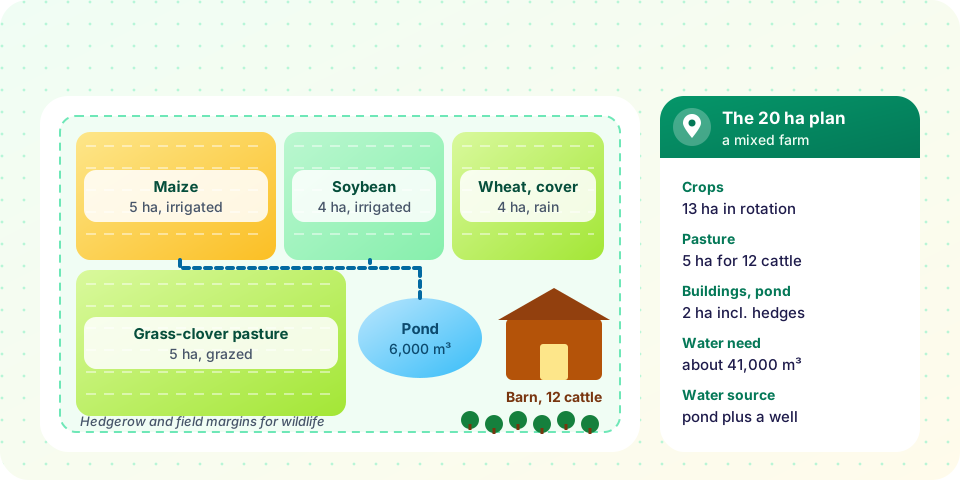
You manage 20 hectares of loam soil in a region with a dry summer. The farm has a pond of 6,000 m³ and a well that can supply about 38,000 m³ per growing season, so the total water supply is 44,000 m³. The starting plan is:
- Maize, 5 ha, irrigated (sprinkler, efficiency 0.75): yield 8 t/ha, price $200/t, variable cost $860/ha.
- Soybean, 4 ha, irrigated: yield 3.2 t/ha, price $420/t, variable cost $520/ha.
- Wheat followed by a cover crop, 4 ha, rainfed: yield 5 t/ha, price $230/t, variable cost $600/ha.
- Grass-clover pasture, 5 ha, grazed and mown for hay: 8 t DM/ha of which 70% is used.
- Herd, 12 beef cattle of about 450 kg, eating 2.5% of body weight in dry matter each day; 10 calves sold a year at $550 each; vet and minerals $70 per cow.
- Fixed costs for the whole farm: $8,000 per year.
- The remaining 2 ha hold the farmstead, pond and hedgerows for wildlife.
All figures are illustrative round numbers, drawn from the lessons of this course, not data from a real farm.
Step by step
1. Land and rotation
Crops are rotated to break pest cycles and use legume nitrogen. A simple three-block rotation is maize, then soybean, then wheat with a clover cover crop. In practice the blocks need equal size, so you would adjust areas slightly. In this exercise, treat the areas as the plan for year one; each year the crops move to the next block.
2. Feed balance
Twelve cattle eat 12 × 450 × 0.025 = 135 kg DM per day, which is about 49.3 t a year. The pasture provides 5 ha × 8 t × 0.70 = 28 t. Crop residues (straw and stover) are assumed to supply about 8 t. The farm therefore falls 13.3 t short, which must be bought, here at $150/t. Options to close the gap: improve pasture, grow forage on a cover crop, reduce the herd, or add a feed crop.
3. Water budget
For each irrigated crop, the net irrigation need is crop ETc minus effective rain, and the gross need divides by efficiency. For maize: ETc 517 mm, effective rain 120 mm, net 397 mm, gross 397 / 0.75 = 529 mm. On 5 ha, that is 529 × 10 × 5 ≈ 26,500 m³. Soybean (ETc 450 mm, rain 180 mm) needs 270 mm net, 360 mm gross, about 14,400 m³ for 4 ha. The total is about 40,900 m³ against a supply of 44,000 m³: only about 7% slack. A drought year with higher ET₀ could break the budget, which is a risk to note.
4. Money
The gross margin of each enterprise (revenue minus variable costs) is added up and the fixed costs subtracted. The farm's net income is what remains for the family, taxes and savings. Compare it with what the household needs.
5. Sustainability checks
Look for soil cover (cover crop, residue), nutrient balance (legume in rotation, manure returned), water productivity, biodiversity (hedgerows, margins) and animal welfare (shade, space, health plan). The farm should also have a plan for drought, a disease outbreak, and a price fall.
Try it
The model below calculates feed, water and money for the starting plan and plots enterprise gross margins and the two budgets. Change the inputs to test ideas, for example a smaller maize area, a different herd size, or drip irrigation.
Press Run (or Ctrl + Enter) to see the result here.
Program input · what you'd type while the program runs
Type the answers before you press Run, one per line. Each time the program reads a line (with input()), it gets the next line from this box.
This planner lets you shift land between maize, soybean and wheat and see the crop gross margin and the water budget live.
Your deliverable
Write a one-to-two page plan with these sections. The numbers from the model will give you most of what you need.
- Summary: the farm in three sentences and your main recommendation.
- Land and rotation: a table of blocks and crops across three years.
- Feed and herd: the feed balance and how you will close any gap.
- Water: the budget, the irrigation method and a drought contingency.
- Money: gross margins, fixed costs, net income and the break-even yield of your main crop.
- Sustainability: soil cover, nutrient balance, biodiversity, animal welfare.
- Risks: price, weather, disease, and what you would do about each.
Ideas to test: drip irrigation for maize (efficiency 0.90), a cover crop that provides forage, reducing the herd to 10, replacing wheat with a second legume, or selling hay. For each, report the effect on net income, water and feed.
Common misconceptions
"The enterprise with the highest gross margin should take all the land." Rotations, water limits, labor peaks and price risk all restrict this. Maize on maize also raises pest and disease problems.
"A farm plan is a prediction." It is a model with assumptions. State them and test them with worse prices, yields and rainfall.
"Profit is the only target." Soil health, water, welfare and the farmer's workload decide whether the farm still works in ten years.
Check your understanding
Quick check · 5 questions
of 5 answered You scored / 5 · perfect!
-
1. 12 cattle of 450 kg eat 2.5% of body weight in DM per day. How many tonnes of DM do they eat in a year?
12 × 450 × 0.025 = 135 kg/day, × 365 = 49,275 kg, about 49.3 t. -
2. Maize needs 397 mm net irrigation and the system efficiency is 0.75. What is the gross depth?
397 / 0.75 = 529 mm. -
3. Which is a constraint on expanding irrigated maize in this plan?
The water supply of 44,000 m³ is just above the need of about 40,900 m³. -
4. What does gross margin leave out?
Gross margin is revenue minus variable costs; fixed costs are subtracted afterwards. -
5. Why should a farm plan include a drought contingency?
With little slack, a dry year can push water need above supply, so the plan needs a fallback.
Summary
- A whole-farm plan combines land, rotation, feed, water, money and sustainability.
- Feed balance and water budget show which constraints bind first.
- Gross margin by enterprise, minus fixed costs, gives net farm income.
- Test changes and state your assumptions; plan for drought, disease and price risk.
Next: Glossary
Track your progress
Create a free account to tick off lessons and pick up where you left off on any device.
of Agricultural Science lessons completed