


















Lesson 42 of 42 · Projects and Practice
Further Study: Where to Go Next in Agricultural Science
Plan your next steps after this course: careers in agriculture, the skills to build, free data and tools, and related subjects such as botany, climate science and microeconomics.
You have covered a wide range: animals and their feed, breeding and welfare; crop water and irrigation; conservation and precision tools; food security and farm economics. What next? Agricultural science is not one subject but a meeting place of many, and the best next step depends on what caught your interest. This lesson maps the options, suggests skills to build, lists free data and tools to practice with, and ends with a study plan you can start this week.
What you will learn
- Identify careers and roles that use agricultural science
- Choose next subjects based on your interests
- Build the numerical, spatial and communication skills that employers value
- Find free datasets and tools to practice with
- Create a simple study plan
Key terms
Agronomist: a specialist in crop production and soil management.
Extension officer: an adviser who brings research and practical knowledge to farmers.
Agricultural economist: a specialist in farm finances, markets and policy.
GIS: geographic information system, software for mapping and analyzing spatial data.
CGIAR: a global partnership of international agricultural research centers.
Careers that use this course
Agriculture employs more people than any other sector in many countries, and the modern food system needs many different specialists.
- Agronomist or crop adviser: plans fertilization, pest management and varieties; uses soil tests, scouting and precision tools.
- Animal scientist, nutritionist or veterinarian: formulates rations, designs breeding programs, protects health and welfare.
- Irrigation or water engineer: designs systems, schedules irrigation and manages basin-level water allocation.
- Soil scientist and environmental consultant: measures soil health, nutrient losses and carbon; advises on conservation.
- Precision-agriculture technician or data analyst: handles GNSS, sensor and imagery data, builds prescription maps.
- Food scientist or quality manager: ensures food safety and reduces loss in processing and storage.
- Agricultural economist, policy analyst or development worker: studies markets, trade and food security programs for governments, banks and aid agencies.
- Extension officer, teacher or farmer: turns knowledge into practice, which is where results appear.
Many roles combine technical skills with communication: explaining a recommendation clearly, in a way that a farmer with limited time and money can act on, is as valuable as the calculation behind it.
Related subjects on this site
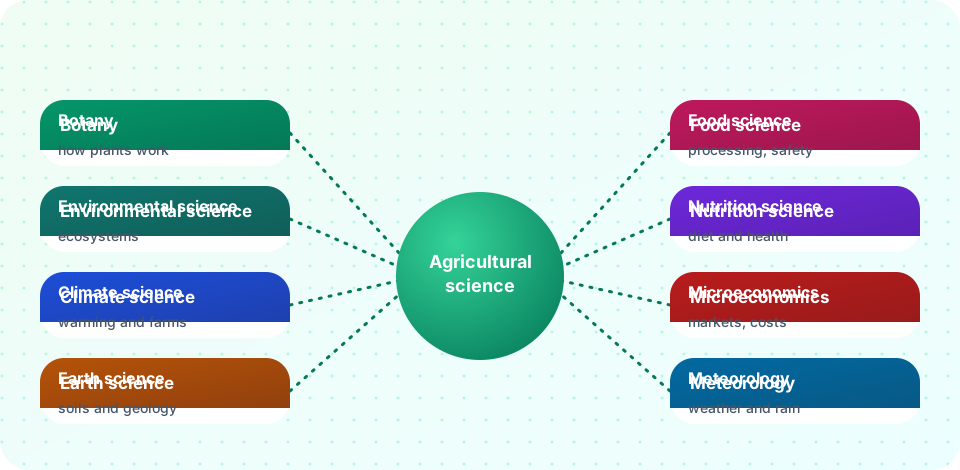
Each of these tracks goes deeper into one part of what you have learned. Choose by interest.
| If you enjoyed... | Try | Why |
|---|---|---|
| How plants grow, photosynthesis, water in plants | Botany | The biology behind crops and Kc |
| Ecosystems, biodiversity, pollution, nitrogen and water cycles | Environmental science | The environmental side of sustainability |
| Weather, rainfall, ET₀ and heat stress | Meteorology | Where ET₀ and drought come from |
| Warming, emissions and adaptation | Climate science | How climate change affects farming |
| Soils, rocks, aquifers and landscapes | Earth science | Soil formation and groundwater |
| Storage, processing and safety | Food science | After the farm gate |
| Diet, nutrients and health | Nutrition science | The utilization pillar in detail |
| Costs, prices and markets | Microeconomics | The theory behind gross margin, elasticity and cobweb cycles |
| Trade, inflation, growth and policy | Macroeconomics | National food policy and price shocks |
Also useful are statistics (trial design, regression, uncertainty), programming with Python or R, and basic GIS. Many of the examples in this course used Python in your browser; the same libraries work on your own computer for real data.
Skills to build
- Quantitative skills. Keep practicing unit conversions, ratios and basic statistics. Being comfortable with numbers is the most transferable agricultural skill.
- Data and spatial skills. Learn to read a map and a table. Free GIS software such as QGIS handles field boundaries, soil maps and satellite images. Python libraries such as pandas, numpy and matplotlib handle tables, simulations and plots.
- Experimental thinking. Field experiments need replication, randomization and controls, because weather and soil vary. A good question and a fair comparison matter more than a fancy tool.
- Communication. Writing a one-page recommendation, drawing a clear chart or explaining a result to a farmer are real professional tasks. The farm-plan project is practice.
- Local knowledge. Soils, crops, markets and customs differ from place to place. Respect and learn from the people who farm there.
Free data, tools and organizations
- FAOSTAT (FAO) publishes national statistics on production, trade, prices and food balances; AQUASTAT covers water and irrigation by country.
- Our World in Data provides charts and downloadable data on food, agriculture, land use and nutrition.
- Copernicus Browser and similar services give free access to Sentinel satellite imagery, including the bands needed for NDVI.
- National weather and soil services often publish rainfall, temperature and soil maps.
- CGIAR centers such as IRRI (rice), CIMMYT (maize and wheat), ICRISAT (dryland crops), ILRI (livestock) and IFPRI (food policy) publish research summaries and datasets.
- Universities and extension services run short courses, field days and open publications. A local extension office can connect you with real farms.
A good project is to find the long-term rainfall for your area, estimate ET₀ with the Hargreaves equation from temperature records, build a Kc curve for a crop grown nearby and calculate an irrigation requirement. That uses nearly everything from the water chapter, and it is real.
A simple study plan
Pick one direction and set a small weekly routine. For example, three hours a week for eight weeks:
- Week 1 to 2: choose a related track and read its first chapter; note three links to this course.
- Week 3 to 4: practice calculations with data from your region (rainfall, prices, yields).
- Week 5 to 6: do a mini-project, such as a feed balance for a farm you know, a water budget for a plot or a gross-margin comparison of two crops.
- Week 7 to 8: write a one-page summary and share it with a teacher, a farmer or a friend, and ask what is unclear.
Learning sticks when you apply it, explain it and revisit it, so schedule the review as well as the reading.
Common misconceptions
"Agriculture is low-tech and low-skill." Modern farming uses sensors, genetics, economics and logistics. It is a knowledge-intensive profession.
"You need a farm to work in agriculture." Most agricultural careers are in research, advice, industry, finance, policy and technology.
"One course is enough." This course gives you the framework. Local conditions, hands-on experience and continuing study turn it into expertise.
Try it
The first tool suggests next subjects from your interests. It is a simple lookup to help you choose, not a career test.
The second program turns your weekly hours into a study plan with a bar chart. Change the weights to match your priorities.
Press Run (or Ctrl + Enter) to see the result here.
Program input · what you'd type while the program runs
Type the answers before you press Run, one per line. Each time the program reads a line (with input()), it gets the next line from this box.
Check your understanding
Quick check · 4 questions
of 4 answered You scored / 4 · perfect!
-
1. Which free service provides national statistics on production and food balances?
FAOSTAT from FAO publishes production, trade and food balance data for countries. -
2. Which related subject best explains where reference evapotranspiration data come from?
ET0 depends on weather variables such as radiation, temperature, humidity and wind, studied in meteorology. -
3. Why does an agricultural project benefit from replication and controls?
Field variability means a single plot can mislead; replicates and controls separate treatment from chance. -
4. Which skill is described as the most transferable in agricultural science?
Quantitative skill carries across feed, water, soil, economics and data work.
Summary
- Agricultural science leads to many careers in production, research, advice, industry, policy and technology.
- Related subjects deepen each part: botany, environmental, climate, earth, food, nutrition, meteorology and economics.
- Build quantitative, spatial, experimental and communication skills, and practice with free real data.
- A short, regular study plan with a mini-project turns knowledge into skill.
Track your progress
Create a free account to tick off lessons and pick up where you left off on any device.
of Agricultural Science lessons completed