


















Lesson 40 of 42 · Projects and Practice
Glossary: Animals, Water, Sustainability, Food and Economics
Fifty key terms from animal production, water and irrigation, sustainable and precision agriculture, food security and farm economics, with short definitions and formulas.
Every field has its own vocabulary, and agriculture borrows from biology, chemistry, physics, engineering and economics at once. When a term is fuzzy, the calculations built on it go wrong: a farmer who confuses dry matter with as-fed weight will over- or under-feed an animal, and an adviser who mixes up gross margin with profit will give bad advice. This glossary collects the fifty most useful terms from the second half of the course in alphabetical order, with a one-line definition and, where it helps, the formula and a pointer to the lesson.
What you will learn
- Find and review the key terms of chapters 5 to 8
- Connect each term to its formula and to the lesson where it was explained
- Use the terms accurately in written explanations
- Test yourself with flashcards and a matching game
Key terms
Dry matter: weight of feed after removing water. Compare feeds and rations on this basis.
Gross margin: revenue minus variable costs. The tool for comparing enterprises.
Evapotranspiration: water lost from soil and plants to the air. The main outflow of a crop's water budget.
Herd immunity: group protection that arises when enough animals are immune.
Yield gap: potential yield minus actual yield.
The glossary
A to F
| Term | Meaning |
|---|---|
| Abomasum | The fourth, "true" stomach of a ruminant, which secretes acid and enzymes. See nutrition. |
| Acidosis | Low rumen pH (below about 5.5) caused by too much fast-fermenting starch. |
| Antimicrobial resistance | The ability of bacteria to survive drugs that once killed them; encouraged by misuse of antibiotics. |
| Application efficiency (Ea) | Water stored in the root zone divided by water applied. Gross = net / Ea. See methods. |
| Artificial insemination (AI) | Placing collected, often frozen, semen into a female to breed her without natural mating. |
| Basal energy | Energy for life processes at rest; about 70 × W^0.75 kcal/day for body weight W in kg (Kleiber). |
| Biosecurity | Measures that keep disease out of a farm and stop it spreading: quarantine, hygiene, movement control. |
| Blue water | Water in rivers, lakes and aquifers available for irrigation. |
| Body condition score | A scale (for dairy cows 1 to 5) for fatness, used to judge nutrition and welfare. |
| Break-even yield | Total cost divided by price: the yield at which revenue just covers costs. |
| Center pivot | Sprinkler system on a rotating pipe that irrigates a circle; a 400 m radius covers about 50 ha. |
| Cobweb cycle | Price oscillation caused by farmers basing planting on last year's price. |
| Conservation agriculture | Minimum soil disturbance, permanent cover and crop diversification. |
| Cover crop | A crop grown to protect and improve soil rather than to harvest. |
| Crop coefficient (Kc) | Factor that turns reference evapotranspiration into crop use: ETc = Kc × ET₀. |
| Crude protein (CP) | Nitrogen content × 6.25. |
| Dry matter (DM) | What remains of a feed after the water is removed. |
| Estimated breeding value (EBV) | Statistical estimate of an animal's genetic merit for a trait. |
| Evapotranspiration (ET) | Evaporation from soil plus transpiration from plants. |
| Feed conversion ratio (FCR) | Kilograms of feed per kilogram of body weight gained. |
| Fertigation | Applying fertilizer dissolved in irrigation water, typically through drip systems. |
| Field capacity (FC) | Soil water content after free drainage; the top of the available-water range. |
| Five Freedoms | Freedom from hunger and thirst, discomfort, pain and disease, fear and distress, and freedom to express normal behavior. |
| Food loss | Reduction of food along the supply chain before retail. See food systems. |
| Food security | All people at all times have access to sufficient, safe, nutritious food (FAO 1996). |
| Food waste | Food discarded at retail, in food service and at home. |
G to N
| Term | Meaning |
|---|---|
| Green water | Rain stored in the soil and used by plants. |
| Gross margin (GM) | Revenue minus variable costs. See farm economics. |
| Heritability (h²) | Share of phenotypic variation due to additive genetic differences; h² = V_A / V_P. |
| Herd immunity | Protection of the herd when enough animals are immune; critical coverage 1 − 1/R₀. |
| Heterosis | Hybrid vigor: crossbred offspring outperform the parental average. |
| Hidden hunger | Micronutrient deficiency in people who may get enough energy. |
| Inbreeding coefficient (F) | Probability that two gene copies are identical by descent; 0.25 for offspring of full siblings. |
| Leaching requirement (LR) | Fraction of water that must drain below the roots to remove salts: ECw / (5 ECe − ECw). |
| Management zone | A part of a field with similar yield potential, treated as one unit. |
| NDVI | (NIR − Red) / (NIR + Red), a vegetation vigor index. |
| Net present value (NPV) | Sum of discounted future cash flows minus the initial cost. |
| Nitrogen use efficiency (NUE) | Nitrogen removed by the crop divided by nitrogen applied. |
| No-till | Planting through residue without plowing. |
P to Y
| Term | Meaning |
|---|---|
| Permanent wilting point (PWP) | Soil water content below which plants cannot recover; the bottom of the available-water range. |
| Precision agriculture | Managing within-field variation with positioning, sensors and variable-rate machines. |
| R₀ | Average number of animals one infected animal infects in a fully susceptible herd. |
| Readily available water (RAW) | Fraction p of total available water the crop can use without stress. |
| Rumen | The first and largest compartment of a ruminant stomach, a fermentation chamber. See the rumen picture. |
| RTK | Real-time kinematic GNSS correction giving about 2 cm accuracy. |
| Selection differential (S) | Mean of selected parents minus herd mean. Response R = h² × S. |
| Stunting | Height-for-age z-score below −2: sign of chronic undernutrition. |
| Temperature-humidity index (THI) | Heat stress index; (1.8T + 32) − (0.55 − 0.0055 RH)(1.8T − 26). |
| Total available water (TAW) | (θ_FC − θ_PWP) × root depth × 1000, in mm. |
| Variable-rate technology (VRT) | Machines that change input rates as they move across a field. |
| Wasting | Weight-for-height z-score below −2: sign of acute undernutrition. |
| Withdrawal period | Time after treatment before milk, eggs or meat may be sold. |
| Yield gap | Water-limited potential yield minus actual yield. |
How to use a glossary well
A glossary is not for memorizing; it is for checking. When a term appears in a lesson and you are not sure of the meaning, look it up, then try to restate the definition in your own words. Better still, give one example: "dry matter" becomes "30 kg of silage at 35% dry matter holds 10.5 kg of dry matter." Terms with formulas deserve special attention, because the formula tells you what the term depends on.
Many agricultural terms look alike and mean different things. Keep these pairs apart: loss and waste, gross margin and net profit, TAW and RAW, ET₀ and ETc, green water and blue water, stunting and wasting, heritability and heterosis, efficiency (a ratio) and productivity (output per unit of input).
Common misconceptions
"Efficiency and yield are the same thing." A system can be efficient with low yield or inefficient with high yield. Efficiency is a ratio; yield is an amount.
"Heritability tells you how important genes are for one animal." It describes a population in an environment, not the share of one animal's traits due to genes.
"Waste and loss are interchangeable." In the FAO sense, loss happens before retail and waste at retail and after.
Try it
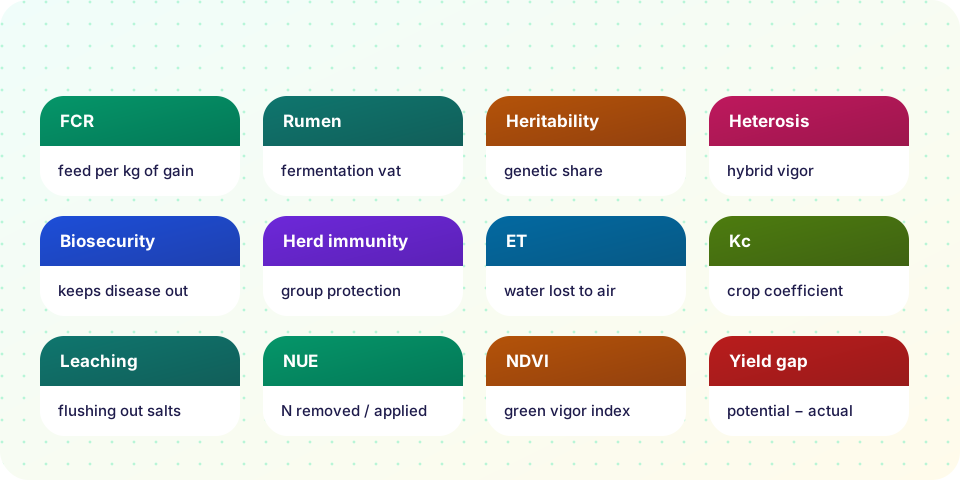
First, flashcards for twelve terms. Click a card to flip it.
Second, a matching game. Choose the definition that fits the term; the choices are shuffled each time.
Check your understanding
Quick check · 4 questions
of 4 answered You scored / 4 · perfect!
-
1. Which pair of terms is correctly distinguished?
FAO uses loss for the supply chain up to retail, and waste for retail and consumers. -
2. TAW and RAW are related by:
Readily available water is the depletion fraction p times total available water. -
3. Which term is a ratio of nitrogen removed to nitrogen applied?
Nitrogen use efficiency = N removed / N applied. -
4. What does heterosis describe?
Heterosis is the advantage of crossbred offspring over the average of their parents.
Summary
- A precise vocabulary prevents calculation errors; check terms rather than memorizing them.
- Keep similar pairs apart: loss versus waste, TAW versus RAW, ET₀ versus ETc, gross margin versus net profit.
- Terms with formulas are easiest to remember when you work an example.
Next: Cheat sheet
Track your progress
Create a free account to tick off lessons and pick up where you left off on any device.
of Agricultural Science lessons completed