


















Lesson 41 of 42 · Projects and Practice
Cheat Sheet: Formulas and Typical Values
A one-page recap of the formulas, units and typical values from animal production, water and irrigation, sustainable and precision agriculture, food security and farm economics.
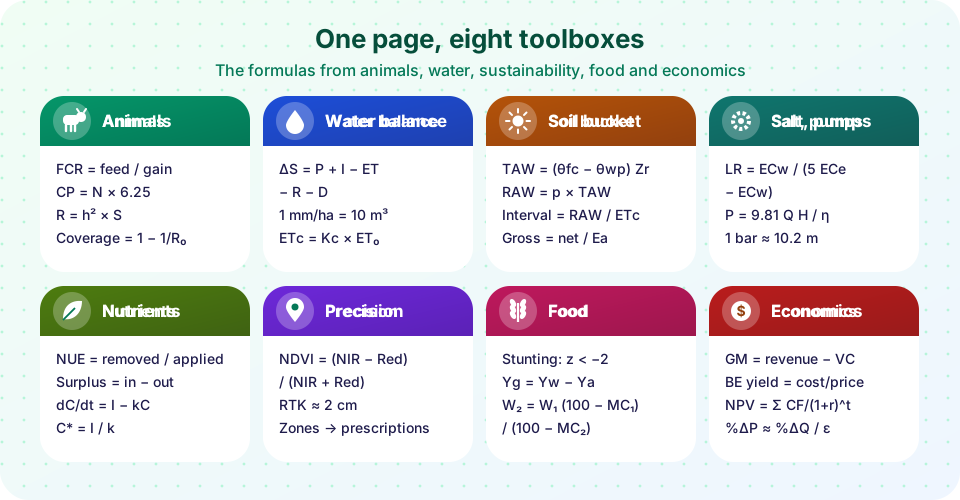
This page is the quick reference for the second half of the course. It has one big picture with the main formulas, then short lists of typical values and rules of thumb you will use again and again. Use it before a test, when you start a project, or any time you want to check a formula without rereading a whole lesson. Each block links back to the lesson with the full explanation.
What you will learn
- Recall the main formulas of chapters 5 to 8 and when to use each
- Recognize typical values so you can sanity-check answers
- Move quickly from a question to the right formula
- Find the lesson where each idea is explained
Key terms
Rule of thumb: a rough, memorable guide that is usually close enough.
Typical value: a common figure that varies with conditions; use it for estimates, not for exact design.
Sanity check: comparing an answer with known sizes to catch mistakes.
Units: the labels on numbers; most errors are unit errors.
Animals (overview)
Nutrition (lesson):
- Dry matter = as-fed weight × DM fraction. Cattle eat about 2 to 3% of body weight as DM per day.
- Crude protein = nitrogen × 6.25.
- Pearson square: parts of the high-protein feed = target − low; parts of the low-protein feed = high − target.
- Basal energy ≈ 70 × W^0.75 kcal/day (W in kg).
- Rumen VFAs on forage: about 70% acetate, 20% propionate, 10% butyrate; acidosis below pH 5.5.
Breeding (lesson):
- h² = V_A / V_P. Response R = h² × S = i × h² × σ_P. Annual gain = R / generation interval.
- Selection intensity i ≈ 1.40 for the top 20%.
- Inbreeding coefficient F: 0.25 for full siblings, 0.125 for half siblings.
- Gestation: cow about 283 days, ewe about 147, goat about 150, sow about 114, mare about 340; estrous cycle about 21 days in cows, pigs and goats.
- Calving interval = gestation + days open.
Health and welfare (lesson):
- Herd immunity coverage = 1 − 1/R₀ (perfect vaccine).
- THI = (1.8T + 32) − (0.55 − 0.0055 RH)(1.8T − 26). Heat stress begins around 68 to 72 for dairy cows.
- Somatic cell count: healthy quarters well under 100,000 cells/mL; above 200,000 suggests mastitis.
- Five Freedoms: hunger and thirst, discomfort, pain and disease, normal behavior, fear and distress.
Typical feed conversion ratios: salmon about 1.2, broiler about 1.7, pig about 2.8, feedlot beef about 7 kg feed per kg gain.
Water and irrigation (overview)
- Water balance: ΔS = P + I − ET − R − D. 1 mm on 1 ha = 10 m³ = 10,000 liters.
- ETc = Kc × ET₀. Hargreaves: ET₀ = 0.0023 (T_mean + 17.8) √(T_max − T_min) R_a.
- Maize Kc: about 0.30 initial, 1.20 mid-season, 0.35 late; stage lengths 20, 35, 40 and 30 days.
- TAW = (θ_FC − θ_PWP) × Z_r × 1000 (mm). RAW = p × TAW (p about 0.5 to 0.55 for maize). Interval = RAW / ETc.
- Typical application efficiency: surface about 60%, sprinkler about 75%, drip about 90%. Gross = net / Ea.
- Leaching requirement LR = ECw / (5 ECe − ECw). Maize tolerates ECe up to about 1.7 dS/m before yield declines.
- Pump power P (kW) = 9.81 × Q (m³/s) × H (m) / η. Energy per m³ = 9.81 H / (3600 η) kWh. 1 bar ≈ 10.2 m.
- Agriculture uses roughly 70% of freshwater withdrawals; irrigated land is about a fifth of cropland and gives about 40% of food (crop water lesson, methods lesson).
Sustainable and precision agriculture (overview)
- Three pillars: environment, economy, society.
- Conservation agriculture: minimum soil disturbance, permanent cover, diversification (lesson).
- NUE = N removed / N applied. Surplus = inputs − outputs.
- Soil carbon: dC/dt = I − kC; equilibrium C* = I / k; time scale about 1/k years.
- Economic optimum nitrogen: where marginal yield = price ratio; it sits below the maximum-yield rate.
- Precision agriculture (lesson): measure, decide, apply. RTK about 2 cm. NDVI = (NIR − Red) / (NIR + Red); bare soil 0.1 to 0.2, dense vigorous canopy 0.6 to 0.9.
Food security and economics (overview)
- Four pillars: availability, access, utilization, stability.
- Loss = before retail; waste = retail and after. About a third of food is lost or wasted (older FAO estimate).
- Stunting: height-for-age z < −2. Wasting: weight-for-height z < −2; severe wasting below −3 (MUAC under 115 mm in children 6 to 59 months).
- Grain drying: W₂ = W₁ × (100 − MC₁) / (100 − MC₂); store cereals at 13 to 14% moisture.
- Yield gap = Yw − Ya.
- Gross margin = revenue − variable costs; net profit = gross margin − fixed costs; break-even yield = total cost / price.
- NPV = Σ CF_t / (1 + r)^t − initial cost.
- % price change ≈ % quantity change / elasticity (staples are inelastic, about −0.3 to −0.5) (food systems lesson, economics lesson).
Habits that prevent mistakes
- Write units next to every number.
- Convert percent to fractions for formulas that need fractions.
- Estimate the answer first (is it 10 or 1,000?).
- Keep extra digits and round at the end.
- State your assumptions, especially for typical values; test a worse case.
Common misconceptions
"A formula is true everywhere." Most agricultural formulas are models with conditions. Kc varies with climate and management, efficiencies vary with skill, and heritabilities vary with population and environment.
"Typical values are exact." They are starting points. Replace them with local data whenever you have it.
"The cheat sheet replaces the lessons." It reminds you of what you already understand. If a formula is unclear, go back to its lesson and work an example.
Try it
The first program prints the typical values from this page as a lookup table and runs a few quick checks. Replace any value with local data.
Press Run (or Ctrl + Enter) to see the result here.
Program input · what you'd type while the program runs
Type the answers before you press Run, one per line. Each time the program reads a line (with input()), it gets the next line from this box.
The second tool is a formula explorer. Pick a formula, change the inputs and read the result.
Check your understanding
Quick check · 5 questions
of 5 answered You scored / 5 · perfect!
-
1. Which formula gives the water use of a crop?
Crop evapotranspiration equals the crop coefficient times reference evapotranspiration. -
2. What is the typical efficiency of drip irrigation?
Typical application efficiencies are about 60% surface, 75% sprinkler and 90% drip. -
3. Which pair is correct?
Wasting is low weight-for-height; stunting is low height-for-age. -
4. A sow's gestation of about 114 days is easily remembered as:
3 months + 3 weeks + 3 days is about 114 days. -
5. Which habit best prevents calculation mistakes?
Units and an estimate catch most errors.
Summary
- The cheat sheet collects the main formulas and typical values from animals, water, sustainability, precision tools, food and economics.
- Typical values are starting points; replace them with local data.
- Write units, convert percentages, estimate first and round last.
Next: Further study
Track your progress
Create a free account to tick off lessons and pick up where you left off on any device.
of Agricultural Science lessons completed