


















Lesson 30 of 42 · Sustainable and Precision Agriculture
Sustainable and Precision Agriculture: The Big Picture
Understand what sustainable agriculture means, which environmental problems it must solve, and how precision tools help farmers produce more with fewer inputs.
Agriculture has a double role. It must feed a growing population, and it must do so without wearing out the land, water and climate that production depends on. About half of the world's habitable land is used for farming. Farming is a leading driver of biodiversity loss, takes most freshwater withdrawals, and together with forestry and other land use contributes roughly a fifth to a quarter of human greenhouse gas emissions, according to IPCC assessments. At the same time farmers are the first to suffer from degraded soils, falling water tables and a changing climate.
Sustainable agriculture is the response: keep production high now, without borrowing from the future. This chapter covers two connected ideas. Conservation and ecological practices (the biological side) protect soil, water and biodiversity. Precision agriculture (the technology side) lets farmers apply the right input in the right place at the right time, instead of treating a whole field as if it were uniform.
What you will learn
- Define sustainable agriculture and name its three pillars
- Identify the main environmental pressures from farming
- Explain why the nitrogen cycle matters so much and what the economic optimum means
- Describe how conservation practices and precision tools fit together
- Preview the two lessons of this chapter
Key terms
Sustainable agriculture: farming that meets present food needs without reducing the ability of future generations to meet theirs, in line with the Brundtland definition of sustainable development.
Agroecology: applying ecological principles (diversity, nutrient cycling, natural pest control) to farm design.
Precision agriculture: managing variation within fields with sensors, maps and variable-rate machines.
Nutrient use efficiency: the share of applied nutrients that ends up in the harvested crop.
Planetary boundaries: limits for processes such as climate, biodiversity and nitrogen and phosphorus flows, beyond which risks to the Earth system rise.
Three pillars
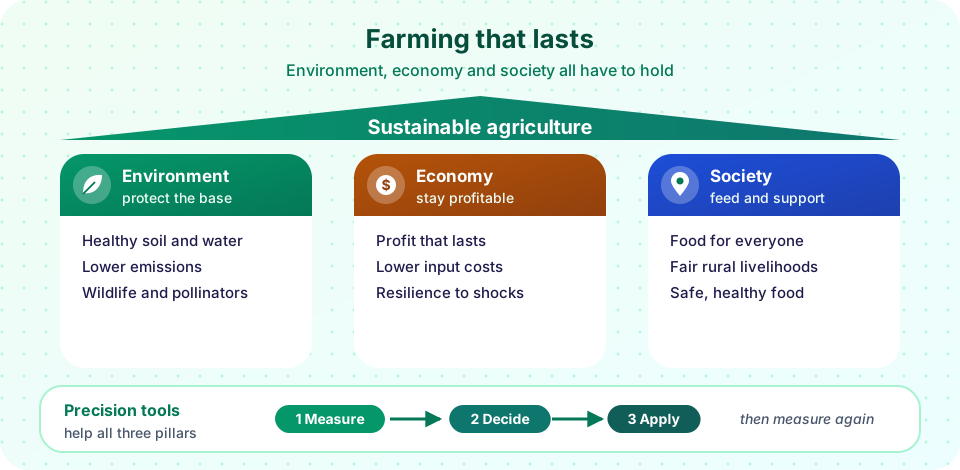
The word sustainable is often used loosely, so it helps to be concrete. The usual framework has three pillars that must all hold:
- Environment: soil is kept healthy and in place, water is used and returned cleanly, emissions fall and wildlife has habitat.
- Economy: the farm earns enough to continue and invest. A practice that saves the planet but bankrupts the farmer will not spread.
- Society: food is safe, affordable and nutritious, workers are treated fairly and rural communities thrive.
These goals sometimes conflict. Cutting nitrogen reduces pollution but may reduce yield; a no-till system saves soil but may need more herbicide. Sustainability is not a checklist of "good" practices. It is the habit of measuring results (soil carbon, nutrient balance, water productivity, emissions per kilogram of product, farm income) and improving them step by step.
Why change?
Produce more while using less
Main pressures
Two toolkits
Measure, then improve
What gets measured gets managed
The nitrogen story
No nutrient shows the dilemma better than nitrogen. Plants need it for protein, and for most of history soil nitrogen limited yields. In the early twentieth century, the Haber-Bosch process (developed around 1909 to 1913) learned to turn atmospheric nitrogen and hydrogen into ammonia. Synthetic nitrogen fertilizer now supports roughly half of the world's population by common estimates, and farmers apply well over 100 million tonnes of nitrogen a year.
Much of that nitrogen is not taken up by the crop. It runs off into rivers and lakes (causing algae blooms and "dead zones"), leaches into groundwater as nitrate, and escapes to the air as ammonia and nitrous oxide, a powerful greenhouse gas with a warming effect roughly 270 to 300 times that of carbon dioxide per molecule over a century. Improving nitrogen use efficiency is therefore a central goal of both conservation and precision agriculture.
The key economic idea is that crop response to nitrogen has diminishing returns. The first kilograms raise yield a lot; the last ones raise it a little. The economic optimum rate is where the value of the extra yield from one more kilogram of nitrogen equals the price of that kilogram. It is usually a little below the rate that gives the maximum yield, so saving nitrogen can save money and the environment at once. The program below shows it with an illustrative response curve.
Common misconceptions
"Sustainable means organic." Organic farming is one approach with its own rules, but sustainability is a goal that can be pursued by many systems. What counts is the measured outcome for soil, water, climate, biodiversity and livelihoods.
"Precision agriculture is only for big farms with expensive machines." Sensors, free satellite imagery and smartphone apps now help smallholders too; the principle is to manage variation, whatever the tool.
"More input always means more yield." Beyond the economic optimum the extra input is mostly waste and pollution.
Try it
First, a small nitrogen-response model. The yield curve is a made-up quadratic, chosen for illustration; real curves come from field trials. The program finds the rate that maximizes yield and the economic optimum for a given price ratio.
Press Run (or Ctrl + Enter) to see the result here.
Program input · what you'd type while the program runs
Type the answers before you press Run, one per line. Each time the program reads a line (with input()), it gets the next line from this box.
Second, a sustainability scorecard. Move the sliders to score a farm on six indicators from 0 to 10 and watch the shape of the radar chart. It is a demonstration of how to read trade-offs, not an official rating.
What is in this chapter
| Lesson | What it covers |
|---|---|
| Conservation agriculture and agroecology | No-till, cover, rotations, legumes, nutrient budgets and soil carbon |
| Precision agriculture technology | GNSS guidance, sensors, NDVI maps, variable-rate application and economics |
| Chapter review | A one-page summary and ten questions |
Check your understanding
Quick check · 4 questions
of 4 answered You scored / 4 · perfect!
-
1. Which is NOT one of the three pillars of sustainable agriculture?
The usual three pillars are environment, economy and society. -
2. Why is the economic optimum nitrogen rate lower than the rate for maximum yield?
Because of diminishing returns, the marginal yield falls to the price ratio before it reaches zero. -
3. Which gas from fertilized soils has a global warming effect roughly 270 to 300 times that of CO2 per molecule?
Nitrous oxide (N2O) is a long-lived greenhouse gas with a much higher warming potential than CO2. -
4. What does precision agriculture aim to do?
It uses sensors, maps and variable-rate machines to give each part of a field what it needs.
Summary
- Sustainable agriculture balances environment, economy and society, and relies on measured results.
- Main pressures are nutrient losses, water depletion, biodiversity loss and greenhouse gases.
- Nitrogen shows diminishing returns: the economic optimum rate is below the maximum-yield rate.
- Biological practices (conservation, agroecology) and digital tools (precision agriculture) work together.
Track your progress
Create a free account to tick off lessons and pick up where you left off on any device.
of Agricultural Science lessons completed