


















Lesson 26 of 42 · Water and Irrigation
Water and Irrigation: The Big Picture
See where farm water comes from and where it goes: the field water balance, green and blue water, why irrigation matters and what the chapter will teach you.
Plants are mostly water, and they use far more than they keep. A maize crop that ends the season weighing a few kilograms per plant will have moved hundreds of liters of water from the soil through its roots and out through its leaves. Across the world, farming is by far the largest human use of fresh water: agriculture accounts for roughly 70% of all freshwater withdrawals, according to FAO estimates. Where rain is reliable, crops live on it. Where it is not, farmers bring water from rivers, reservoirs and wells.
This chapter teaches you to think about water the way an irrigation engineer does. You will track a field's water like a bank account, estimate how much a crop needs, decide when and how much to irrigate, and choose a method that suits the soil, the water and the budget.
What you will learn
- Describe the field water balance and name each term
- Distinguish green water from blue water, and rainfed from irrigated farming
- Convert between millimeters of water and cubic meters per hectare
- Explain the main problems of irrigation: waste, depletion and salt
- Preview the three lessons of this chapter
Key terms
Evapotranspiration (ET): water lost to the air by evaporation from soil plus transpiration through plant leaves.
Green water: rain stored in the soil and used by plants.
Blue water: water in rivers, lakes, reservoirs and aquifers, which can be pumped or diverted for irrigation.
Irrigation: applying water to crops to supplement rainfall.
Water productivity: crop yield per unit of water used, for example kilograms of grain per cubic meter.
The field as a bucket
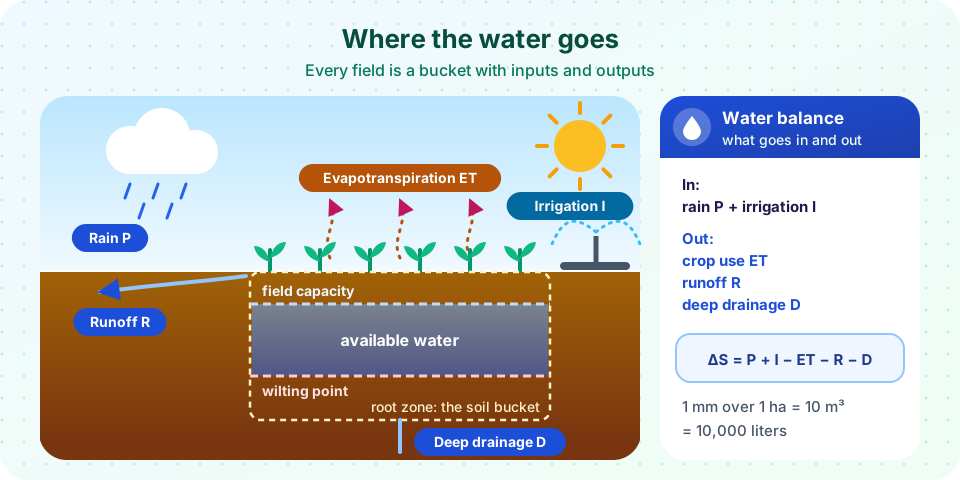
Think of the root zone, the layer of soil that the roots can reach, as a bucket. Rain and irrigation fill it. The crop and the soil surface empty it, by evapotranspiration. If rain is too heavy, some of it runs off the surface and some drains below the roots. The bookkeeping for a period is the water balance:
ΔS = P + I − ET − R − D
where ΔS is the change in stored soil water, P is precipitation (rain), I is irrigation, ET is evapotranspiration, R is surface runoff and D is deep drainage, all in millimeters. A millimeter of water over one hectare (10,000 m²) is 10,000 liters, or 10 m³. So 30 mm of irrigation on 2 hectares is 30 × 10 × 2 = 600 m³.
Where does farm water go?
The balance decides when to irrigate
Green and blue water
Rainfed and irrigated
Irrigation risks
Green water, blue water
Rain that soaks into the soil and is used by plants is called green water. Water in rivers, lakes and aquifers, which can be taken and applied to fields, is blue water. Most of the world's crop production runs on green water: roughly four fifths of cropland is rainfed. Irrigation adds blue water to about a fifth of cropland, but because irrigated land is more productive and more reliable, it yields roughly 40% of the world's food by commonly cited estimates.
Irrigation is an old technology. Early civilizations in Mesopotamia, Egypt and the Indus valley built canals; the Persians dug qanats, gently sloping tunnels that bring groundwater to the surface; and the shaduf, a counterweighted lever, has lifted Nile water for thousands of years. Pumps, pipes and modern controllers have changed the tools, not the aim: put the right amount of water in the root zone at the right time.
What can go wrong
Irrigation turns dry land into farmland, but it comes with risks that every agricultural scientist must understand.
- Waste. In poorly managed systems a large share of the water never reaches roots: it evaporates, leaks from canals or runs off the field. Improving efficiency is usually the cheapest source of "new" water.
- Depletion. Pumping groundwater faster than rain recharges it lowers water tables. This is documented in several of the world's big irrigated regions, such as parts of the High Plains aquifer in the United States, northern India and northern China. Deeper wells cost more energy and can run dry.
- Salinization. All irrigation water contains dissolved salts. When water evaporates or is used by plants, the salts stay in the soil. Without enough drainage, salt builds up and can ruin land. Common estimates put the share of irrigated land affected to some degree at around a fifth.
- Competition. Cities, industry and ecosystems need water too. The shrinking of the Aral Sea after river diversions for cotton irrigation is a well-known example of the environmental cost.
Common misconceptions
"More irrigation always means more yield." Beyond the crop's need, extra water drains away and wastes energy, nutrients and money. Over-watering can also waterlog roots and wash fertilizer below them.
"Rainfall totals tell you if a crop has enough water." Timing matters as much as the total. Ten millimeters on ten separate days can be worth more than 100 mm in one storm that runs off.
"Drip irrigation always saves water at the basin scale." Reducing losses on a field can leave less return flow for others downstream. Water accounting must look at the whole river basin.
Try it
First, a bucket you can fill and empty. Each day the crop uses water; rain and irrigation refill the root zone. Keep the water level in the green zone, and note what happens if you over-water.
Second, a 60-day water balance of one field with random rain and a fixed daily crop demand. The program compares rainfed farming with irrigation triggered by a simple rule. The rain is randomly generated, so the numbers illustrate the method and do not describe a real site.
Press Run (or Ctrl + Enter) to see the result here.
Program input · what you'd type while the program runs
Type the answers before you press Run, one per line. Each time the program reads a line (with input()), it gets the next line from this box.
What is in this chapter
| Lesson | What it covers |
|---|---|
| Crop water requirements | ET₀, the crop coefficient Kc, ETc, soil water storage and irrigation timing |
| Irrigation methods and efficiency | Surface, sprinkler and drip systems, efficiency, salinity and pump power |
| Chapter review | A one-page summary, a recap table and ten questions |
Check your understanding
Quick check · 4 questions
of 4 answered You scored / 4 · perfect!
-
1. How many cubic meters of water is 40 mm over one hectare?
1 mm over 1 ha = 10 m³, so 40 mm = 400 m³. -
2. Which term describes rain stored in the soil and used by plants?
Green water is soil moisture from rain. Blue water is in rivers, lakes and aquifers. -
3. In the water balance ΔS = P + I − ET − R − D, which terms are losses from the root zone?
Evapotranspiration, runoff and deep drainage remove water; rain and irrigation add it. -
4. Why does salt build up in irrigated soil?
Pure water leaves the soil while the salts in the irrigation water remain unless leached out.
Summary
- A field's water balance is ΔS = P + I − ET − R − D; 1 mm over 1 ha equals 10 m³.
- Green water (soil moisture from rain) supports most crops; blue water (rivers, aquifers) supports irrigation.
- Irrigation gives about 40% of food from about 20% of cropland, but can waste water, deplete aquifers and salinize soil.
- Timing and efficiency matter as much as total amounts.
Next: Crop water requirements
Track your progress
Create a free account to tick off lessons and pick up where you left off on any device.
of Agricultural Science lessons completed