


















Lesson 6 of 42 · Soils and Fertility
Soils overview: the living ground under the crop
Meet soil as a living system: how it forms, what horizons and pores it has, what it does for crops, and a map of the lessons in this chapter.
Soil is the thin skin of weathered rock, organic matter, water, air and living things that covers most land. Almost everything we eat starts in it. A crop uses soil as an anchor, a water tank, a pantry of nutrients and a home for the microbes that make those nutrients available. Soil is also slow to build and quick to lose: forming a centimeter of topsoil can take centuries under natural conditions, while a single heavy storm can wash it away.
This chapter treats soil as a system with three jobs: physical (structure, texture, water and air), chemical (pH, nutrients, charge) and biological (organic matter, microbes, worms). This overview sets out the big picture and maps the lessons ahead.
What you will learn
- How soil forms and why parent material, climate, organisms, relief and time all matter.
- The horizons of a soil profile and what each contains.
- What a healthy soil is made of by volume, and how to compute bulk density and porosity.
- The main roles soil plays for crops and for the wider environment.
Key terms
Soil horizon: a layer of soil with its own color, texture and structure, named O, A, B, C and R from top to bottom.
Parent material: the rock or sediment from which a soil forms.
Pore space: the gaps between solid particles that hold water and air.
Bulk density: the dry mass of soil per unit volume, in g/cm³.
Soil organic matter (SOM): decaying plant and animal material and the humus it forms.
How soil forms
Soil scientists summarize soil formation with five factors, often credited to Hans Jenny: climate, organisms, relief (landscape position), parent material and time. Warm, wet climates weather rock quickly and leach nutrients away. Cold, dry climates form soil slowly. Plants and animals add organic matter and mix the soil. A steep slope sheds soil, while a valley floor collects it. A soil formed from limestone differs from one formed from granite or from river sediment. Time lets all of it add up.
Weathering breaks rock into smaller mineral particles (physical weathering) and changes minerals chemically into clays and dissolved ions (chemical weathering). Living things then add organic matter, and water moves materials down the profile. The result is a vertical stack of layers.
The soil profile
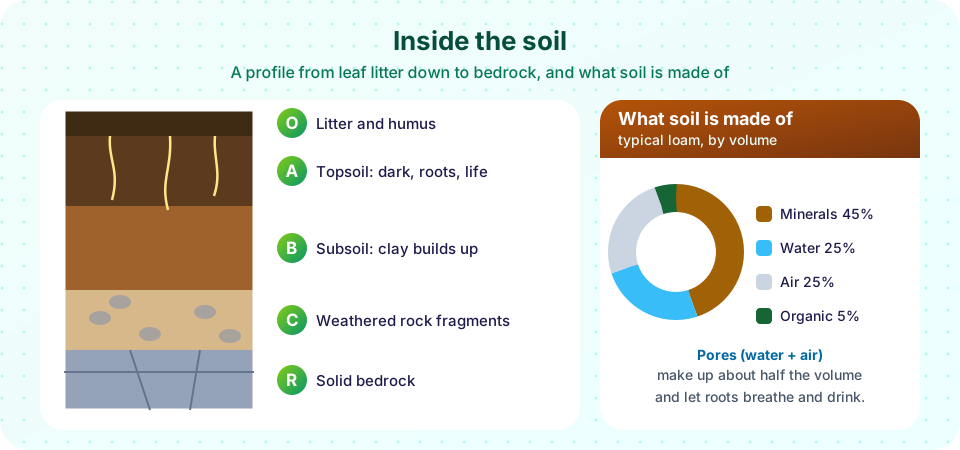
A cut through a soil, called a profile, shows horizons:
- O horizon: surface litter and humus, rich in organic matter. It may be thin or absent in cultivated fields.
- A horizon (topsoil): dark from decomposed organic matter, full of roots and life, where most crop roots feed. Plowed layers are mostly A material.
- B horizon (subsoil): accumulates clay, iron oxides or other materials washed down from above. It holds water and supports deeper roots.
- C horizon: weathered parent material, only partly changed.
- R: unweathered bedrock.
Farmers care about rooting depth, the depth roots can reach before hitting rock, a hardpan or a layer with toxic or waterlogged conditions. Deep soils store more water and buffer dry spells.
What soil is made of
A topsoil in good condition for crops is, by volume, around 45 % mineral particles, about 5 % organic matter, and about 50 % pore space. The pores are shared, by volume, between water and air, and the balance changes constantly: after rain the pores fill with water, and as the soil drains and plants draw water, air returns. Roots need both. Waterlogged soil starves roots of oxygen. Very dry soil has plenty of air but no water to take up.
Two measurements describe how the solids are packed:
bulk density (g/cm3) = dry mass of soil / total volume
porosity (%)         = (1 − bulk density / particle density) × 100
Particle density of mineral soil is close to 2.65 g/cm³. A soil with a bulk density of 1.30 g/cm³ has a porosity of (1 − 1.30/2.65) × 100 = 50.9 %. Compacted soil may reach 1.6 g/cm³ or more, leaving too little pore space for roots in many soils.
What soil does
- Supports plants by anchoring roots and supplying water and nutrients.
- Stores and filters water, reducing floods and cleaning rainwater as it passes through.
- Cycles nutrients through organic matter, microbes and mineral surfaces.
- Stores carbon. Soils hold more carbon than the atmosphere and living plants combined, which is why soil management matters for climate.
- Houses biodiversity. A handful of healthy soil contains vast numbers of bacteria and fungi, plus mites, nematodes, insects and earthworms.
Common misconceptions
"Soil is just dirt that holds the plant up." Soil is an active system of minerals, water, air and life that supplies nutrients and water and recycles waste.
"Dark soil is always fertile." Color often reflects organic matter, but fertility also depends on nutrients, pH, drainage and structure.
"Topsoil is renewable on a human time scale." Natural formation is very slow compared with erosion losses on unprotected sloping land.
What the next lessons cover
| Lesson | Focus |
|---|---|
| Soil texture and structure | Sand, silt and clay; aggregates; water holding and drainage |
| Soil pH and organic matter | Acidity, liming, humus and carbon |
| Plant nutrients and fertilizers | The 17 essential elements, fertilizer grades and the 4Rs |
| Chapter 2 review | Recap and a longer quiz |
Three jobs of soil
Five soil-forming factors
Soil in numbers
Try it
Press Run (or Ctrl + Enter) to see the result here.
Program input · what you'd type while the program runs
Type the answers before you press Run, one per line. Each time the program reads a line (with input()), it gets the next line from this box.
Check your understanding
Quick check · 5 questions
of 5 answered You scored / 5 · perfect!
-
1. Which of these is NOT one of the five soil-forming factors?
The factors are climate, organisms, relief, parent material and time. Prices do not form soil. -
2. A soil has a bulk density of 1.325 g/cm3 and a particle density of 2.65 g/cm3. What is its porosity?
1 - 1.325/2.65 = 0.5, which is 50 %. -
3. Which horizon is usually called topsoil?
The A horizon is dark with organic matter and holds most roots. -
4. Why does waterlogging harm most crops?
Roots respire and need oxygen; filled pores leave none. -
5. Compacting a soil from 1.3 to 1.6 g/cm3 (particle density 2.65) changes porosity from about 51 % to about:
1 - 1.6/2.65 = 0.396, about 40 %.
Summary
- Soil forms from parent material through climate, organisms, relief and time.
- A profile has O, A, B, C and R layers, and rooting depth controls water storage.
- A good topsoil is about half solids and half pores, with 5 % organic matter.
- Bulk density and porosity measure packing and compaction.
- Soil supports plants, stores water, cycles nutrients, stores carbon and hosts biodiversity.
Track your progress
Create a free account to tick off lessons and pick up where you left off on any device.
of Agricultural Science lessons completed