


















Lesson 18 of 42 · Plant Protection
Insect pests and plant diseases
Learn how insect pests feed and develop, how fungi, bacteria, viruses and nematodes cause disease, how to tell symptoms from signs, and how to scout fields and time control.
Insects are the most diverse animals on Earth, and only a tiny share of them eat crops. Most insects are harmless, and many are helpful: pollinators, decomposers and predators that keep pests in check. Plant diseases similarly come from a small number of organisms out of a vast microbial world. Effective protection starts by knowing who is attacking, how it lives and when it is weak.
This lesson covers insect biology (feeding types and life cycles), the groups of plant pathogens and how a disease develops, and the practical skill of scouting. You will also model how fast a pest population can grow, and why catching it early matters so much.
What you will learn
- How insects feed and develop, and why mouthparts and life stages guide control.
- The main groups of plant pathogens and the stages of a disease cycle.
- The difference between symptoms and signs, and how to scout and diagnose.
- How pest populations grow and how thermal time predicts insect development.
Key terms
Metamorphosis: the change in body form during an insect's development.
Vector: an organism, such as an aphid, that carries a pathogen from plant to plant.
Symptom: the plant's visible response to a problem, such as spots or wilting.
Sign: a visible part of the cause itself, such as fungal spores, insects or ooze.
Scouting: regular, systematic inspection of crops to find and measure problems.
How insects feed and develop
An adult insect has three body parts (head, thorax, abdomen), six legs and usually two pairs of wings. Mites and spiders have eight legs and are not insects, though some mites are serious crop pests.
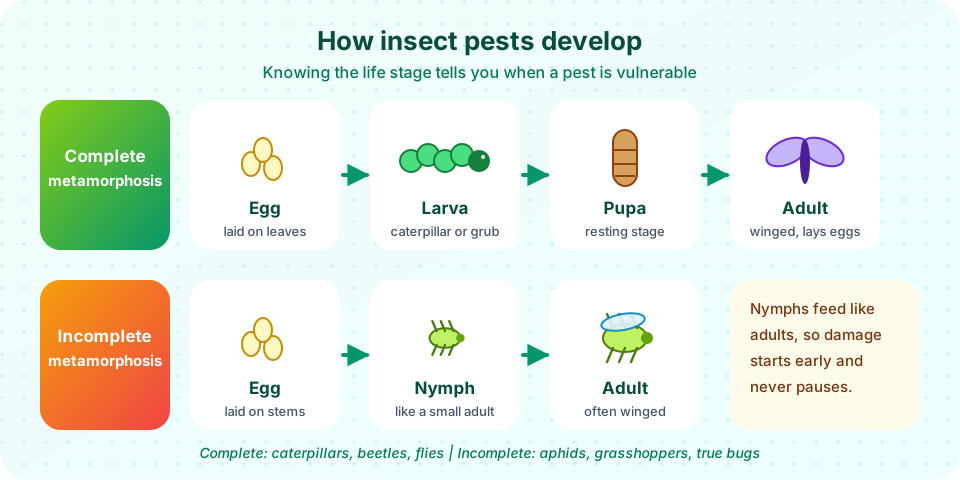
Feeding types decide the damage.
- Chewing mouthparts (caterpillars, beetles, locusts, grasshoppers) remove leaf, root or grain tissue and leave holes or ragged edges.
- Piercing-sucking mouthparts (aphids, whiteflies, leafhoppers, stink bugs) drink sap. Heavy feeding stunts plants, and many of these insects also transmit viruses. Aphids and whiteflies excrete sticky honeydew on which black sooty mold grows.
- Boring larvae (stem borers, pod borers, fruit flies) feed inside stems, fruits and seeds, where sprays hardly reach them.
- Rasping insects (thrips) scrape surfaces and suck up the fluid, leaving silvery scars.
Life cycles decide timing. In complete metamorphosis (butterflies and moths, beetles, flies, bees) the stages are egg, larva, pupa and adult. The larva (caterpillar, grub, maggot) usually does the feeding, and the adult may be harmless or damaging in a different way. In incomplete metamorphosis (aphids, grasshoppers, true bugs) the stages are egg, nymph and adult, and nymphs resemble small wingless adults and feed in the same way.
Many pests have several generations per season. The number depends on temperature, so it is predicted with degree-days, just like crop development. A pest needing 300 degree-days (above its base temperature) from egg to adult completes a generation in about 30 days if the mean temperature is 10 °C above base, and in about 20 days if it is 15 °C above base.
Why aphids spread so fast. Many aphids reproduce without mating for most of the season, and females give birth to live young that are already pregnant. Numbers can double every few days in warm weather, so a few aphids on a field edge can become a problem within weeks.
Beneficial insects. Ladybird beetles and their larvae, lacewings, hoverfly larvae and ground beetles eat pests. Parasitoid wasps lay eggs in or on pest insects, and the wasp larvae kill their hosts. Bees and other pollinators are essential for many fruit, oilseed and vegetable crops. Sprays that kill pests also kill these allies.
How plant disease develops
Plant pathogens fall into several groups:
| Group | How it lives | Examples |
|---|---|---|
| Fungi | Threads (hyphae) and spores; spread by wind, water and seed | Wheat rusts, powdery mildews, smuts, rice blast, grey mold |
| Oomycetes (water molds) | Fungus-like, thrive in wet conditions | Potato late blight, downy mildews, damping-off |
| Bacteria | Single cells entering through wounds and pores; spread by water splash, insects and tools | Leaf spots, bacterial blights, soft rot, fire blight |
| Viruses | Genetic material inside a protein coat; need living cells and usually a vector | Tobacco mosaic virus, cassava mosaic, potato viruses |
| Nematodes | Microscopic worms feeding on roots | Root-knot and cyst nematodes |
A disease cycle runs through survival of the pathogen between seasons (in soil, crop residue, seed or weeds), dispersal (wind, rain splash, insects, people), infection (often needing leaf wetness for hours), colonization of the plant, symptom development and reproduction, with new spores starting the next round. The cycle can repeat many times in a season, so a small early infection can become an epidemic. Breaking any step controls the disease: clean seed, residue management, resistant varieties, drainage, wider spacing and, where necessary, a well-timed fungicide.
Symptoms and signs
Symptoms are what the plant shows: leaf spots, yellowing, wilting, stunting, mosaics, galls, rotting roots and stems. Signs are the pathogen itself: rust-colored pustules, white mildew powder, sooty mold, bacterial ooze, insects or eggs. Signs make diagnosis much easier. Symptoms alone can mislead, since nutrient deficiency, herbicide injury, frost, drought and salt can all mimic disease. When in doubt, send a sample to a plant clinic. Laboratories use microscopy, culturing, and molecular tests such as PCR and ELISA to confirm the cause. Pathologists use Koch's postulates (isolate the organism, reproduce the disease in healthy plants, re-isolate the organism) to prove which organism causes which disease.
Scouting
Scouting turns a vague worry into numbers.
- Walk the field regularly, weekly in the growing season, more often when pressure is high or the crop is at a vulnerable stage.
- Sample in a systematic pattern, such as a W or zigzag across the field, avoiding only the edges, and inspect several plants at each station (for example five plants at ten stations).
- Use the right tool: a hand lens, a sweep net for insects in foliage, a beating tray, sticky traps, pheromone traps that attract male moths, and soil samples for nematodes.
- Count and record what you find: pest numbers per plant or per sweep, or the percentage of plants or leaf area with symptoms, plus the growth stage and weather.
- Compare with a threshold (see the next lesson) to decide whether to act.
Keep records from year to year. The pattern of where problems appear (field edges, wet hollows, a single variety) is a clue to the cause.
Common misconceptions
"All insects are pests." The great majority are harmless or beneficial. Killing everything with broad-spectrum sprays can release pests by removing their enemies.
"If a plant is wilting, it needs water." Wilting can also come from root rot, vascular wilt diseases, nematodes or stem borers, and more water can make some of these worse.
"Fungicides cure disease." Most protect healthy tissue and work best before or very early in infection. They rarely repair damage already done.
Try it
Press Run (or Ctrl + Enter) to see the result here.
Program input · what you'd type while the program runs
Type the answers before you press Run, one per line. Each time the program reads a line (with input()), it gets the next line from this box.
Press Run (or Ctrl + Enter) to see the result here.
Program input · what you'd type while the program runs
Type the answers before you press Run, one per line. Each time the program reads a line (with input()), it gets the next line from this box.
Check your understanding
Quick check · 6 questions
of 6 answered You scored / 6 · perfect!
-
1. Which insect group has the life stages egg, larva, pupa and adult?
Beetles, moths, flies and bees undergo complete metamorphosis. -
2. Why are aphids especially important in virus diseases?
Piercing-sucking insects such as aphids and whiteflies transmit many plant viruses. -
3. A pest needs 360 degree-days for a generation. Mean temperature is 22 C and the base is 10 C. How many days?
DD per day = 22 - 10 = 12; 360 / 12 = 30 days. -
4. A white powder on leaves is a:
Visible pathogen structures are signs, and white powder is typical of powdery mildew. -
5. What is the best reason to scout in a W pattern?
A systematic pattern gives a more representative estimate. -
6. Which damage type is typical of boring larvae such as stem borers?
Borers feed inside plant tissue, which protects them from many sprays.
Summary
- Insects feed by chewing, sucking, boring or rasping, and their life cycle (complete or incomplete) shows when they are vulnerable.
- Pathogens include fungi, oomycetes, bacteria, viruses and nematodes; a disease cycle can repeat many times in a season.
- Symptoms are the plant's response and signs are the pathogen itself; confirm the cause before acting.
- Scout systematically, record counts and compare with a threshold.
- Pest numbers grow exponentially in warm weather, and natural enemies are powerful allies.
Track your progress
Create a free account to tick off lessons and pick up where you left off on any device.
of Agricultural Science lessons completed