


















Lesson 11 of 42 · Crop Science
Crops overview: growing plants for people
Meet the main crop groups, how crops are classified by life cycle, season and plant type, which crops dominate world production, and what chapter 3 covers.
A crop is a plant grown on purpose for food, feed, fibre, fuel or another use. Of the roughly 300,000 known plant species, only a few hundred have ever been widely farmed, and a few dozen supply most of the world's food. This chapter asks how those few plants make yield and how a farmer helps them do it.
You do not need to memorize hundreds of species. Learn a handful of groups, understand what makes them behave alike, and you can reason about nearly any crop you meet. This overview gives the classification and the map; later lessons cover photosynthesis and growth, seeds and planting, and rotations.
What you will learn
- The main crop groups and typical examples.
- How crops are classified by life cycle, season and plant type, and why that matters in the field.
- Which crops dominate world production, with approximate figures.
- Where the next four lessons fit.
Key terms
Annual: a plant that completes its life cycle, from seed to seed, in one growing season.
Biennial: a plant that takes two years, usually forming leaves or roots the first year and flowering the second.
Perennial: a plant that lives for many years.
Monocot and dicot: the two big groups of flowering plants. Grasses are monocots, and most broadleaf crops such as beans are dicots.
Cultivar (variety): a named, cultivated form of a crop selected for particular traits.
Grouping crops
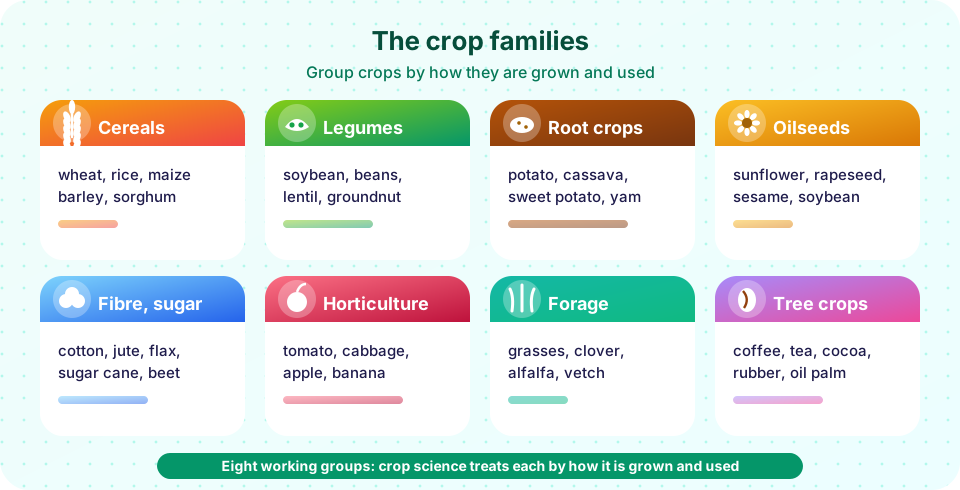
Farmers group crops mainly by use, because use decides how the crop is grown, harvested and sold:
- Cereals (grasses grown for grain): wheat, rice, maize, barley, oats, sorghum and millets. They supply a large share of the world's calories.
- Legumes or pulses: soybean, common bean, lentil, chickpea, pea, groundnut. High in protein, and most fix nitrogen with root-nodule bacteria.
- Roots and tubers: potato, cassava, sweet potato, yam, sugar beet. Starchy storage organs.
- Oilseeds: sunflower, rapeseed (canola), sesame, soybean, and tree crops such as oil palm and olive.
- Fibre and sugar crops: cotton, jute, flax, sugar cane and sugar beet.
- Horticultural crops: vegetables, fruits and ornamentals, grown intensively and often perishable.
- Forage and fodder: grasses, clover, alfalfa and silage maize, grown for animals.
- Tree and plantation crops: coffee, tea, cocoa, rubber and many fruits, producing for decades.
Other ways to classify
| Basis | Groups | Why it matters |
|---|---|---|
| Life cycle | Annual, biennial, perennial | Annuals are replanted each year; perennials need establishment care but protect the soil |
| Season | Warm-season (maize, rice, cotton), cool-season (wheat, barley, peas) | Sets sowing time and the temperatures the crop tolerates |
| Plant type | Monocot (grasses) and dicot (broadleaf) | Selective herbicides often target one group |
| Photosynthetic pathway | C3, C4, CAM | Controls response to heat, light and water (see the next lesson) |
| Growth habit | Determinate (flowers once, then ends) and indeterminate (keeps growing and flowering) | Affects harvest timing and plant spacing |
The big crops by tonnage
According to recent international statistics, the largest crops by harvested mass are sugar cane (well over a billion tonnes a year, mostly water-heavy stems), then maize, wheat and rice, each in the range of roughly 0.7 to 1.2 billion tonnes, followed by potato, soybean and vegetables. Maize now leads the cereals by output, partly because much of it feeds animals and industry as well as people. Figures change from year to year, so treat the numbers below as approximate and compare ratios rather than exact values.
How the chapter proceeds
| Lesson | Focus |
|---|---|
| Photosynthesis and crop growth | How plants make sugar, C3 versus C4, growth stages and thermal time |
| Seeds and planting | Germination needs, seed quality, seed rate and sowing depth |
| Crop rotation and intercropping | Sequences, legumes, mixtures and land equivalent ratio |
| Chapter 3 review | Recap and a longer quiz |
From seed to harvest
What the farmer controls
Three yield drivers
Common misconceptions
"A crop is a type of plant." A crop is a use, not a botanical group. Maize is a crop for grain, a different crop (silage) for cattle feed and a vegetable (sweet corn).
"Vegetables and fruits are separate in botany." Botanically a tomato, cucumber and pepper are fruits. In the kitchen and in horticulture they are vegetables.
"Cereals are the only staple foods." Roots and tubers such as cassava and potato are staples for hundreds of millions of people.
Try it
Press Run (or Ctrl + Enter) to see the result here.
Program input · what you'd type while the program runs
Type the answers before you press Run, one per line. Each time the program reads a line (with input()), it gets the next line from this box.
Check your understanding
Quick check · 5 questions
of 5 answered You scored / 5 · perfect!
-
1. Which group of crops is mostly grown for high-protein seeds and usually fixes nitrogen?
Legumes such as soybean and lentil host nitrogen-fixing bacteria in root nodules. -
2. A plant that completes its life cycle in one growing season is called:
Annuals go from seed to seed in one season, such as wheat, maize and soybean. -
3. Why does the monocot or dicot distinction matter to a farmer?
Grass-killing and broadleaf-killing herbicides exploit differences between monocots and dicots. -
4. Which crop is the largest by harvested tonnage worldwide?
Sugar cane stems are heavy and the crop is grown over huge areas, so it leads by mass. -
5. A tomato is botanically a fruit but grown as a vegetable. This shows that 'crop' groupings are mainly based on:
Crop categories reflect how plants are used and managed, not only botany.
Summary
- A crop is a plant grown for a use; most food comes from a few dozen species.
- Main groups are cereals, legumes, roots and tubers, oilseeds, fibre and sugar, horticulture, forage and tree crops.
- Life cycle, season, monocot or dicot and photosynthetic pathway guide management.
- Maize, wheat, rice and sugar cane dominate by tonnage, and the numbers change yearly.
Track your progress
Create a free account to tick off lessons and pick up where you left off on any device.
of Agricultural Science lessons completed