


















Lesson 27 of 42 · Water and Irrigation
Crop Water Requirements
Estimate how much water a crop needs with reference evapotranspiration and crop coefficients, then work out soil water storage, irrigation depth and timing.
How much water does a crop need, and when? Guessing leads to wasted water on one side and stressed plants on the other. The standard answer, used by irrigation agencies around the world, comes from a method published by the FAO in its Irrigation and Drainage Paper 56 (Allen and colleagues, 1998). It splits the question into two parts: how thirsty is the weather, and how thirsty is the crop at its current growth stage? Multiply the two and you have the crop's daily water use.
In this lesson you will use that method to estimate a season's water need, then convert it into the practical questions a farmer asks: how deep to irrigate and how many days apart.
What you will learn
- Explain reference evapotranspiration ET₀ and estimate it with the Hargreaves equation
- Use the crop coefficient Kc to compute ETc across the growth stages
- Calculate total and readily available soil water and the irrigation interval
- Turn a depth of water into volumes per hectare and per field
- Name the crop stages that are most sensitive to water stress
Key terms
ET₀ (reference evapotranspiration): the water use of a standard, well-watered, short grass surface under the day's weather, in mm/day.
Kc (crop coefficient): a number that scales ET₀ to a particular crop and growth stage.
ETc (crop evapotranspiration): ET₀ × Kc, the water use of a well-watered crop.
Field capacity (FC) and permanent wilting point (PWP): the soil moisture after free drainage, and the moisture below which plants cannot recover.
Readily available water (RAW): the part of the soil water that the crop can take up without stress.
The weather's thirst: ET₀
Evapotranspiration is driven by energy and by how much water the air can still absorb. Sunshine, warm air, dry air and wind all raise it. To compare places and seasons, scientists define reference evapotranspiration, ET₀, for a hypothetical reference grass: 12 cm tall, actively growing, fully shading the ground and never short of water. ET₀ depends only on weather, not on the crop or soil. It is typically 2 to 3 mm/day in cool seasons and 5 to 8 mm/day in hot, dry summers, higher in deserts.
The FAO-56 standard method is the Penman-Monteith equation, which needs radiation, temperature, humidity and wind speed. When only temperature is available, the simpler Hargreaves-Samani equation is often used:
ET₀ = 0.0023 × (T_mean + 17.8) × √(T_max − T_min) × R_a
where temperatures are in °C and R_a is the extraterrestrial radiation expressed as an equivalent depth of evaporation in mm/day. At around 40° latitude in midsummer, R_a is roughly 16 to 17 mm/day. For T_max = 32 °C, T_min = 18 °C (so T_mean = 25 °C) and R_a = 16.8:
ET₀ = 0.0023 × 42.8 × √14 × 16.8 ≈ 6.2 mm/day
The wider the day-to-night temperature range, the clearer and drier the air, which the equation uses as a stand-in for sunshine.
The crop's thirst: Kc and ETc
A real crop is not reference grass. A seedling that covers little ground uses less, a full canopy of maize uses more, and a senescing crop uses less again. The crop coefficient captures this:
ETc = Kc × ET₀
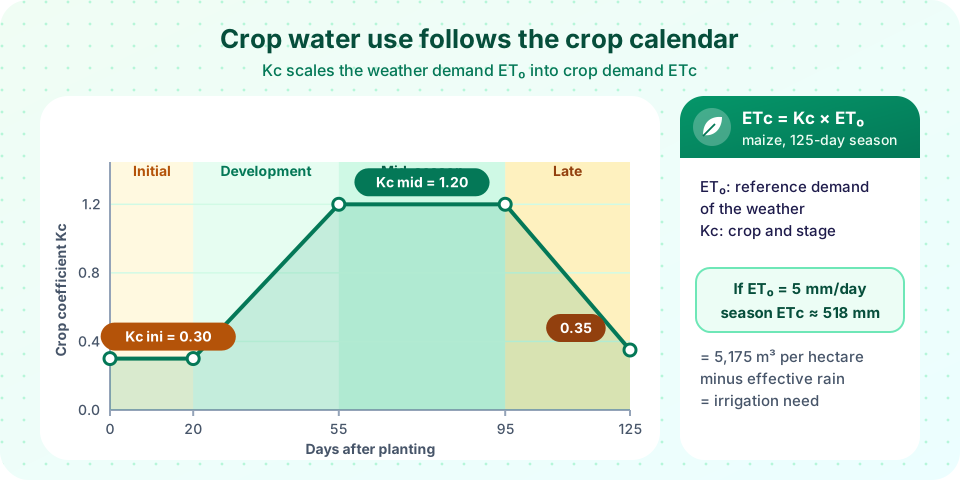
The FAO divides the season into four stages and gives a Kc for each:
| Stage | What is happening | Maize (grain) | Length |
|---|---|---|---|
| Initial | Germination and early growth, mostly bare soil | Kc ≈ 0.30 | 20 days |
| Development | Canopy grows to full cover | Kc rises from 0.30 to 1.20 | 35 days |
| Mid-season | Full cover, flowering and grain set | Kc ≈ 1.20 | 40 days |
| Late season | Ripening and drying | Kc falls to about 0.35 | 30 days |
The 125-day maize season gives the curve in the picture. With a constant ET₀ of 5 mm/day (a simplification; real ET₀ changes day by day) the stages add up to:
- Initial: 20 × 0.30 × 5 = 30 mm
- Development: 35 × (average Kc 0.75) × 5 = 131 mm
- Mid-season: 40 × 1.20 × 5 = 240 mm
- Late: 30 × (average Kc 0.775) × 5 = 116 mm
The total is about 518 mm, and since 1 mm over a hectare is 10 m³, that is about 5,175 m³ per hectare. Other crops differ: tomatoes have a Kc of around 0.6 at the start, 1.15 in mid-season and 0.8 at the end; shallow-rooted vegetables can need frequent small irrigations while deep-rooted crops like alfalfa tolerate longer intervals.
From crop use to irrigation need
Crops do not rely on irrigation alone. Rain that is stored in the root zone, called effective rainfall, counts toward ETc; the rest runs off or drains. A common field rule is to count about 70 to 80% of rainfall as effective, though better methods use daily soil water balances. The net irrigation requirement is then
NIR = ETc − effective rain − soil water used from storage
If the maize above gets 150 mm of rain in the season and 80% is effective, NIR = 518 − 120 = 398 mm, which is about 3,980 m³ per hectare. A farm irrigating 40 hectares of it needs roughly 159,000 m³ of net water, before accounting for the losses in the irrigation system itself. The next lesson shows how efficiency raises the gross amount.
Soil water: the bucket
The root zone stores water that the crop draws on between irrigations. Two soil moisture limits define the bucket:
- Field capacity (FC): the water held after excess drains away, usually about one to three days after soaking.
- Permanent wilting point (PWP): the moisture at which plants wilt and cannot recover.
The water between the two is the total available water:
TAW = (θ_FC − θ_PWP) × Z_r × 1000 (mm)
with θ the volumetric water content (m³ of water per m³ of soil) and Z_r the rooting depth in meters. For a loam with θ_FC = 0.30 and θ_PWP = 0.15, rooted to 1.0 m: TAW = 0.15 × 1.0 × 1000 = 150 mm. Sandy soils hold much less (roughly 70 to 100 mm per meter), clays and loams hold more, so sandy fields need smaller, more frequent irrigations.
Plants do not take water easily when the soil gets close to dry. The share of TAW that the crop can use without stress is the depletion fraction p; for maize FAO gives a value around 0.55 when ETc is moderate. Readily available water is
RAW = p × TAW = 0.55 × 150 ≈ 82 mm
On a hot day when ETc = 6 mm/day, a full bucket lasts about 82 / 6 ≈ 14 days before the crop starts to suffer. That is the maximum irrigation interval, and the net depth to apply each time is RAW, about 82 mm, to bring the soil back to field capacity. In practice farmers irrigate a little earlier and apply a little less, which leaves room for rain.
Critical stages
Not all days matter equally. Many crops are most sensitive at flowering and early grain or fruit set. Maize suffers major yield loss if it is short of water around silking, tomatoes and beans at flowering, wheat at heading and flowering. Deficit irrigation deliberately gives less than the full ETc at less sensitive stages to save water with small yield loss. It must be done carefully, with knowledge of the crop.
How do you know what the soil holds? Methods range from the feel method (squeezing soil in your hand), through gravimetric sampling (weigh, oven-dry, weigh again), to buried sensors: tensiometers that read soil suction, and capacitance or TDR probes that read water content continuously. Satellites and weather stations let advisory services publish ET₀ for every farm.
Common misconceptions
"Water the crop when the surface looks dry." The surface dries within hours while roots may still have plenty below. Judge by root-zone moisture, not the top centimeter.
"ET₀ is the crop's water use." It is the demand of the reference grass. A crop's use is ETc = Kc × ET₀ and changes through the season.
"All rain counts." A heavy storm may run off, and a light shower under 5 mm may wet only the surface and evaporate. Count effective rain only.
Try it
This program builds the maize Kc curve, converts it to daily ETc for an ET₀ of 5 mm/day and totals the season. It also solves the Hargreaves example. The inputs are the round numbers used above, so you can change them and see the effect.
Press Run (or Ctrl + Enter) to see the result here.
Program input · what you'd type while the program runs
Type the answers before you press Run, one per line. Each time the program reads a line (with input()), it gets the next line from this box.
This scheduler turns a soil, a rooting depth and the daily ETc into the irrigation interval and the volume to apply. The soil moisture values are illustrative round numbers.
Check your understanding
Quick check · 5 questions
of 5 answered You scored / 5 · perfect!
-
1. ET0 is 6 mm/day and Kc is 1.15. What is ETc?
ETc = Kc × ET0 = 1.15 × 6 = 6.9 mm/day. -
2. A soil has θFC = 0.28, θPWP = 0.12 and roots to 0.8 m. What is TAW?
TAW = (0.28 - 0.12) × 0.8 × 1000 = 128 mm. -
3. With TAW = 128 mm and p = 0.5, RAW is:
RAW = p × TAW = 0.5 × 128 = 64 mm. -
4. If RAW is 64 mm and ETc is 8 mm/day, what is the maximum irrigation interval?
64 / 8 = 8 days. -
5. Why does Kc start low in the initial stage?
Early on most water loss is evaporation from bare soil, so Kc is small.
Summary
- ET₀ is the weather's demand on a reference grass; the Hargreaves equation estimates it from temperature and R_a.
- ETc = Kc × ET₀; maize Kc goes 0.30, 1.20, 0.35 over a 125-day season, totalling about 518 mm at 5 mm/day.
- Net irrigation requirement = ETc − effective rain − stored soil water; 1 mm per hectare = 10 m³.
- TAW = (θ_FC − θ_PWP) × Z_r; RAW = p × TAW; the maximum interval is RAW / ETc.
- Protect critical stages such as flowering; use deficit irrigation only with care.
Track your progress
Create a free account to tick off lessons and pick up where you left off on any device.
of Agricultural Science lessons completed