


















Lesson 13 of 42 · Crop Science
Seeds and planting
Learn seed anatomy, what germination needs, how to test seed quality, how to calculate a seed rate from thousand-seed weight and germination, and how depth and date affect emergence.
A seed is a small package that contains a new plant, a food store to start it growing and a tough coat to wait for the right moment. Everything a farmer does before the crop emerges is meant to help that package do its work: buy good seed, prepare the seedbed, plant at the right depth and date, and avoid conditions that let the seedlings rot or starve.
Get this stage right and the rest of the season is much easier. A crop with a patchy or late start never fully recovers, because early differences in plant number, size and timing carry through to harvest. This lesson covers what a seed contains, what it needs to germinate, how to judge seed quality, and how to turn a target plant population into a seed rate in kilograms per hectare.
What you will learn
- The parts of a seed and the order of events in germination.
- Why dormancy exists and how it is broken.
- How to read seed quality measures: purity, germination percentage, vigor and thousand-seed weight.
- How to calculate seed rate and choose sowing depth, spacing and date.
Key terms
Germination: the start of growth of an embryo, finished when the radicle (first root) breaks through the seed coat.
Dormancy: a state in which a viable seed will not germinate even if conditions seem right.
Vigor: how fast and uniformly a seed lot grows into healthy seedlings in less-than-perfect conditions.
Thousand-seed weight (TSW): the mass of 1,000 seeds, in grams.
Seed rate: the mass of seed sown per hectare.
Inside a seed
A seed has three main parts. The embryo is the baby plant with a tiny root (radicle), a tiny shoot (plumule) and one or two seed leaves (cotyledons). The food reserve is starch, protein or oil, stored in the endosperm (wheat, maize, rice, where the single cotyledon is small) or inside the cotyledons themselves (beans, peas, sunflower, where there are two). The seed coat protects the contents from drying, mechanical damage and microbes.
In wheat, the grain you eat is mostly endosperm, so milling it separates the bran (coat) and the germ (embryo) from the starchy flour. In soybean, the cotyledons contain the protein and oil that make it valuable.
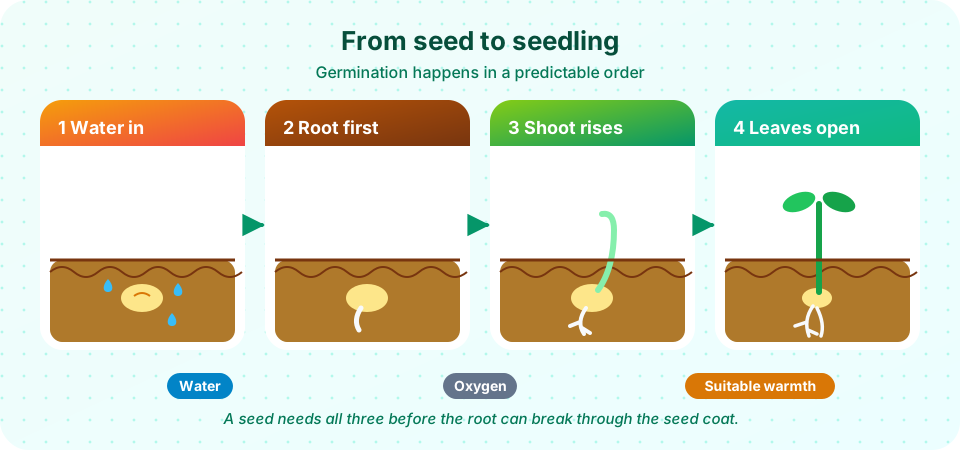
Germination step by step
- Imbibition. The dry seed takes up water and swells. Water softens the coat and activates enzymes.
- Enzyme activation. Hormones such as gibberellins signal the stored starch, protein and fat to be broken into sugars, amino acids and fatty acids.
- Radicle emergence. The embryo's root breaks through the coat and grows down, anchoring the seedling and absorbing water.
- Shoot emergence. The shoot grows toward the light. In dicots like beans a hook protects the tip as it pushes through soil. In grasses a sheath (coleoptile) does the same job.
- First leaves. Once green leaves open and photosynthesis begins, the seedling no longer depends on the seed's reserves.
Germination needs three things at the same time: water, oxygen (the seed respires and needs air in the soil pores) and a suitable temperature. Each crop has a minimum, an optimum and a maximum temperature for germination, which is why sowing dates differ. A few species also need light (some small-seeded weeds and lettuce) or darkness.
Dormancy
Dormancy prevents seeds from germinating at the wrong time, such as in a brief warm spell in autumn. It is a survival feature of wild plants and a nuisance in crops and weeds. Common causes are a hard seed coat that blocks water, chemical inhibitors and a need for cold or light. Cultivated crops have mostly been bred to reduce dormancy so that they germinate quickly and evenly, but some seed lots still need treatment. Scarification (nicking or abrading a hard coat) and stratification (a cold, moist period) are used to break dormancy. Weeds, on the other hand, may keep buried seeds dormant for years, which makes them hard to eliminate (Chapter 4).
Seed quality
Buy or save seed with these checks in mind:
- Purity: the share of the sample that is the target crop, free of weed seeds, other crops, stones and chaff.
- Germination percentage: the share of seeds that make normal seedlings in a standard test. Seed laws set minimums, often around 80 to 90 % depending on crop.
- Vigor: how well the seeds perform in cold, wet or crusted soil.
- Moisture content: low (for cereals about 12 to 14 %) for safe storage.
- Health: freedom from seed-borne diseases. Fungicide seed treatments protect seedlings.
- Genetic identity: certified seed is traceable to a named variety and produced under inspected conditions.
A simple germination test: count out 100 seeds (4 replicates of 50 or 25 are better), place them between moist paper towels, roll and keep them warm for 7 to 10 days, then count normal seedlings. If 87 are normal, the germination is 87 %.
Hybrids versus saved seed. Hybrid seed (common in maize and many vegetables) comes from a cross of two inbred parents and gives uniform, high-yielding plants, but seed saved from the hybrid crop segregates and loses that uniformity, so farmers buy fresh seed each season. Open-pollinated varieties and self-pollinating crops such as wheat and rice can be saved and replanted with little loss, though seed quality (purity, disease) must be watched.
Calculating seed rate
You decide the target plants per hectare, then correct for seeds that will not germinate or will not emerge.
seeds per ha = target plants per ha / (germination × field emergence)
seed rate (kg/ha) = seeds per ha × TSW (g) / 1,000,000
Germination and emergence are entered as fractions. Field emergence (often 80 to 90 % of germinating seeds) accounts for crusting, depth, disease and pests.
Worked example for wheat: target 4,000,000 plants/ha (400 plants/m²), germination 0.95, field emergence 0.85, TSW 45 g.
seeds per ha = 4,000,000 / (0.95 × 0.85) = 4,953,560
seed rate = 4,953,560 × 45 / 1,000,000 = 222.9 kg/ha
The same plant population with a heavier-seeded variety (TSW 55 g) needs 272 kg/ha. This is why seed rate should be expressed in plants or seeds per square meter and converted to kilograms only at the end. The 20 % difference matters in a large field.
Depth, spacing and date
- Depth. A common rule is to plant seeds at about two to four times their diameter, shallower in heavy or crusting soils and deeper in dry, sandy soils where moisture is lower. Too shallow, and the seed dries or birds find it. Too deep, and the seedling exhausts its reserves before reaching the surface, especially for small-seeded crops.
- Spacing and population. Per-plant yield falls as plants crowd one another, but yield per hectare rises and then levels off. There is an optimum that depends on the crop, soil fertility and water, and above it extra seed is wasted. Row spacing affects light capture, weed control and machinery use.
- Date. Sow when the soil is warm enough for fast emergence and when the crop's critical stages avoid heat, drought and frost. Warm-season crops such as maize wait until the soil is about 10 °C or warmer, while cool-season crops like wheat and peas can go in earlier.
- Seedbed. A fine, firm seedbed gives good seed-to-soil contact and even moisture. No-till seeders do the same job without cultivation, which Chapter 7 discusses.
Common misconceptions
"A higher seed rate always gives a higher yield." Past the optimum, extra seed costs money, increases competition and disease, and may reduce the yield per plant more than it adds plants.
"Seed that looks good will germinate." Healthy-looking seed can be dead or weak. Only a germination test reveals it.
"Germination and emergence are the same." Germination is the start of growth. Emergence is the seedling breaking the soil surface. Many seeds germinate but never emerge.
Try it
Press Run (or Ctrl + Enter) to see the result here.
Program input · what you'd type while the program runs
Type the answers before you press Run, one per line. Each time the program reads a line (with input()), it gets the next line from this box.
Check your understanding
Quick check · 6 questions
of 6 answered You scored / 6 · perfect!
-
1. Which three things must be present together for most seeds to germinate?
Imbibition, respiration and enzyme activity need water, oxygen and a suitable temperature. -
2. Which part of a seed is the baby plant?
The embryo has the radicle, plumule and cotyledon(s). The endosperm is the food store and the coat is protection. -
3. Target 300,000 plants per ha, germination 0.9, emergence 0.8 (TSW 40 g). What is the seed rate?
Seeds per ha = 300,000 / 0.72 = 416,667; x 40 g / 1,000,000 = 16.7 kg/ha. -
4. In a germination test, 41 of 50 seeds make normal seedlings. What is the germination percentage?
41 / 50 = 0.82, or 82 %. -
5. Why does the same plant population need more seed (kg/ha) if the variety has a larger seed?
Seed rate in kg equals seed number times weight per seed. -
6. Which is the best description of dormancy?
Dormant seeds are alive but blocked from germinating by coat, chemicals or a cold or light requirement.
Summary
- A seed holds an embryo, a food reserve and a protective coat.
- Germination needs water, oxygen and a suitable temperature; it ends when the root emerges.
- Check seed purity, germination, vigor, moisture and health, and test germination yourself.
- Seed rate (kg/ha) = target plants / (germination x emergence) x TSW / 1,000,000.
- Depth, spacing and sowing date control emergence and later yield; more seed beyond the optimum wastes money.
Track your progress
Create a free account to tick off lessons and pick up where you left off on any device.
of Agricultural Science lessons completed