


















Lesson 14 of 42 · Crop Science
Crop rotation and intercropping
Learn why rotating crops breaks pest cycles and builds fertility, how legumes fix nitrogen, which sequences work, and how to judge an intercrop with the land equivalent ratio.
Growing the same crop on the same field year after year is the easiest system to manage and the riskiest to sustain. Pests and diseases that live on that crop build up. Weeds that suit it flourish. The same nutrients are taken from the same layer of soil every season. Farmers have known this for thousands of years, and most traditional farming systems rotate crops or mix them in space.
Rotation (different crops in different seasons) and intercropping (different crops at the same time) are two ways to use diversity as a management tool. This lesson explains what each does, how to design a sequence with simple rules, and how to measure whether a mixture really beats growing crops separately.
What you will learn
- The agronomic and economic benefits of rotation, and the rules of thumb for good sequences.
- How legumes add nitrogen and how to account for it.
- The main types of intercropping and the traditional "three sisters" system.
- How to calculate the land equivalent ratio (LER) and interpret it.
Key terms
Crop rotation: growing different crops in a planned order on the same field.
Monoculture: growing the same crop on the same land year after year.
Break crop: a crop that interrupts the cycle of a pest or disease of the main crop.
Intercropping: growing two or more crops at the same time on the same field.
Land equivalent ratio (LER): the area of sole crops needed to match the yield of one hectare of intercrop.
Why rotate
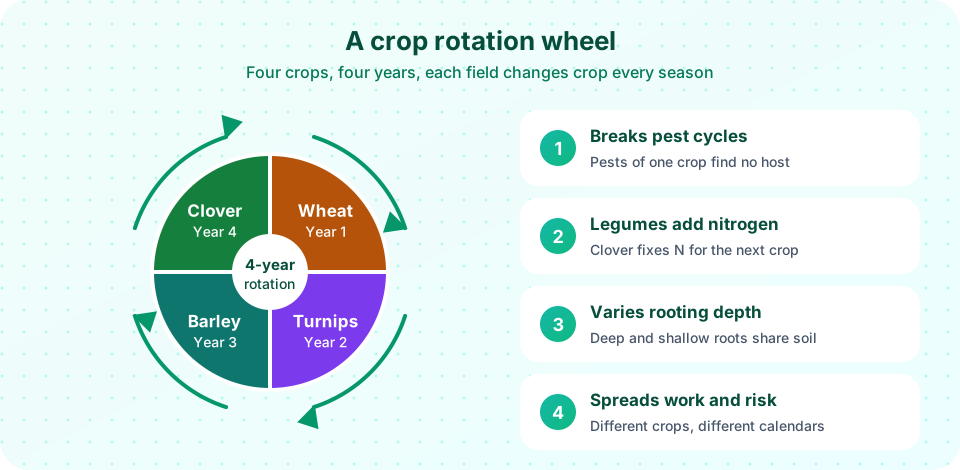
- Pest and disease control. Many pathogens and pests survive in the soil or in crop residues from one season to the next. If the field is planted with a non-host crop, populations fall because they have nothing to feed on. This is why "take-all", a root disease of wheat, is much lower after a break crop such as oilseed rape or peas than after wheat, and why clubroot of cabbage family crops needs a long gap between brassica crops.
- Weed control. Different crops allow different weed control tools and different sowing dates, so weeds that thrive in one crop are disrupted in the next. A dense forage crop or a cover crop can smother weeds.
- Fertility. Legumes add nitrogen. Deep-rooted crops bring up nutrients from below the plough layer. Crops that leave abundant residues add organic matter.
- Soil structure. Crops with different root systems, such as fibrous grass roots and deep taproots, create different pore networks.
- Risk and workload. Different crops have different sowing and harvest times, spreading work and reducing exposure to a single bad price or weather event.
Rotation has costs. Some crops earn less than the main money crop. Farmers need knowledge, equipment and markets for several crops. When one crop is much more profitable than the others, short rotations or monoculture are tempting and the pest and soil costs show up later.
How legumes add nitrogen
Legumes (peas, beans, soybean, lentil, clover, alfalfa) form root nodules with Rhizobium and related bacteria. The bacteria convert atmospheric N₂ into ammonia that the plant can use, and in return they receive sugars from the plant. Some of the nitrogen is removed in the harvested seed, and the rest stays in roots, nodules and residues and becomes available to the next crop as it decomposes.
The size of the benefit varies widely with species, yield, soil nitrogen and management. As a rough guide, grain legumes leave a modest net credit (often tens of kilograms of N per hectare) for the following crop, while well-grown forage legume leys, ploughed in, can leave much more. In soils where the right bacteria are absent, seed can be treated with an inoculant of the right strain. Plenty of soil nitrate suppresses nodulation, so heavy nitrogen fertilizer on a legume is wasted.
Designing a rotation: rules of thumb
- Alternate cereals (grasses) with broadleaf crops, because their pests and diseases are different.
- Do not follow a crop with a close relative: potato after tomato (both nightshades) shares diseases, and one brassica after another shares clubroot.
- Put legumes before hungry crops (maize, wheat) to supply nitrogen.
- Alternate deep-rooted and shallow-rooted crops.
- Follow crops that leave heavy residue with crops that tolerate residue, or manage it carefully.
- Include a crop or a cover that suppresses weeds or that lets you control a problem weed with a different herbicide or tillage.
- Check the economics of the whole sequence, not each crop alone.
Classic examples include the Norfolk four-course (wheat, turnips, barley, clover) of 18th-century England, the maize and soybean rotation widely used in the Americas, rice followed by wheat in the Indo-Gangetic plain, and cereal, oilseed and pulse rotations in the dry-land farming of Australia and Canada. Ley farming puts several years of grass and clover in a rotation with arable crops, linking crops and livestock.
Intercropping
Intercropping grows two or more crops together, in four common ways:
- Mixed intercropping: seeds mixed together and broadcast.
- Row intercropping: different crops in alternate rows.
- Strip intercropping: bands several rows wide, which suit machinery.
- Relay intercropping: a second crop is sown into the first before its harvest.
The best-known example is the "three sisters" of Indigenous farmers in the Americas: maize gives the beans a trellis to climb, beans add nitrogen, and squash spreads along the ground shading weeds and holding moisture. Today, maize with beans or groundnut in Africa, cereal with legume mixtures in Europe, and tree-and-crop combinations (agroforestry) are widely researched and used.
Why intercropping can work: crops use light, water and nutrients at different times and depths (complementarity); a legume gives nitrogen to its neighbor (facilitation); diversity makes it harder for pests to find and spread among hosts. Why it is not always chosen: machinery is built for single crops, harvest times can clash, and one crop can suppress the other.
Land equivalent ratio
To judge a mixture, compare it with the same crops grown separately:
LER = Σ (yield of crop i in the mixture / yield of crop i as a sole crop)
Example: maize yields 4.0 t/ha alone and 3.2 t/ha in a mixture with beans. Beans yield 1.5 t/ha alone and 0.6 t/ha in the mixture.
partial LER (maize) = 3.2 / 4.0 = 0.80
partial LER (beans) = 0.6 / 1.5 = 0.40
LER = 0.80 + 0.40 = 1.20
An LER of 1.20 means separate sole crops would need 20 % more land to give the same total. An LER of 1.0 is a draw, and below 1.0 the mixture is worse. LER compares yields in physical units, so also check the economics: maize and beans have different prices and workloads.
Common misconceptions
"Rotation just means resting the field." Rotation changes crops in a plan. A bare fallow can leave soil exposed to erosion and lose nitrate.
"A legume gives away all its nitrogen." Much of the nitrogen it fixes leaves in the seed. The residue credit is usually modest for grain legumes.
"Intercropping is always better than sole cropping." It is better when LER exceeds 1 and the extra labor and complexity pay off, which depends on species, spacing and conditions.
Try it
Press Run (or Ctrl + Enter) to see the result here.
Program input · what you'd type while the program runs
Type the answers before you press Run, one per line. Each time the program reads a line (with input()), it gets the next line from this box.
Press Run (or Ctrl + Enter) to see the result here.
Program input · what you'd type while the program runs
Type the answers before you press Run, one per line. Each time the program reads a line (with input()), it gets the next line from this box.
Check your understanding
Quick check · 5 questions
of 5 answered You scored / 5 · perfect!
-
1. Which crop is a good break crop after several years of wheat?
A non-grass crop does not host the cereal root diseases, so inoculum falls. -
2. Why put a legume before maize in a rotation?
Legumes fix atmospheric N2, and part of that nitrogen remains for the next crop. -
3. Maize yields 5.0 t/ha alone and 4.0 in a mixture; beans 2.0 alone and 0.8 in the mixture. What is the LER?
4.0/5.0 + 0.8/2.0 = 0.8 + 0.4 = 1.2. -
4. Which pairing is a poor back-to-back sequence because of shared diseases?
Potato and tomato are both nightshades and share blight and other diseases. -
5. The 'three sisters' mixture combines:
Indigenous farmers in the Americas grew maize, beans and squash together.
Summary
- Rotation breaks pest, disease and weed cycles, spreads risk and can improve fertility and structure.
- Legumes fix nitrogen, but much leaves with the seed, so the credit for grain legumes is modest.
- Good rotations alternate cereals and broadleaf crops, avoid close relatives and include a legume.
- Intercropping uses resources in space and time; judge it with LER = sum of partial yields over sole yields.
- LER above 1 means land savings, but check economics and workload as well.
Next: Chapter 3 review
Track your progress
Create a free account to tick off lessons and pick up where you left off on any device.
of Agricultural Science lessons completed