


















Lesson 21 of 42 · Animal Production
Animal Production: The Big Picture
Meet the main farm animals, how their digestion differs, why feed efficiency matters and how livestock systems range from grazing to intensive housing.
Farm animals turn plants that people cannot eat (grass, crop residues, by-products) and plants that people can eat (grain, soybeans) into milk, meat, eggs, wool, leather, manure and power. Livestock supply a large share of the world's protein and a smaller share of its food energy, and they are the main income for hundreds of millions of rural households. They also use a great deal of land, water and feed, and they release greenhouse gases. Good animal production is therefore a balancing act: make animals healthy, productive and comfortable, and do it with as few inputs and as little damage to the environment as possible.
This chapter takes you through that balancing act in four steps: what animals eat, how they are bred, how they are kept healthy and treated well, and how the pieces fit into a whole production system.
What you will learn
- Name the main livestock groups and explain why digestion splits them into ruminants and monogastrics
- Describe the three broad production systems and the trade-offs between them
- Explain feed conversion ratio and compare typical values across species
- Preview the four lessons of this chapter and how they connect
Key terms
Livestock: domesticated animals kept for food, fiber, work or other products.
Ruminant: an animal with a four-part stomach that ferments fibrous plants (cattle, sheep, goats, buffalo).
Monogastric: an animal with a single-compartment stomach (pigs, chickens, humans).
Feed conversion ratio (FCR): kilograms of feed eaten per kilogram of weight gained. Lower is more efficient.
Husbandry: the day-to-day care and management of farm animals.
Who is on the farm?
Livestock fall into a few groups, and the groups matter because they decide what an animal can eat.
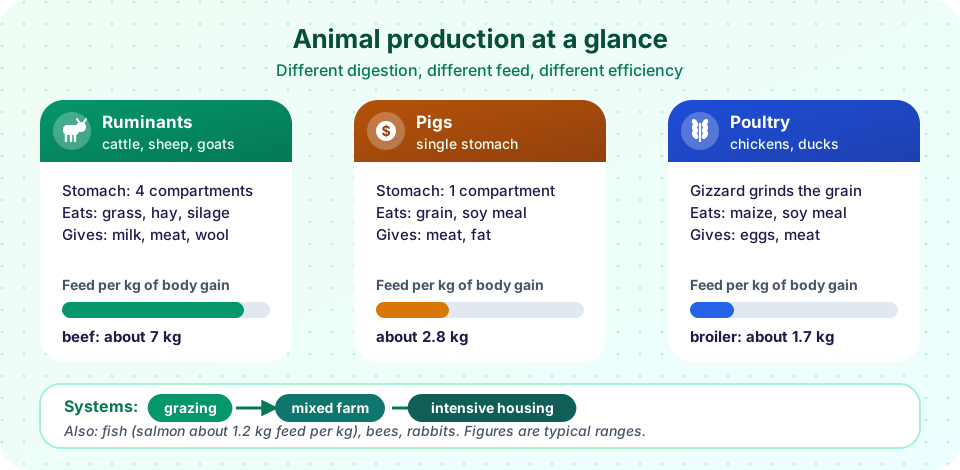
Ruminants are cattle, buffalo, sheep and goats (and camels and deer, which have a related system). Their rumen is a fermentation tank of billions of microbes that break down cellulose, so a ruminant can live on grass, hay and silage that a pig or a person could not digest. Ruminants take years to reach full production, give birth to one or two young at a time and produce milk, meat and fiber.
Pigs and poultry are monogastric. They need concentrated feed, mostly cereals and protein meals such as soybean meal. They grow fast and reproduce quickly: a sow has two litters a year with 10 or more piglets each, and a broiler chicken reaches market weight in roughly five to six weeks in modern systems. That speed is why chicken and pork are the cheapest meats in many countries.
Aquaculture (fish and shellfish) is the fastest-growing food-production sector. Fish are cold-blooded and float, so they spend very little energy on keeping warm or holding up their weight, which is why a farmed salmon can need as little as 1.2 kg of feed per kg of growth.
Other animals matter regionally: horses, donkeys and oxen for draft power, rabbits, ducks, bees for honey and pollination, and silkworms.
Three ways to keep animals
Three production systems
Most farms sit somewhere between these
Extensive grazing
Mixed farming
Intensive housing
Efficient, but welfare and waste need care
In extensive systems animals live mostly on natural pasture, with little added feed or housing. Nomadic herders in the Sahel, cattle ranchers in Australia and sheep farmers in the Andes all work this way. Output per animal is modest, but so is the cost, and the animals use land that is too dry, steep or cold to crop.
In mixed (integrated) systems the same farm grows crops and keeps animals. Crop residues feed the animals, manure returns nutrients and organic matter to the soil, and animals add a second source of income that is not tied to the same weather risk as the crops. Most smallholder farms in Asia and Africa are mixed.
In intensive (industrial) systems animals are housed, fed rations that are balanced to the gram, and bred for maximum output. This produces far more meat, milk and eggs per hectare and per kilogram of feed, but it concentrates manure, raises questions about welfare, and relies on strict biosecurity and veterinary control.
Why feed efficiency matters
Feed is the largest cost in almost every livestock enterprise, often well over half of the total. It is also where most of the environmental footprint begins, because growing feed takes land, water and fertilizer. Producers therefore track the feed conversion ratio:
FCR = feed eaten (kg) / body weight gained (kg)
Typical values, which vary with the breed, diet and system, are roughly 1.7 for broiler chickens, 2.5 to 3 for growing pigs, about 6 to 8 kg of dry feed per kg of gain for beef cattle in a feedlot, and 1.1 to 1.3 for farmed salmon. Cattle look inefficient, but remember what they eat: much of that feed is grass and by-products with no other use, and cattle also produce milk, which is a far better conversion than meat alone.
Common misconceptions
"Ruminants and pigs eat the same things, just in different amounts." No. A ruminant's microbes can turn cellulose into energy and protein, which a pig cannot do. That is why cattle can use grassland and pigs compete more directly with people for grain.
"A low FCR means the best system." Not by itself. FCR ignores what the feed is made of, the land it needs and the welfare of the animal. Comparing feed that people could eat with feed they cannot is part of a fair judgment.
Try it
The first demo draws the typical FCR values as a bar chart. The values are typical figures for illustration, not measurements from one farm.
Press Run (or Ctrl + Enter) to see the result here.
Program input · what you'd type while the program runs
Type the answers before you press Run, one per line. Each time the program reads a line (with input()), it gets the next line from this box.
The second demo is a small calculator. Pick a species, enter a target gain and the price of feed, and see how much feed and money the gain needs.
What is in this chapter
| Lesson | What it covers |
|---|---|
| Nutrition and rations | Nutrients, the rumen, energy and protein, balancing a ration |
| Breeding and reproduction | Heritability, selection, crossbreeding, artificial insemination, reproductive cycles |
| Health and welfare | Biosecurity, vaccination, parasites, the Five Freedoms, herd disease spread |
| Chapter review | One-page picture, recap table and a ten-question quiz |
Check your understanding
Quick check · 4 questions
of 4 answered You scored / 4 · perfect!
-
1. Why can a cow live on grass while a pig cannot?
Rumen microbes break down cellulose into volatile fatty acids the cow can absorb. A pig's single stomach has no such fermentation chamber. -
2. Which system keeps animals in buildings and feeds balanced rations?
Intensive systems house animals and feed them measured rations. Extensive systems rely on grazing. -
3. A broiler gains 2.0 kg while eating 3.4 kg of feed. What is its FCR?
FCR = feed / gain = 3.4 / 2.0 = 1.7 kg of feed per kg of gain. -
4. What is a main advantage of a mixed crop and livestock farm?
Mixed farms cycle nutrients between crops and animals and spread income risk, although they remain exposed to weather.
Summary
- Livestock turn feed into food and other products; ruminants digest fiber, monogastrics need concentrated feed.
- Production systems run from extensive grazing through mixed farms to intensive housing, each with trade-offs.
- Feed conversion ratio (kg feed per kg gain) is a basic efficiency measure; typical values are about 1.2 (salmon), 1.7 (broiler), 2.8 (pig) and 7 (feedlot beef).
- Feed dominates both cost and environmental footprint, so nutrition is the first topic.
Track your progress
Create a free account to tick off lessons and pick up where you left off on any device.
of Agricultural Science lessons completed