


















Lesson 20 of 42 · Plant Protection
Chapter 4 review: plant protection
Review chapter 4 of agricultural science: the disease triangle, weeds and the critical period, insect and pathogen biology, scouting, IPM thresholds and safe pesticide use, with a ten-question quiz.
You have now covered the first half of the course: the field, the soil, the crop and the things that attack it. This chapter on plant protection showed that the aim is not to destroy every pest but to keep damage below an economic level using the least risky tools. This review gathers the key ideas in one picture, a recap table, practice calculations and a ten-question quiz.
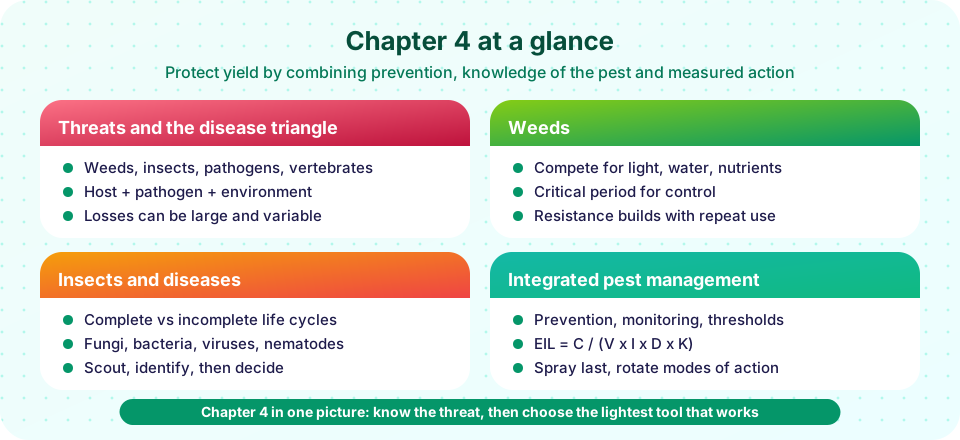
What you will learn
- A quick recall of each lesson's key ideas and formulas.
- How prevention, scouting, thresholds and control fit together.
- Practice with the chapter's calculations.
The chapter in one table
| Lesson | Key ideas | Formulas and numbers |
|---|---|---|
| Plant protection overview | Five groups of threats; disease triangle; six families of control | Loss % = (potential - actual) / potential x 100 |
| Weeds and weed control | Competition; critical period; seed bank; herbicide modes of action and resistance | Yield loss = I x d / (1 + I x d / A) |
| Insect pests and plant diseases | Feeding types; complete and incomplete metamorphosis; pathogen groups; symptoms and signs; scouting | Degree-days per generation = DD needed / (Tmean - Tbase) days |
| Integrated pest management | Pyramid; economic threshold; biological control; label and safety; resistance management | EIL = C / (V x I x D x K) |
How the pieces fit
Protection starts before the pest arrives. Prevention (resistant varieties, rotations from Chapter 3, clean seed, weed control and good drainage) removes or weakens a corner of the disease triangle. Knowledge then turns worry into action: you identify the weed, insect or pathogen correctly, know its life cycle and know when it is vulnerable. Measurement supplies the numbers: scouting counts compared with an economic threshold. Tools are chosen from the bottom of the IPM pyramid upward, ending with a targeted pesticide when needed. Finally, evaluation and resistance management protect the tools for next season.
Notice how many ideas come from earlier chapters. Rotations and sowing dates (Chapter 3) are protection tools. Sprayer calibration and sampling (Chapter 1) make every spray accurate. Nitrogen and soil health (Chapter 2) change how susceptible a crop is. The chapters are parts of one system, just as the farm is.
Practice problems
- A crop would have yielded 9.0 t/ha but made 7.2 t/ha. Percentage loss? ((9.0 - 7.2) / 9.0 = 20 %.)
- With I = 3 % per plant and A = 50 %, what yield loss does 10 weeds per m² cause? (3 x 10 / (1 + 30/50) = 30 / 1.6 = 18.75 %.)
- A moth needs 400 degree-days per generation with a base of 8 °C. If the mean temperature is 23 °C, how many days per generation? (23 - 8 = 15 DD/day; 400 / 15 = 26.7 days.)
- Control costs 18 per ha, the crop is worth 300 per tonne, each pest per plant costs 0.01 t/ha and the control is 85 % effective. EIL? (18 / (300 x 0.01 x 0.85) = 18 / 2.55 = 7.1 pests per plant.)
Try it
Press Run (or Ctrl + Enter) to see the result here.
Program input · what you'd type while the program runs
Type the answers before you press Run, one per line. Each time the program reads a line (with input()), it gets the next line from this box.
Check your understanding
Quick check · 10 questions
of 10 answered You scored / 10 · perfect!
-
1. Removing which of the following stops a disease according to the disease triangle?
All three must be present, so removing any one prevents or slows disease. -
2. A crop yields 6.4 t/ha but would have made 8.0 t/ha without a disease. What is the loss?
(8.0 - 6.4) / 8.0 = 0.2, so 20 %. -
3. Which weeds typically cost the most yield?
Early weeds have a head start in competing for light, water and nutrients. -
4. Which is an example of incomplete metamorphosis?
Aphids hatch as nymphs that look like small adults. -
5. Rust-colored pustules on wheat leaves are best described as:
Visible pathogen structures are signs, and rust pustules are fungal. -
6. A pest needs 360 degree-days per generation. Mean temperature is 21 C and the base 9 C. How many days?
21 - 9 = 12 DD per day; 360 / 12 = 30 days. -
7. EIL with C = 24, V = 200, damage per pest 0.03 and K = 0.8 is:
24 / (200 x 0.03 x 0.8) = 24 / 4.8 = 5. -
8. What is the main reason to rotate pesticide modes of action?
Using different modes of action reduces the selection pressure on any one. -
9. Which is a conservation biological control measure?
Flower strips and hedgerows support the natural enemies already present. -
10. What does the label's re-entry interval protect?
The REI is the time after spraying before people may enter without protection.
Summary
- Plant protection aims at economic, safe control, not zero pests.
- Prevention, identification and scouting come before any spray.
- Weeds are most damaging early; insects and pathogens follow life and disease cycles that guide timing.
- EIL and thresholds make decisions economic, and biological control and careful pesticide use protect people, pollinators and the future usefulness of products.
- Chapters 1 to 4 give the plant and its environment; the next half of the course adds animals, water, sustainability, food security and projects.
Track your progress
Create a free account to tick off lessons and pick up where you left off on any device.
of Agricultural Science lessons completed