


















Lesson 5 of 42 · Getting Started
Chapter 1 review: getting started
Review the first chapter of agricultural science: what agriculture is, how farming systems differ, and how to measure fields, yields, moisture and sprays.
You have finished the first chapter. It gave you the vocabulary and the measuring tools that the rest of the course depends on. This review pulls the chapter together in one picture, a recap table, two quick practice tools and a longer quiz that mixes all the lessons.
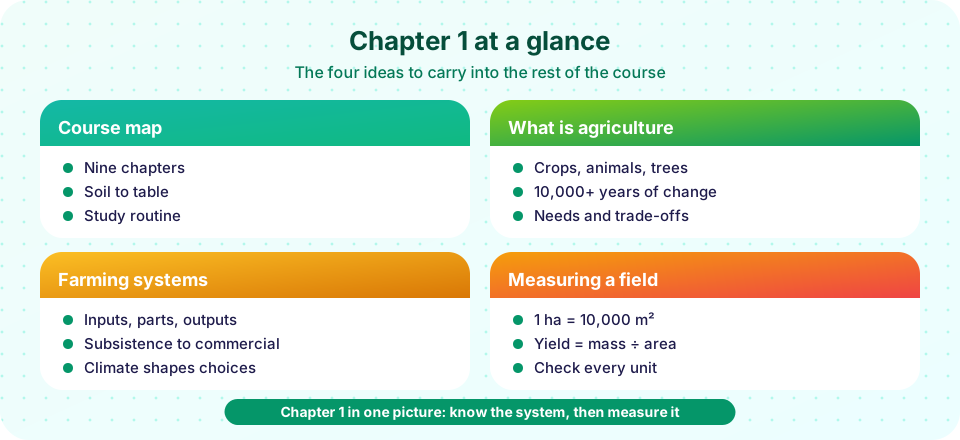
What you will learn
- A quick recall of the big ideas from each lesson of Chapter 1.
- Which calculations from the chapter you can now do without notes.
- Where the chapter's ideas return in later chapters.
The chapter in one table
| Lesson | Big idea | Number or formula to remember |
|---|---|---|
| Course map | Nine chapters follow food from soil to table | About 0.19 ha of cropland per person |
| What is agriculture? | Growing crops and keeping animals for food, fibre and fuel | Domestication 10,000 to 12,000 years ago; Haber-Bosch 1909 to 1913 |
| Farming systems | A farm is a system of inputs, parts, outputs and feedback | The scarcest resource limits yield |
| Measuring farms and yields | Reliable numbers need the right units and samples | 1 ha = 10,000 m²; 1 t/ha = 100 g/m² |
Mistakes to avoid in chapter 1 calculations
- Mixing units. Convert everything to the same unit before you divide: hectares with hectares, tonnes with tonnes. Write the units next to every number.
- Forgetting moisture. A yield without a stated moisture content cannot be compared with another yield. Always say "at 14 % moisture" or the standard that applies.
- Trusting one sample. A single quadrat can be far from the field average. Take several, spread them out, and report the uncertainty.
- Copying an application rate from another country. Labels and recommendations are written for specific crops, climates and regulations. Check the active ingredient and the unit (per hectare or per acre).
- Treating a system as a list. If you change one part of a farm, for example by removing animals, check what happens to manure, rotation and labor too.
Ideas that return later
- Systems thinking returns in every chapter. Soil, crops, pests, animals and water interact, so a change in one affects the others.
- Limiting factors become Liebig's law of the minimum in Chapter 2 and the idea of crop water stress in Chapter 6.
- Yield and moisture arithmetic is used in seed-rate, fertilizer and economic calculations throughout.
- The Green Revolution trade-off (more food, more inputs, more environmental cost) frames the sustainability debate in Chapters 7 and 8.
Self-check: can you do these without notes?
- Convert 7.2 t/ha to g/m² (answer: 720 g/m²).
- Convert a 36 ha farm to square kilometers (answer: 0.36 km²).
- Adjust 5.5 t/ha measured at 16 % moisture to a 14 % standard:
5.5 × 84 / 86 = 5.37 t/ha. - Work out the spray volume for 0.8 L/min nozzles at 8 km/h and 0.5 m spacing:
0.8 × 600 / (8 × 0.5) = 120 L/ha.
Try it
Press Run (or Ctrl + Enter) to see the result here.
Program input · what you'd type while the program runs
Type the answers before you press Run, one per line. Each time the program reads a line (with input()), it gets the next line from this box.
Check your understanding
Quick check · 10 questions
of 10 answered You scored / 10 · perfect!
-
1. Which is the best short definition of agriculture?
Agriculture covers crops, livestock and related products, at any scale. -
2. Which development made nitrogen fertilizer cheap at scale?
Haber showed ammonia synthesis in 1909 and Bosch scaled it for industry by 1913. -
3. A farm uses seed saved from last year's crop and manure from its own cattle. What does this illustrate?
Saved seed and manure close loops, reducing purchased inputs. -
4. Which pair is correctly matched?
Intensive systems use high inputs per unit area. -
5. 1 hectare equals how many square meters?
A hectare is 100 m x 100 m = 10,000 m2. -
6. A quadrat of 1 m2 yields 720 g of grain. What is the yield?
720 g/m2 divided by 100 is 7.2 t/ha. -
7. Grain at 18 % moisture is compared with grain at 14 % moisture without adjustment. What is the mistake?
Water adds weight. Compare yields at the same moisture content. -
8. In the toy model, yield follows water or nitrogen, whichever is scarcer. This is an example of:
The scarcest resource caps the yield, so adding more of the plentiful one gives no gain. -
9. Variable costs are 700 per hectare and the price is 250 per tonne. What is the break-even yield?
Break-even yield = variable cost / price = 700 / 250 = 2.8 t/ha. -
10. Which is the most accurate way to estimate a field's yield before harvest?
Spread-out replicate samples give an unbiased mean and an estimate of uncertainty.
Summary
- Agriculture is the production of food, fibre and fuel from crops and animals, and it has changed through domestication, rotations, nitrogen fertilizer and the Green Revolution.
- Farms are systems with inputs, parts, outputs and feedback; the scarcest resource limits yield.
- Always convert units carefully: 1 ha = 10,000 m², 1 t/ha = 100 g/m².
- Use quadrats, moisture correction, calibration and gross margin to turn measurements into decisions.
Next: Soils: the living ground
Track your progress
Create a free account to tick off lessons and pick up where you left off on any device.
of Agricultural Science lessons completed