


















Lesson 7 of 42 · Soils and Fertility
Soil texture and structure
Learn sand, silt and clay sizes, how to read the USDA texture triangle, how structure and compaction affect roots, and how texture controls water storage and drainage.
Pick up two handfuls of soil. One feels gritty and falls apart. The other is smooth, sticky and holds a shape when squeezed. They will behave very differently in a field: the gritty one drains quickly and dries out, the sticky one holds water and nutrients but may flood or crack. The difference is texture, the mix of particle sizes in the soil, and it is the most permanent property a farmer has to work with.
Structure is the second physical property. It describes how those particles clump together into aggregates, and it decides whether roots, water and air can move through the soil. You can change structure within a few seasons (for better or worse), but you cannot realistically change texture. This lesson explains both and shows how to turn laboratory percentages into a name and a farming decision.
What you will learn
- The size limits of sand, silt and clay, and how each affects soil behavior.
- How to read the USDA texture triangle and find a soil's class.
- The main structure types, and how compaction and tillage change them.
- How to estimate plant-available water from texture and rooting depth.
Key terms
Texture: the proportions of sand, silt and clay in the fine earth fraction (particles under 2 mm).
Aggregate: a cluster of soil particles bound together by organic matter, clay and roots.
Field capacity (FC): the water a soil holds after free drainage, usually one to three days after heavy rain.
Permanent wilting point (PWP): the water content at which plants can no longer extract water and wilt permanently.
Plant-available water: the water between field capacity and permanent wilting point.
Sand, silt and clay
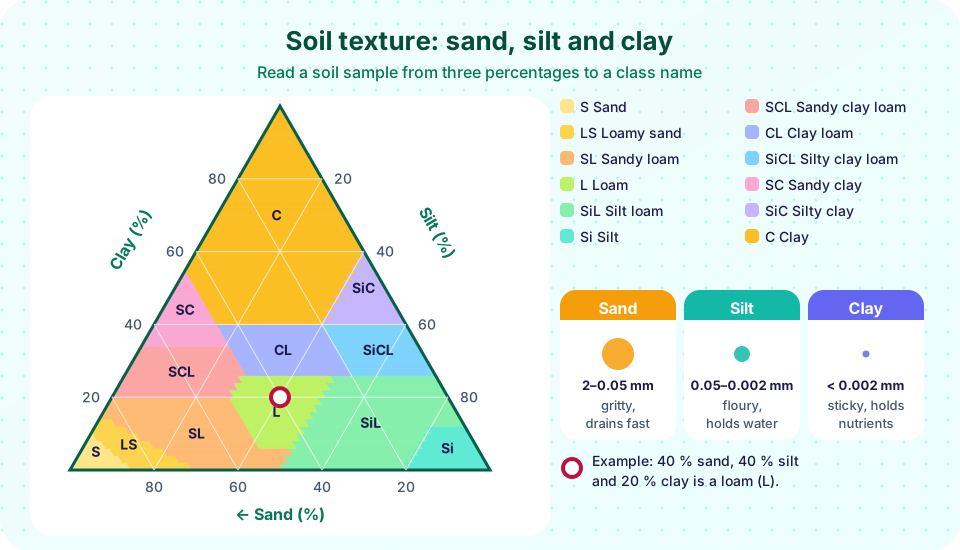
The USDA system divides particles smaller than 2 mm into three groups:
| Particle | Diameter | Feel | Behavior |
|---|---|---|---|
| Sand | 2 to 0.05 mm | Gritty | Large pores, fast drainage, low water and nutrient holding |
| Silt | 0.05 to 0.002 mm | Floury, silky | Medium pores, good water holding, easily crusts or erodes |
| Clay | under 0.002 mm | Sticky when wet, hard when dry | Tiny pores, holds water and nutrients, swells and shrinks, drains slowly |
Other systems (ISSS, the international scheme, and national systems) use slightly different size limits, so always check which classification a report uses.
Clay particles are plate-like and carry a negative electrical charge, which is why they hold positively charged nutrients such as calcium, magnesium, potassium and ammonium. This is cation exchange, explained in the next lesson. Sand holds almost no nutrients.
Reading the texture triangle
A laboratory reports the percentage of sand, silt and clay. Because the three add up to 100 %, you only need two to place a point. Worked example: a soil with 40 % sand, 40 % silt and 20 % clay lies in the loam region (the red ring in the figure). A soil with 10 % sand, 10 % silt and 80 % clay is a clay, and one with 85 % sand, 10 % silt and 5 % clay is a loamy sand.
Loam is the name for a balanced mix that has good drainage and good water and nutrient holding. Many of the world's most productive arable soils are loams or silt loams, but good crops are grown on all textures with suitable management.
The feel test gives a field estimate: rub moist soil between your fingers (gritty means sand, smooth and floury means silt, sticky and moldable means clay), then try to roll it into a ribbon. Sands will not hold together. Loams make a short, weak ribbon. High-clay soils make long, strong ribbons. Experience and a few lab comparisons make the feel test reliable.
Texture and water
Texture sets the soil's water budget. Think of the soil as a sponge that drains down to field capacity, then gives up water to roots until the permanent wilting point.
| Texture | Typical plant-available water (mm per m of soil) | Drainage |
|---|---|---|
| Sand | about 40 to 80 | Very fast |
| Sandy loam | about 80 to 120 | Fast |
| Loam | about 140 to 200 | Moderate |
| Silt loam | about 170 to 220 | Moderate |
| Clay | about 120 to 180 | Slow |
These are rough values for teaching; real soils vary with structure, organic matter and stones. Available water in the root zone is AW = AWC × rooting depth. For a loam with 170 mm/m and a root zone of 0.8 m, AW = 170 × 0.8 = 136 mm. If a crop uses 5 mm per day, that is about 27 days of water if no rain or irrigation came, though crops suffer before the last drop is used. Chapter 6 builds irrigation scheduling on exactly this arithmetic.
Structure
Structure is how particles are arranged into aggregates, with pores between them. Common types include granular (small crumbs, typical of healthy topsoils), blocky (cube-like, common in subsoils), platy (flat sheets, often a sign of compaction), prismatic and columnar (vertical columns in some subsoils), single grain (loose sand) and massive (no visible structure).
Aggregates are glued by organic matter, fungal threads, roots, and clay and calcium. They create two sizes of pores: large ones that drain quickly and carry air, and small ones that hold water for plants. A well-structured soil has both. A poorly structured one has a surface that seals under raindrops, which sheds water as runoff and promotes erosion, or a compacted layer that stops roots.
Compaction happens when heavy machinery or animals press wet soil. It raises bulk density, shrinks pore space and slows both root growth and water movement. Roots can be stopped by bulk densities above about 1.4 to 1.6 g/cm³ in many loams, with lower limits in clays. Avoid driving on wet soil, spread loads with wide tires and controlled traffic lanes, and keep organic matter high.
Tillage loosens soil temporarily but breaks aggregates and burns organic matter, so repeated intensive tillage can leave soil weaker over time. Chapter 7 explains reduced and no-till systems.
Common misconceptions
"Clay soil is bad soil." Clay holds water and nutrients well and is productive when drained and well managed. The problem is bad management (working it wet), not clay itself.
"Adding sand to clay improves it." Small amounts of sand make a sticky, concrete-like mix. Organic matter is the better amendment.
"Texture can be fixed with tillage." Tillage changes structure temporarily. Texture is fixed unless you import tonnes of other soil.
Try it
Press Run (or Ctrl + Enter) to see the result here.
Program input · what you'd type while the program runs
Type the answers before you press Run, one per line. Each time the program reads a line (with input()), it gets the next line from this box.
Check your understanding
Quick check · 5 questions
of 5 answered You scored / 5 · perfect!
-
1. Which particle size group is the smallest?
Clay is under 0.002 mm, silt is 0.05 to 0.002 mm and sand is 2 to 0.05 mm. -
2. A soil has 40 % sand, 40 % silt and 20 % clay. Which class is it?
That mix falls in the loam region of the USDA triangle. -
3. A loam stores 170 mm of available water per meter. How much is stored in a 0.6 m root zone?
170 x 0.6 = 102 mm. -
4. Which structure type often signals compaction?
Flat, plate-like layers are typical of compaction because roots and water cannot cross them easily. -
5. Why can you not realistically change a soil's texture?
Sand, silt and clay proportions are set by parent material and weathering. Tillage only changes structure.
Summary
- Texture is the sand, silt and clay mix; clay holds water and nutrients, sand drains fast.
- The USDA triangle turns percentages into twelve classes such as loam and clay loam.
- Structure is how particles form aggregates and pores, and compaction destroys it.
- Plant-available water is roughly AWC times root depth, and texture sets AWC.
- Protect structure with organic matter, careful traffic and sensible tillage.
Track your progress
Create a free account to tick off lessons and pick up where you left off on any device.
of Agricultural Science lessons completed