


















Lesson 8 of 42 · Soils and Fertility
Soil pH and organic matter
Understand soil pH, why it controls nutrient availability, how liming works, and how organic matter, humus and the C:N ratio build soil fertility and store carbon.
Two properties quietly decide whether a fertile-looking soil actually feeds a crop. The first is pH, a number that says how acidic or alkaline the soil is. The second is organic matter, the dark, spongy residue of dead plants, animals and microbes. A soil with the wrong pH can hold plenty of nutrients that roots cannot use. A soil short of organic matter is more likely to crust, compact, leak nutrients and run dry.
Both can be managed. Lime shifts pH upward. Residues, manure, cover crops and reduced tillage build organic matter. This lesson explains the chemistry in plain terms, then shows how to calculate lime doses and soil carbon.
What you will learn
- What pH measures and why each pH unit means a tenfold change.
- How pH affects nutrient availability, toxicity and soil life, and what ranges crops prefer.
- How liming raises pH, and why the dose depends on soil buffering.
- What soil organic matter is, what it does and how the C:N ratio controls decomposition.
- How to calculate a soil organic carbon stock in t/ha.
Key terms
pH: the negative base-10 logarithm of the hydrogen ion concentration, pH = −log10[H⁺].
Buffering: the soil's resistance to pH change.
Cation exchange capacity (CEC): the soil's ability to hold positively charged nutrient ions on clay and humus surfaces.
Humus: the dark, stable end product of decomposition.
C:N ratio: the mass of carbon divided by the mass of nitrogen in a material.
What pH means
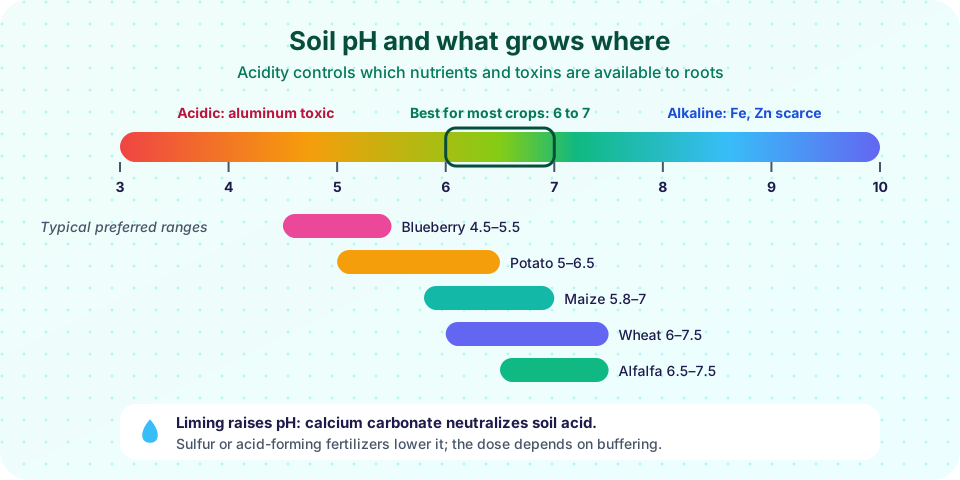
pH is measured on a logarithmic scale: pH 5 has ten times more hydrogen ions than pH 6 and a hundred times more than pH 7. Pure water is neutral at 7. Most agricultural soils fall between about 4.5 and 8.5. Soils get more acidic as rain washes basic ions (calcium, magnesium, potassium) out of the topsoil, as crops remove bases at harvest, as ammonium fertilizers nitrify and release acid, and as organic acids form. Dry-region soils often contain calcium carbonate and stay alkaline.
Why pH matters
- Nutrient availability. In a range of about 6 to 7, most nutrients are readily available. Phosphorus becomes locked up with aluminum and iron in acid soil and with calcium in alkaline soil. Molybdenum is less available in acid soil. Iron, manganese, zinc and copper become less available as pH rises above about 7.5.
- Toxicity. Below about pH 5.0 to 5.5, aluminum in the soil solution can damage roots, and manganese can reach toxic levels. Root growth stops and crops cannot use deeper water.
- Soil life. Many bacteria, including those that fix nitrogen in legumes and those that nitrify ammonium, work poorly in strong acidity.
- Crop preference. Blueberries and tea tolerate acid soil, while alfalfa and sugar beet need near neutral conditions.
Liming
Lime is a name for materials that neutralize soil acidity, mostly ground limestone (calcium carbonate, CaCO₃) and dolomite (calcium magnesium carbonate). The carbonate reacts with hydrogen ions:
CaCO3 + 2 H+ → Ca2+ + H2O + CO2
How much to apply depends on how far you want to raise the pH and on the soil's buffering. A soil with lots of clay and organic matter holds many hydrogen ions on its surfaces and needs much more lime for the same pH change than a sandy soil. Laboratories use a buffer pH test to give a lime recommendation. A rough teaching rule, not a substitute for a lab recommendation, is the dose per pH unit in the table:
| Soil | Typical lime per pH unit (t CaCO₃/ha) |
|---|---|
| Sandy, low organic matter | about 1 |
| Loam | about 2 |
| Clay | about 3 |
| High organic matter | about 4 |
Lime quality is described by its neutralizing value (calcium carbonate equivalent, 100 % for pure limestone) and fineness, because fine particles react faster. Lime works slowly and moves little, so incorporate it into the layer where roots grow and recheck pH every few years. To lower the pH of alkaline soils, sulfur or acid-forming fertilizers can be used, but changes are small and costly in calcareous soils, so choosing tolerant crops is often better.
Organic matter
Soil organic matter (SOM) includes living organisms, fresh residue, partly decomposed material and humus. It typically makes up about 1 to 6 % of cropland soils by mass, much more in peat soils. Its benefits are large for a small share:
- Binds particles into aggregates, improving structure, infiltration and resistance to erosion.
- Holds water, since humus can hold many times its own weight in water.
- Holds nutrients on charged surfaces, raising CEC.
- Releases nitrogen, phosphorus and sulfur as it decomposes (mineralization).
- Feeds soil organisms and buffers pH changes.
- Stores carbon that would otherwise be in the atmosphere as CO₂.
Soil organic carbon (SOC) is roughly 58 % of SOM by mass, so SOM ≈ SOC × 1.72.
Stocks and calculation. To convert a carbon concentration to a mass per hectare:
SOC stock (t/ha) = C (%) × bulk density (g/cm3) × depth (cm)
For 1.2 % carbon, bulk density 1.3 g/cm³ and a 30 cm layer: 1.2 × 1.3 × 30 = 46.8 t C/ha. Multiply by 3.67 (44/12) to get tonnes of CO₂ equivalent.
What raises SOM. Returning crop residues, adding manure and compost, growing cover crops and perennial grass or legumes in rotations, reducing tillage, and keeping soil covered. Gains are slow, and soils tend toward an equilibrium that depends on climate, soil type and management. A first-order model says ΔSOM = inputs − k × SOM, so the equilibrium level is inputs divided by the decay rate k. Warm, wet, well-aerated, frequently tilled soils lose SOM faster.
The C:N ratio
Microbes decomposing residues need nitrogen. Materials with a C:N ratio above about 25 to 30 (cereal straw is around 60 to 100, sawdust far higher) are low in nitrogen, so microbes take nitrate from the soil to build their bodies. This immobilization can temporarily starve a young crop. Materials below about 20 (legume residues, fresh manure) release extra nitrogen. Stable humus has a C:N of roughly 10 to 12. Plan with this in mind: incorporate straw well before sowing, add a little nitrogen, or follow high-C:N residues with a legume.
Common misconceptions
"Lime is a fertilizer." Lime corrects acidity and supplies calcium (and magnesium for dolomite), but it does not supply N, P or K.
"More organic matter always means more nitrogen for this year's crop." High-C:N residues can lock nitrogen up temporarily.
"pH 6 is only a little more acidic than pH 7." It is ten times the hydrogen ion concentration.
Try it
Press Run (or Ctrl + Enter) to see the result here.
Program input · what you'd type while the program runs
Type the answers before you press Run, one per line. Each time the program reads a line (with input()), it gets the next line from this box.
Check your understanding
Quick check · 5 questions
of 5 answered You scored / 5 · perfect!
-
1. How many times more hydrogen ions does pH 5 have than pH 7?
Each pH unit is a tenfold change, so two units is 10 x 10 = 100 times. -
2. Which problem is most likely in a strongly acid soil below pH 5?
Aluminum dissolves in strong acidity and damages roots. -
3. A clay soil needs about 3 t lime per pH unit. How much lime raises the pH from 5.4 to 6.4?
One pH unit times 3 t per unit is 3 t/ha. -
4. Soil has 2 % carbon, bulk density 1.2 g/cm3 and a 30 cm layer. What is the SOC stock?
2 x 1.2 x 30 = 72 t C/ha. -
5. Why can incorporating wheat straw (C:N about 80) just before sowing hurt the crop?
High-C:N residues cause temporary nitrogen immobilization.
Summary
- pH is logarithmic; most crops prefer 6 to 7, where nutrients are most available.
- Strong acidity brings aluminum toxicity and phosphorus lock-up; high pH reduces iron and zinc availability.
- Lime neutralizes acid; dose depends on the target pH change and the soil's buffering.
- Organic matter improves structure, water and nutrient holding and stores carbon, and SOC stock = C% x bulk density x depth.
- A C:N ratio above about 25 to 30 immobilizes nitrogen; legume residues release it.
Track your progress
Create a free account to tick off lessons and pick up where you left off on any device.
of Agricultural Science lessons completed