


















Lesson 15 of 42 · Crop Science
Chapter 3 review: crop science
Review chapter 3 of agricultural science: crop groups, photosynthesis and growth stages, seed rate and planting, and rotation and intercropping, with a ten-question quiz.
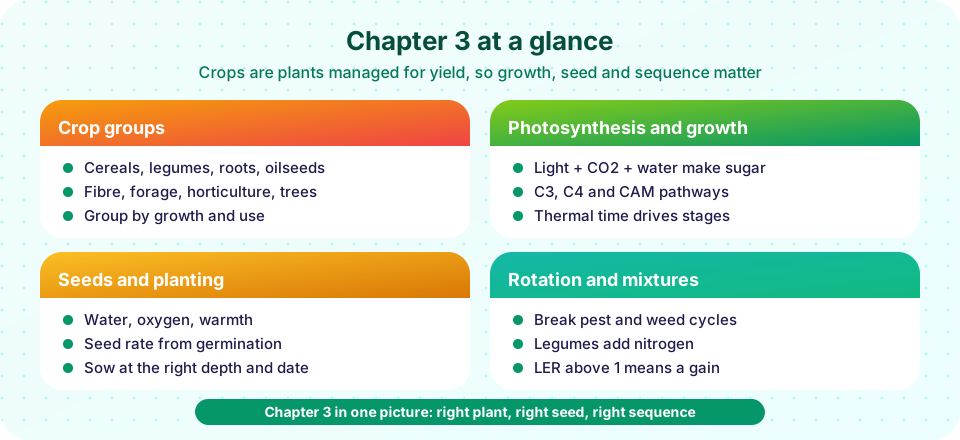
This chapter followed a crop from its family tree to its seed, its season of growth and the place it holds in a sequence of crops. Together, the four lessons explain why a crop yields what it does and what a farmer can do about it. This review gathers the key ideas into one picture, a recap table, practice problems and a ten-question quiz.
What you will learn
- A fast recall of each lesson's key facts and formulas.
- How the lessons connect into one crop-management plan.
- Practice with the chapter's calculations.
The chapter in one table
| Lesson | Key ideas | Formulas and numbers |
|---|---|---|
| Crops overview | Eight crop groups; annual, biennial, perennial; monocot and dicot | Maize, wheat, rice and sugar cane dominate tonnage |
| Photosynthesis and crop growth | C3, C4, CAM; growth stages; thermal time | GDD = (Tmax + Tmin)/2 - Tbase; yield = light x RUE x HI |
| Seeds and planting | Germination needs; dormancy; seed quality | seed rate = plants / (germination x emergence) x TSW / 1,000,000 |
| Crop rotation and intercropping | Break crops; legume nitrogen; mixtures | LER = sum of (mixed yield / sole yield) |
One crop plan from four lessons
Start with what to grow: pick a crop that suits the climate (temperature, season length, photosynthetic pathway) and the market. Then plan how it will start: a quality seed lot, a seedbed, a sowing date matched to soil temperature and a seed rate that produces the target plant population. Then ensure the crop can capture light all season: enough leaf area by the right date, kept green by adequate nitrogen and water and protected from weeds and disease. Finally, think about what comes before and after: a rotation that breaks pest cycles and uses legumes, or an intercrop that makes better use of the land.
A good plan works backward from yield. The yield equation (light intercepted x efficiency x harvest index) tells you where to look when yields disappoint: a late or patchy start (poor seed, wrong depth, cold soil), a short green season (drought, disease, early senescence) or a low harvest index (stress at flowering or grain fill).
Practice problems
- Maize with a base temperature of 10 °C has a day with Tmax 31 °C and Tmin 15 °C. Cap Tmax at 30 °C. GDD? ((30 + 15)/2 - 10 = 12.5.)
- Barley: target 3,500,000 plants/ha, germination 0.92, emergence 0.85, TSW 42 g. Seed rate? (3,500,000 / 0.782 = 4,475,703 seeds; x 42 / 1,000,000 = 188 kg/ha.)
- Sole yields are wheat 6.0 and peas 3.0 t/ha. In a mixture they give 4.2 and 1.2. LER? (0.70 + 0.40 = 1.10.)
- Light intercepted is 1,100 MJ/m², RUE is 1.3 g/MJ and the harvest index is 0.5. Grain yield in t/ha? (1,100 x 1.3 x 0.5 = 715 g/m², or 7.15 t/ha.)
Try it
Press Run (or Ctrl + Enter) to see the result here.
Program input · what you'd type while the program runs
Type the answers before you press Run, one per line. Each time the program reads a line (with input()), it gets the next line from this box.
Check your understanding
Quick check · 10 questions
of 10 answered You scored / 10 · perfect!
-
1. Which pair lists C4 crops?
Maize and sugar cane use the C4 pathway; wheat, rice, soybean and potato are C3. -
2. A day has Tmax 26 C and Tmin 10 C, with a base of 10 C. How many GDD?
(26 + 10)/2 - 10 = 8 GDD. -
3. Which is the best description of a harvest index?
Harvest index is the fraction of biomass that is harvested product. -
4. Which condition is NOT required for germination?
The seed's own reserves feed the seedling at first, so fertilizer is not required. -
5. Target 5,000,000 plants/ha, germination 0.95, emergence 0.80, TSW 38 g. Seed rate?
5,000,000 / 0.76 = 6,578,947 seeds; x 38 / 1,000,000 = 250 kg/ha. -
6. A mixture gives 70 % of sole-crop yield for crop A and 45 % for crop B. What is the LER?
0.70 + 0.45 = 1.15, so the mixture saves 15 % of the land. -
7. Why is a four-year rotation usually better at controlling a soil-borne disease than monoculture?
Pathogen populations decay when no host is grown. -
8. Which crop is a short-day plant that flowers as nights lengthen?
Soybean and rice are short-day plants. Wheat and barley are long-day. -
9. Which is a reason legumes before maize can reduce fertilizer needs?
Legume residues mineralize and release some nitrogen for the next crop. -
10. Which is the best sign that an intercrop is worth growing?
LER above 1 shows better land use, and the economics must also work.
Summary
- Crops are grouped by use and classified by life cycle, season, plant type and photosynthetic pathway.
- Photosynthesis, thermal time and the yield equation explain growth and yield.
- Good seed, correct seed rate, depth and sowing date set the crop's start.
- Rotations and intercrops use diversity to control pests, supply nitrogen and use land efficiently.
Track your progress
Create a free account to tick off lessons and pick up where you left off on any device.
of Agricultural Science lessons completed