


















Lesson 3 of 42 · Getting Started
Farming systems: how farms differ and why
Compare subsistence and commercial, intensive and extensive, arable, pastoral and mixed farms, and learn how climate, soil and markets shape what a farm does.
Walk across the world and you will see very different farms. In the highlands of Ethiopia a family grows teff on terraces and keeps a few cattle. In the American Midwest one operator plants thousands of hectares of maize and soybeans with a GPS-guided tractor. In the Mekong delta families grow rice in flooded fields and raise fish in ponds. Each farm is a sensible answer to its own mix of land, climate, labor, money and markets.
Scientists call such an answer a farming system: a set of inputs, activities and outputs on a farm, organized around the goals of the people who run it. Understanding systems stops you from judging a farm by looks alone. A small, low-input plot can be efficient for the family that depends on it, and a huge, high-input operation can be fragile if prices or weather turn against it.
What you will learn
- What a farming system is and how to describe its inputs, parts and outputs.
- The main ways farms are classified: purpose, intensity and what they produce.
- How climate, soil, relief and human factors shape the choice of crops and animals.
- How a limiting factor (water, nutrient, labor) caps output, using a simple model.
Key terms
Farming system: the pattern of crops, animals, resources and decisions on a farm.
Subsistence farming: producing mainly for the household's own food, with only a small surplus sold.
Commercial farming: producing mainly for sale to markets.
Intensive farming: high inputs and output per hectare (labor, capital, fertilizer or animals per unit area).
Extensive farming: low inputs per hectare over large areas, such as rangeland grazing.
Limiting factor: the resource in shortest supply, which caps the yield.
The farm as a system
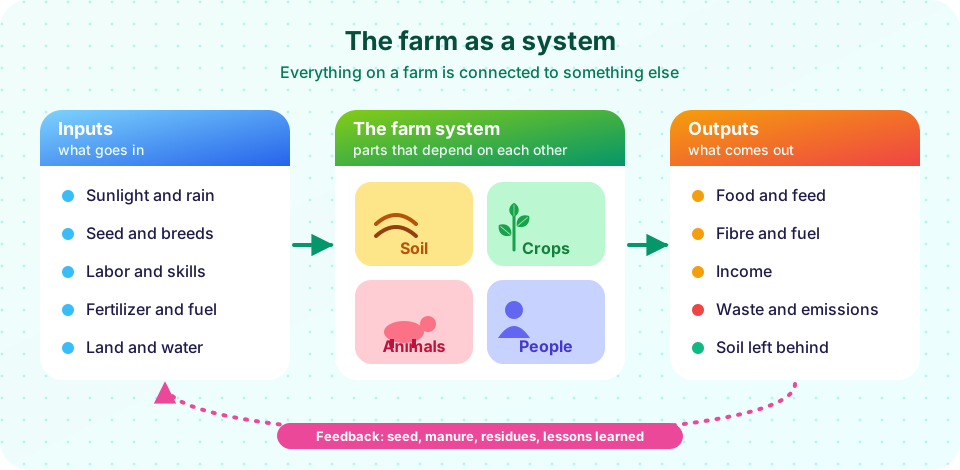
A system view asks three questions. What goes in (sunlight, rain, seed, labor, energy, fertilizer, knowledge)? What are the parts and how do they interact (soil feeds crops, crops feed animals and people, animals return manure to soil)? What comes out (food, fibre, income, but also waste, greenhouse gases and the condition of the soil left behind)?
The feedback loops are the clever part. Saved seed grows next year's crop. Manure from the barn becomes fertilizer for the field. Crop residues become animal bedding or soil cover. A mixed farm that closes more loops buys fewer inputs. A specialized farm gains scale and efficiency but must buy what it no longer produces, and depends more on markets.
Ways to classify farms
By purpose. Subsistence farms feed the household first. Commercial farms sell most of their output, and many farms sit in between, selling a surplus. Plantations are large commercial estates growing one crop, such as tea, oil palm or rubber, often for export.
By intensity. Intensive systems squeeze a lot from each hectare: irrigated vegetable gardens, greenhouses, dairy herds fed in barns. Extensive systems spread low inputs over large areas: cattle ranching on semi-arid grassland or wheat in dry regions that yield little per hectare but need few inputs.
By what they produce. Arable farms grow crops, pastoral farms keep grazing animals, and mixed farms combine crops and livestock so the two support each other. Horticultural farms grow fruit, vegetables and flowers, and aquaculture farms raise fish or shellfish.
By movement. In shifting cultivation farmers clear and crop a plot for a few seasons, then let it recover under fallow vegetation while they farm elsewhere. It works well when land is plentiful and fallow periods are long, and it degrades land when population presses and fallows shorten. Nomadic pastoralism moves herds between seasonal pastures.
By management philosophy. Conventional, organic, conservation, regenerative and agroforestry systems differ in what inputs they allow and which practices they stress. Chapter 7 compares them.
What shapes the system: physical and human factors
Physical factors include temperature, rainfall and its seasonality, soil type and depth, slope, altitude and exposure. Rainfall decides whether farmers can rely on rain-fed crops. Roughly, regions that receive under about 250 mm a year are too dry for most crops without irrigation, while many cereals need several hundred millimeters spread across the growing season. The growing season is the period when temperature and moisture allow growth, often counted as the number of days with an average temperature above about 5 °C, or the number of frost-free days. Crops with a long season to maturity (for example, rice varieties that need over 150 days) do not fit a short summer.
Human factors include capital, labor, land tenure, knowledge, markets, roads, storage, prices and government policy. A crop that suits the soil but cannot be stored or sold nearby is a poor choice. A subsidy, a tariff or a new road can change what farmers plant within a season.
Agroecological zones combine climate, soil and landform into mapped regions that have similar potentials and constraints. Planners use them to decide where a new variety, a rotation or an irrigation project is likely to work.
Limiting factors
At any moment, one resource usually limits growth more than the others. Add more of the plentiful resources and the crop does not respond. Remove the limit, and yield rises until the next factor takes over. This idea, which you will meet again as Liebig's law of the minimum in Chapter 2, explains why the same fertilizer dose can double the yield on one field and do nothing on another.
Reading a system: three quick case sketches
A highland smallholder. Two hectares, family labor, rain-fed, maize intercropped with beans, two cows whose manure goes onto the maize. The goal is household food security with a little cash. Good decisions here protect against risk: several varieties, early and late plantings, and cheap soil-building steps such as manure and residues.
A mechanized grain farm. Four hundred hectares, two workers, hired machines, one or two crops sold at harvest. The goal is profit per hectare and per hour of labor. Good decisions here manage costs and timing: planting windows, machinery capacity, input prices and marketing dates.
A market garden near a city. Five hectares, many workers, drip irrigation, several crops a year sold fresh to nearby customers. The goal is a high return per square meter. Good decisions here manage labor, water, pests that spread fast in dense plantings, and customers' tastes.
Each farm is rational for its owner. Comparing them by yield per hectare alone would call the market garden the winner and the mechanized farm the loser, while comparing by output per hour of labor reverses the order. That is why the practice exercise below measures both.
Common misconceptions
"Subsistence means primitive." Subsistence farmers often manage complex mixed systems (intercrops, several varieties, trees, animals) tuned to local conditions and risk.
"Intensive means harmful." Intensive describes the inputs per hectare, not the impact. Intensifying production on good land can spare other land, but careless intensification pollutes water and degrades soil.
"There is a single best farming system." The best system depends on climate, soil, markets, labor and goals. Judge it against the context, not against another place.
Try it
Press Run (or Ctrl + Enter) to see the result here.
Program input · what you'd type while the program runs
Type the answers before you press Run, one per line. Each time the program reads a line (with input()), it gets the next line from this box.
Check your understanding
Quick check · 5 questions
of 5 answered You scored / 5 · perfect!
-
1. A farm grows crops mainly to feed the household and sells only a small surplus. What is it called?
Subsistence farming aims first at the household's own food needs. -
2. Which farm type combines crops and livestock so they support each other?
Mixed farms use manure for crops and crop residues or grain for animals, closing nutrient loops. -
3. In the toy model, doubling fertilizer on a very dry field changes the yield little. Why?
Yield follows the scarcest resource, so adding a non-limiting input does not help. -
4. Which is an example of a HUMAN factor shaping a farm system?
Markets and roads are human and economic factors; soil, rain and slope are physical. -
5. Extensive farming is best described as:
Extensive systems spread low inputs across large areas, such as rangeland grazing.
Summary
- A farming system is the pattern of inputs, parts and outputs on a farm, with feedback loops such as seed and manure.
- Farms are classified by purpose, intensity, products, movement and management philosophy.
- Physical factors (climate, soil, slope) and human factors (capital, labor, markets, policy) both shape choices.
- The scarcest resource limits yield, so adding a non-limiting input wastes money.
Track your progress
Create a free account to tick off lessons and pick up where you left off on any device.
of Agricultural Science lessons completed