


















Lesson 35 of 42 · Food Security and Economics
Food Security and Food Systems
Follow food from farm to plate: where food is lost and wasted, how malnutrition is measured, what yield gaps are, and how early warning and safety nets prevent famine.
A grain of maize can fail to feed anyone in many ways. It can be eaten by weevils in a farm store, spoil in a hot truck, be thrown out in a supermarket, or sit on a plate that nobody finishes. Each of these losses is also a loss of the land, water, fertilizer and labor that grew it. Cutting losses is one of the cheapest ways to improve food security, because the food already exists.
This lesson looks at the whole food system. You will learn where food is lost and wasted, how malnutrition is defined and measured, how scientists describe the gap between actual and possible yields, and how governments and agencies warn of and respond to food crises.
What you will learn
- Distinguish food loss from food waste and name their main causes
- Use moisture content to calculate grain drying and safe storage
- Explain stunting, wasting and micronutrient deficiency, and how they are measured
- Define yield gap and estimate the effect of closing it
- Describe early-warning systems and safety nets
Key terms
Food loss: a decrease in the quantity or quality of food along the supply chain up to, but not including, retail.
Food waste: food discarded at retail, in food service and in homes.
Stunting: height-for-age more than 2 standard deviations below the WHO reference median, a sign of chronic undernutrition.
Wasting: weight-for-height more than 2 standard deviations below the median, a sign of acute undernutrition.
Yield gap: the difference between the yield that is attainable and the yield farmers actually get.
Loss and waste
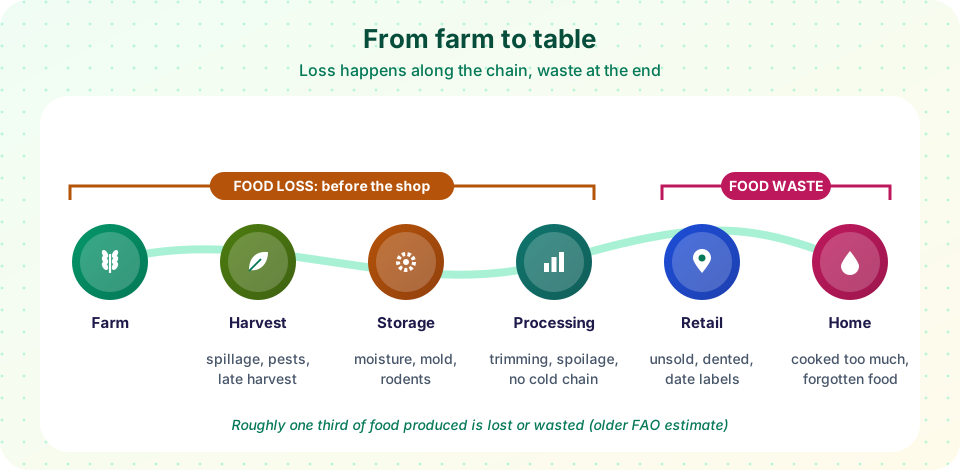
The FAO's widely cited estimate, first published in 2011, is that about one third of food produced for human consumption is lost or wasted each year, on the order of 1.3 billion tonnes. More recent work by UNEP estimated that about 931 million tonnes of food, roughly 17% of all food available to consumers, were wasted in 2019 in households, restaurants and shops, with households accounting for the largest share. Exact numbers differ by method, but the message holds.
The pattern differs by income level. In low-income countries most losses occur early: at harvest (shattering, spillage, late harvest), in drying and storage (moisture, mold, insects and rodents), in transport on bad roads and in markets without refrigeration. In high-income countries most waste happens late: retailers reject produce on appearance, shops over-order, and households buy and cook more than they eat or misread date labels.
A storage calculation
Grain must be dried to a safe moisture level before storing. For cereals such as maize, rice and wheat this is commonly 13 to 14% moisture on a wet basis. Wetter grain heats up and grows molds, some of which produce aflatoxin, a toxin that harms human and animal health. Moisture content on a wet basis is
MC = (W_water / W_total) × 100
If 1,000 kg of maize at 20% moisture is dried to 13%, the dry matter (800 kg) does not change, so the new total weight is 800 / (1 − 0.13) = 919.5 kg. About 80.5 kg of water has to leave. The general formula is
W₂ = W₁ × (100 − MC₁) / (100 − MC₂)
Dried grain then needs protection from rain, insects and rodents. Hermetic (airtight) storage bags and metal silos have cut insect losses sharply for smallholders in many countries, and cold chains (refrigerated storage and transport) protect fruit, vegetables, milk and fish.
Malnutrition and how it is measured
Malnutrition covers several conditions, measured against the WHO Child Growth Standards (2006), which describe the growth of healthy children in six countries.
- Stunting: height-for-age more than 2 standard deviations (a z-score below −2) under the reference median. It reflects long-term shortage of food, repeated illness and poor care, and has lasting effects on health and learning. Roughly one in five children under five worldwide is stunted.
- Wasting: weight-for-height z-score below −2. It signals acute malnutrition and a high risk of death if severe (below −3). In emergencies workers screen children with a tape that measures mid-upper arm circumference (MUAC); under 115 mm in a child aged 6 to 59 months indicates severe acute malnutrition.
- Underweight: weight-for-age below −2.
- Micronutrient deficiencies, often called hidden hunger: lack of iron (anemia), vitamin A, zinc, iodine and others, even when calories are sufficient.
- Overweight and obesity: too much energy, often with poor diet quality, increasing risk of diabetes and heart disease.
Diet quality is measured with scores such as dietary diversity: for women, the Minimum Dietary Diversity indicator counts how many of ten food groups were eaten the previous day, with five or more regarded as the minimum. Responses include fortification (adding iodine to salt, vitamins to flour or oil), supplements, school meals, and biofortification, plant breeding to raise nutrients in staples (orange-fleshed sweet potato rich in vitamin A, iron-rich beans, zinc wheat). Farmers' own production matters too: a household that grows legumes, vegetables and some animal products usually eats a more diverse diet.
Yield gaps
Agronomists distinguish three yields.
- Potential yield (Yp): the yield of an adapted variety with no water or nutrient limits and no pests, set only by sunlight, temperature and CO₂.
- Water-limited potential yield (Yw): the same, under rainfall or irrigation actually available.
- Actual yield (Ya): what farmers get.
The yield gap is Yg = Yw − Ya (or Yp − Ya for irrigated land). In many parts of Africa average maize yields are around 2 t/ha while the water-limited potential is several times larger, and the gap comes from too little fertilizer and seed of poor quality, late planting, weeds, pests and weak access to credit and markets. In intensive systems of Europe or North America, Ya is already close to Yw, and gains must come from raising the potential itself through breeding and better management. Closing part of the yield gap on existing farmland is one of the most efficient ways to raise production without clearing new land.
Early warning and safety nets
Famines rarely arrive without warning. Early-warning systems combine satellite rainfall and vegetation data, market prices, crop assessments and household surveys. The Integrated Food Security Phase Classification (IPC) uses five phases, from Minimal to Catastrophe or Famine, to describe the severity of a situation so agencies can respond in time. The Famine Early Warning Systems Network (FEWS NET) publishes outlooks for vulnerable countries.
Responses range from emergency food aid to cash transfers, which help families buy food locally, to safety nets such as school meals and public works programs, to grain buffer stocks that governments can release when prices spike. Export bans can protect domestic buyers but worsen price shocks abroad, as seen in the 2007–08 and 2022 episodes. Long-term resilience comes from irrigation, drought-tolerant varieties, savings, insurance and diverse incomes.
Common misconceptions
"Food waste is a rich-country problem only." Rich countries waste more at home; poor countries lose more before food reaches the market. Both lose food and the resources behind it.
"Giving food aid is always the best response." Aid can save lives in emergencies but, if poorly timed or sourced, may depress local prices. Cash or local purchase is often better where markets work.
"Stunted children will catch up if they eat more later." Some recovery is possible when intervention is early, but much of the damage to growth and brain development in the first 1,000 days is hard to reverse.
Try it
This calculator applies the drying formula. Choose a starting moisture and a target and see how much weight the grain loses and how much water to remove.
The second program estimates how production would change if farmers in three illustrative regions closed part of their yield gap. The areas and yields are invented for teaching.
Press Run (or Ctrl + Enter) to see the result here.
Program input · what you'd type while the program runs
Type the answers before you press Run, one per line. Each time the program reads a line (with input()), it gets the next line from this box.
Check your understanding
Quick check · 5 questions
of 5 answered You scored / 5 · perfect!
-
1. How is food waste defined, as opposed to food loss?
Loss happens along the supply chain up to retail; waste occurs at retail and with consumers. -
2. 500 kg of rice at 18% moisture is dried to 14%. What is the new weight?
500 × (100 - 18) / (100 - 14) = 500 × 82 / 86 = 476.7 kg. -
3. A child's height-for-age z-score is -2.6. This indicates:
A height-for-age z-score below -2 is the definition of stunting. -
4. Actual yield is 2.5 t/ha and the water-limited potential is 6.5 t/ha. What is the yield gap?
Yg = Yw - Ya = 6.5 - 2.5 = 4.0 t/ha. -
5. What is the purpose of the IPC classification?
The IPC grades food insecurity from Minimal to Catastrophe/Famine to guide a timely response.
Summary
- Roughly a third of food is lost or wasted; losses concentrate early in poorer countries and late in richer ones.
- Drying grain to 13 to 14% moisture prevents mold and aflatoxin; W₂ = W₁ (100 − MC₁) / (100 − MC₂).
- Stunting (height-for-age z < −2), wasting (weight-for-height z < −2) and hidden hunger are distinct forms of malnutrition.
- The yield gap Yw − Ya shows how much production could rise on existing land.
- Early warning (IPC, FEWS NET), cash transfers, safety nets and buffer stocks help prevent famine.
Track your progress
Create a free account to tick off lessons and pick up where you left off on any device.
of Agricultural Science lessons completed