


















Lesson 2 of 44 · Getting Started
What Is Political Science?
Learn what political science studies, how it differs from history and philosophy, and meet its five subfields: theory, comparative, international, national politics and policy.
Every group that has to make decisions together faces the same problem: its members want different things, and resources, rules and honors are limited. A village must decide who farms which field. A nation must decide how much to tax and how to spend it. The world must decide who may use force and who pays for a warming climate. Political science studies how such decisions are made, who makes them, and who benefits.
The field is young as an academic discipline, but its questions are ancient. Plato and Aristotle asked who should rule and what makes a good constitution. Modern political science adds systematic data, comparison across countries and controlled tests, so that claims can be checked and not only argued.
What you will learn
- how political scientists define politics, power and government
- how political science differs from history, philosophy, sociology and economics
- the five main subfields and a typical question in each
- why the field mixes description, explanation and evaluation
Key terms
Politics: the process of making collective decisions in a group where people disagree.
Power: the ability to get an outcome you want, even against resistance.
Normative: about what ought to be, a question of values.
Empirical: about what is, a question checked with evidence.
Subfield: a major branch of a discipline with its own questions and methods.
A definition that works
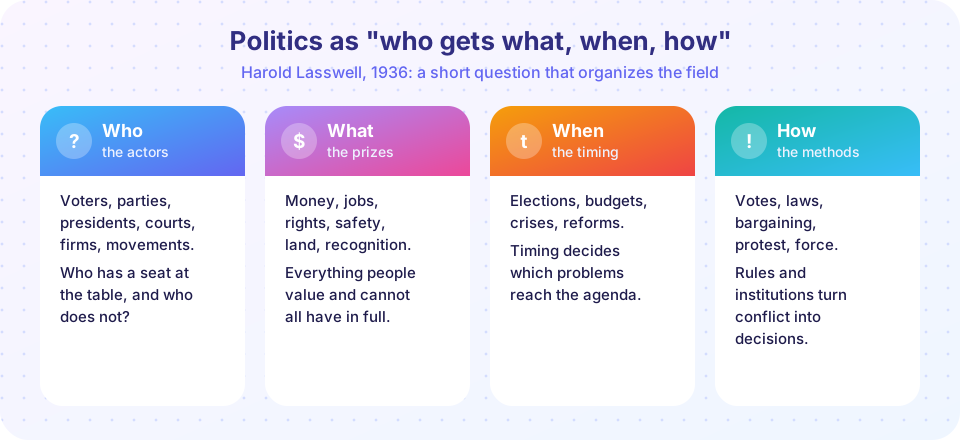
The American political scientist Harold Lasswell published a book in 1936 titled Politics: Who Gets What, When, How. The title became the most quoted short definition of the subject. Politics is the struggle over who receives valued things, at what time, and by which means. "Valued things" is broad: money, jobs, safety, public honors, the right to speak, even the right to decide what counts as a problem.
Another classic definition comes from David Easton (1953): politics is the "authoritative allocation of values for a society." The word "authoritative" signals that political decisions bind everyone, backed by the possibility of force. A club can pick its meeting date by consensus, but only a state can tax you and send you to prison.
A third definition, associated with Bernard Crick, stresses a different aspect: politics is the activity by which differing interests are conciliated through sharing power. For Crick, politics is the alternative to simply ordering people around. You can see the thread running through all three: disagreement, decisions that bind, and rules about who gets a say.
Where political science sits among neighbors
Political science borrows from many fields and is easy to confuse with them. A quick comparison shows the differences.
| Field | Main question | Typical evidence |
|---|---|---|
| History | What happened and why, in one time and place? | Archives, documents |
| Philosophy | What is justice, and what should the state do? | Arguments, thought experiments |
| Sociology | How do groups and social structures behave? | Surveys, observation |
| Economics | How do people allocate scarce resources? | Prices, models, data |
| Political science | How are power and collective decisions organized? | Votes, laws, surveys, cases |
The lines blur on purpose. A study of why some countries stay democratic uses history, statistics and moral theory together. What marks political science is its focus on power, institutions and public decisions.
Description, explanation and evaluation
Political scientists do three kinds of work, and good studies keep them separate.
- Describe. How many parties compete in this election? How long do governments last? A description answers "what is the case?"
- Explain. Why do some countries have two main parties and others have six? An explanation proposes causes and tests them.
- Evaluate. Is a particular voting rule fair? An evaluation needs values, not only facts. This is the normative part of the field.
Confusing the three is a common mistake. "The tax cut raised revenue" is a factual claim, which data can support or refute. "The tax cut was good" mixes the fact with a value judgment about who should gain or lose.
The five subfields
Universities usually divide political science into five areas.
Five subfields
And the fifth
Many scholars work across two or three subfields.
Political theory examines ideas such as justice, liberty and legitimacy, from Plato to John Rawls. Comparative politics compares countries to learn what makes democracies last or revolutions succeed. International relations studies war, trade, alliances and international organizations. National politics (often called American politics in US universities, or British politics in the UK) studies one country's institutions in depth. Public policy studies the choice and effect of government programs such as health insurance or carbon taxes.
Why bother? Three uses
First, citizenship: voters who know how institutions work can judge claims about them. Second, careers: law, journalism, civil service, advocacy, business risk analysis and diplomacy all use the field. Third, prediction and design: knowing, for example, that certain electoral rules tend to produce more parties helps people who write constitutions.
When you read a political claim, ask: Is this a description, an explanation or an evaluation? What evidence supports it? Who gains if I believe it?
Common misconceptions
"Politics is just what politicians do." Politics also happens in firms, schools, families and international bodies wherever people need binding group decisions. Politicians are one set of actors.
"Political science can predict elections exactly." Models help, especially for large patterns, but single outcomes depend on many hard-to-measure factors. Honest researchers state uncertainty.
"Theory and data are rivals." Good work needs both. Theory says what to look for; data tell you whether you were right.
Try it
The first demonstration shows Lasswell's idea in numbers. It splits 100 units of public money among five groups of different size and different influence under four rules. Different rules produce very different winners, which is the heart of politics. The groups and numbers are invented for the example.
Press Run (or Ctrl + Enter) to see the result here.
Program input · what you'd type while the program runs
Type the answers before you press Run, one per line. Each time the program reads a line (with input()), it gets the next line from this box.
Change the size and influence arrays and rerun. Notice how a rule that sounds fair ("by population") and one that mirrors lobbying ("by influence") send money to different people.
Press Run (or Ctrl + Enter) to see the console output here.
No output.
This is a toy keyword matcher, not a real classifier. Real research questions often belong to several subfields at once. Try writing a question that your matcher gets wrong, and say why.
Check your understanding
Quick check · 5 questions
of 5 answered You scored / 5 · perfect!
-
1. Which title did Harold Lasswell give his 1936 book on politics?
Lasswell's title became a short definition of politics as the struggle over who receives valued things. -
2. Which statement is NORMATIVE?
Normative claims say what should be; the other two statements describe facts that data could check. -
3. Which subfield mainly compares political systems across countries?
Comparative politics studies how and why countries differ in regimes, institutions and outcomes. -
4. Why is the claim 'the tax cut was good' not purely empirical?
Calling an outcome good requires a standard of value, which data alone cannot supply. -
5. In the sharing-rules demonstration, what changes the winners?
With the same budget and groups, different rules favor different groups, which is why rule choice is political.
Summary
- Politics is the process of making binding collective decisions despite disagreement; Lasswell's phrase is "who gets what, when, how."
- Political science differs from history, philosophy, sociology and economics by its focus on power, institutions and public decisions.
- Good work separates description, explanation and evaluation.
- The five subfields are theory, comparative politics, international relations, national politics and public policy.
- Rules for sharing out resources decide winners, so choosing rules is itself a political act.
Next: Evidence and Methods
Track your progress
Create a free account to tick off lessons and pick up where you left off on any device.
of Political Science lessons completed