


















Lesson 15 of 44 · Political Ideologies
Chapter 3 Review: Political Ideologies
Review chapter 3: liberalism, conservatism, socialism, nationalism, anarchism, feminism and environmentalism, with a recap table of thinkers and a ten-question quiz.
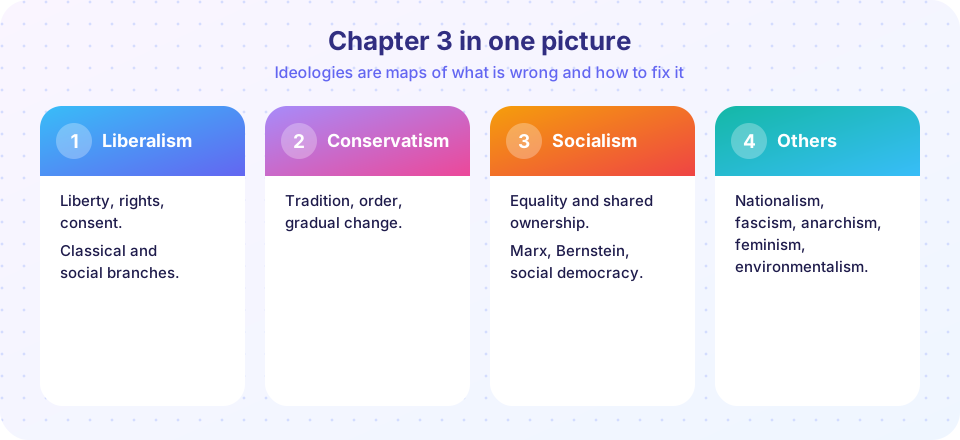
You have now met the main ideas that organize political argument. This review gathers the thinkers and key claims into one table, shows the chapter in one picture, and ends with a ten-question quiz. A good check is to describe each ideology in two sentences that its supporters would accept.
What you will learn
- recall the central values and thinkers of each ideology
- tell apart look-alike ideas: socialism and communism, nationalism and fascism, social and classical liberalism
- practice explaining a view fairly before criticizing it
Recap table
| Ideology | Core value | Key thinkers | Typical policy emphasis |
|---|---|---|---|
| Classical liberalism | Individual liberty | Locke, Smith, Mill | Rights, free markets, limited state |
| Social liberalism | Liberty with opportunity | Green, Keynes, Beveridge | Education, welfare, regulation |
| Conservatism | Order and continuity | Burke, Oakeshott | Tradition, gradual change |
| Socialism | Equality and solidarity | Owen, Marx, Bernstein | Shared ownership or welfare state |
| Nationalism | The nation | Herder, Anderson, Gellner | Self-rule, national identity |
| Anarchism | Freedom from rulers | Proudhon, Bakunin, Kropotkin | Voluntary cooperation |
| Feminism | Gender equality | Wollstonecraft, de Beauvoir, Crenshaw | Rights, work, family, safety |
| Environmentalism | Ecological limits | Carson, Brundtland | Sustainability, climate policy |
Common misconceptions
"Everyone is either left or right." Many hold mixed positions, and some issues cut across the line.
"Ideologies never change." Each has branches and has changed over time in response to events.
"Understanding means agreeing." You can describe a view accurately and still reject it.
Try it
The first demonstration is a matching drill. It scores your answers to a matching task of thinker to ideology; edit the dictionary with your own guesses.
Press Run (or Ctrl + Enter) to see the console output here.
No output.
The second demonstration counts how many ideologies you can place correctly in the spaced review for the chapter.
Press Run (or Ctrl + Enter) to see the result here.
Program input · what you'd type while the program runs
Type the answers before you press Run, one per line. Each time the program reads a line (with input()), it gets the next line from this box.
Check your understanding
Quick check · 10 questions
of 10 answered You scored / 10 · perfect!
-
1. Which thinker gave the harm principle?
John Stuart Mill's On Liberty (1859) states it. -
2. What does social liberalism add to classical liberalism?
Green, Keynes and others argued that the state can expand liberty. -
3. What does Burke's conservatism favor?
Burke stressed experience, tradition and cautious reform. -
4. Which pair of ideas did Marx emphasize?
Marx linked history to modes of production and class struggle. -
5. What is the Gini coefficient?
0 means perfect equality; higher values mean more inequality. -
6. Which of these is a typical feature of fascism?
Those are central features across scholars' definitions. -
7. Which describes anarchism?
Anarchists reject the state but not social organization. -
8. What is the origin of the terms left and right?
Delegates sat by their views on the king and the Revolution. -
9. Which statement about nationalism is accurate?
Nationalism takes many forms. -
10. Which is a reason to understand an ideology before criticizing it?
Fair description is the basis of serious critique.
Summary
- Liberalism, conservatism and socialism are the three great families; nationalism, anarchism, feminism and environmentalism add other dimensions.
- Branches within each tradition disagree, so describe the branch.
- Labels vary by country; check the definition each time.
Next: Chapter 4 Overview: Political Systems and Institutions
Track your progress
Create a free account to tick off lessons and pick up where you left off on any device.
of Political Science lessons completed