


















Lesson 42 of 44 · Projects and Practice
Political Science Glossary: Elections, Policy, Comparison and World Politics
A plain-language glossary of key political science terms from elections, public policy, comparative politics and international relations, with a lookup tool.
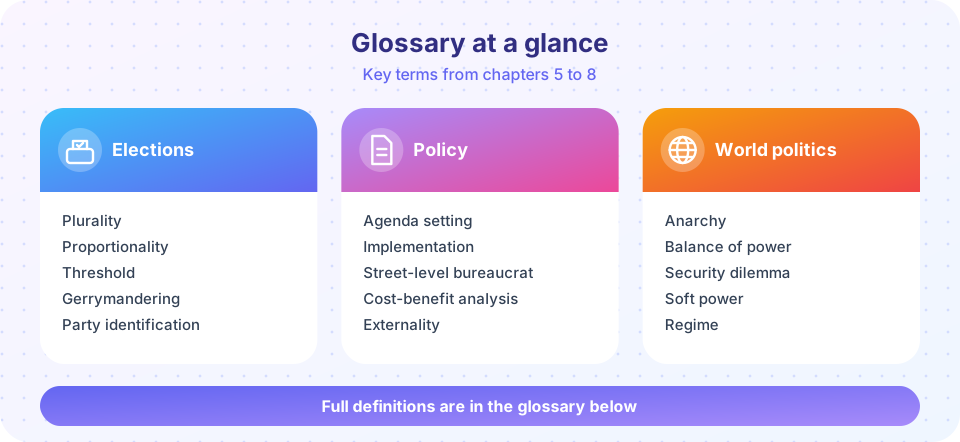
This glossary collects the key terms from chapters 5 to 8 in one place, grouped by chapter. Use it as a reference while you read, and as a study list before a quiz. Definitions are short on purpose: the lessons give the reasoning and the examples.
What you will learn
- The precise meaning of the main terms in each chapter.
- How terms connect across chapters, for example how veto players appear in both policy and comparative politics.
- How to quiz yourself with a lookup and drill tool.
Elections, parties and voting
| Term | Meaning |
|---|---|
| Plurality | Winner is the candidate with the most votes, even without a majority. |
| Majority | More than half of the votes. |
| Runoff (two-round) | A second round between the top candidates if nobody wins a majority. |
| Ranked-choice (instant-runoff) | Voters rank candidates; last-place candidates are eliminated and their ballots transferred. |
| Proportional representation (PR) | A family of systems in which seat shares roughly follow vote shares. |
| District magnitude | The number of seats elected in a district. |
| Threshold | A minimum vote share needed to win seats under PR. |
| D'Hondt / Sainte-Laguë | Divisor formulas for allocating list-PR seats; the first slightly favors large parties. |
| Mixed-member proportional (MMP) | Two tiers (districts and lists) with list seats compensating for disproportionality. |
| Single transferable vote (STV) | Ranked ballots in multi-member districts with transfers of surplus and eliminated votes. |
| Gerrymandering | Drawing district boundaries to benefit a party or group. |
| Gallagher index | A measure of the gap between vote shares and seat shares. |
| Effective number of parties | 1 / Σp²: the number of equal-sized parties that would give the same fragmentation. |
| Duverger's law | Plurality rule in single-member districts tends toward two parties. |
| Cleavage | A lasting social division that parties organize around. |
| Electoral volatility | Net shift of votes among parties between elections (Pedersen index). |
| Party identification | A lasting psychological attachment to a party. |
| Retrospective voting | Judging incumbents by past performance. |
| Rational ignorance | Rationally staying uninformed because one vote rarely matters. |
| Turnout | The share of eligible people who vote. |
Public policy
| Term | Meaning |
|---|---|
| Agenda setting | How issues come to receive serious attention. |
| Policy window | A brief chance when problem, policy and politics streams align. |
| Incrementalism | Policy change through small adjustments to the status quo. |
| Bounded rationality | Decision-makers have limited time, information and attention. |
| Veto player | An actor whose agreement is needed for a decision. |
| Implementation | Carrying out a policy decision. |
| Street-level bureaucrat | A front-line public employee who uses discretion. |
| NATO (nodality, authority, treasure, organization) | Hood's four families of government tools. |
| Externality | A cost or benefit that falls on people outside a transaction. |
| Public good | Non-excludable and non-rivalrous good. |
| Counterfactual | What would have happened without the policy. |
| Difference-in-differences | Comparing the change in a treated group with the change in a comparison group. |
| Net present value (NPV) | Discounted sum of future benefits and costs. |
Comparative politics
| Term | Meaning |
|---|---|
| Regime | Rules and institutions deciding who governs and how. |
| Polyarchy | Dahl's term for real-world democracy combining contestation and inclusion. |
| Hybrid regime | A mix of democratic and authoritarian features. |
| Democratic backsliding | Gradual erosion of democratic institutions. |
| Consolidation | Democracy accepted by all major actors as the only legitimate way to compete for power. |
| Most similar systems design | Compare alike cases that differ in outcome. |
| Most different systems design | Compare unlike cases that share an outcome. |
| Selection bias | Distortion from choosing cases in a way related to the outcome. |
| Process tracing | Following the steps of a causal chain within a case. |
| Majoritarian and consensus democracy | Lijphart's models of concentrating versus sharing power. |
International relations
| Term | Meaning |
|---|---|
| Sovereignty | Supreme authority of a state over its territory. |
| Anarchy | No central authority above states. |
| Balance of power | A distribution in which no state can dominate the rest. |
| Polarity | The number of great powers in the system. |
| Security dilemma | One state's efforts to increase security make others less secure. |
| Democratic peace | Pairs of democracies rarely fight each other. |
| Norm | A shared expectation about appropriate behavior. |
| Prisoner's dilemma | Individually rational choices lead to a collectively worse outcome. |
| Nash equilibrium | A set of choices where no player gains by switching alone. |
| Comparative advantage | Lower opportunity cost of producing a good. |
| Collective security | States agree to respond jointly to aggression. |
| Hegemony | Dominance of one state over the system or a region. |
Try it
Press Run (or Ctrl + Enter) to see the console output here.
No output.
Press Run (or Ctrl + Enter) to see the console output here.
No output.
Check your understanding
Quick check · 4 questions
of 4 answered You scored / 4 · perfect!
-
1. Which term describes a minimum vote share needed to win seats under PR?
A threshold keeps very small parties out of the legislature. -
2. What does 'veto player' mean?
More veto players make change harder. -
3. Which term refers to what would have happened without a policy?
Evaluation compares outcomes with the counterfactual to estimate impact. -
4. Which term describes pairs of democracies rarely fighting each other?
The democratic peace is a pattern about pairs of democracies.
Summary
- The glossary groups terms by chapter and gives short definitions.
- Many terms recur across chapters, such as veto players and counterfactuals.
- Active recall with a drill helps the terms stick.
Track your progress
Create a free account to tick off lessons and pick up where you left off on any device.
of Political Science lessons completed