


















Lesson 4 of 44 · Getting Started
Chapter 1 Review: Getting Started
Review chapter 1 of the political science course: definitions, subfields, methods, confounders and polls, with a recap table and a ten-question quiz.
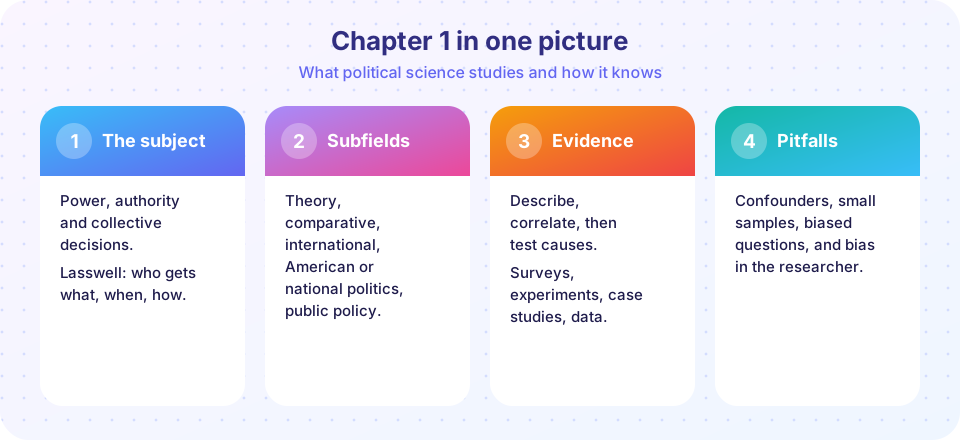
You have met the subject, its five subfields and its main methods. This review pulls the chapter into one page, gives you a recap table to check yourself, and ends with a ten-question quiz that mixes all three lessons. Try the quiz before rereading anything; the wrong answers will tell you where to look.
What you will learn
- check that you can define politics and name the five subfields
- recall each method and its main weakness
- explain correlation, confounders and margin of error in your own words
Recap table
| Idea | One-line summary | Lesson |
|---|---|---|
| Politics | Making binding group decisions despite disagreement | What is political science? |
| Lasswell | Who gets what, when, how | What is political science? |
| Normative vs empirical | What should be vs what is | What is political science? |
| Five subfields | Theory, comparative, international, national, policy | What is political science? |
| Operationalization | Turning a concept into a measurable indicator | Evidence and methods |
| Experiment | Random assignment gives causal evidence | Evidence and methods |
| Confounder | A third factor that creates a fake link | Evidence and methods |
| Margin of error | Sampling chance only, not bias | Evidence and methods |
Common misconceptions
"Facts settle every political argument." Facts matter, but many disputes combine facts with values. Separate the two before you argue.
"One study proves it." Single studies can be wrong or fragile. Look for repeated results from different methods.
Try it
The first tool is a spaced-review schedule: it lists the days on which to revisit this chapter so that it sticks. The intervals are a common rule of thumb, not an exact science.
Press Run (or Ctrl + Enter) to see the result here.
Program input · what you'd type while the program runs
Type the answers before you press Run, one per line. Each time the program reads a line (with input()), it gets the next line from this box.
The second tool is a self-test scorer. Fill in 1 for a concept you can explain without notes and 0 for one you cannot.
Press Run (or Ctrl + Enter) to see the console output here.
No output.
Check your understanding
Quick check · 10 questions
of 10 answered You scored / 10 · perfect!
-
1. Which statement is empirical?
It can be checked with data; the others express values. -
2. Which is NOT one of the five subfields in this course?
The five are theory, comparative politics, international relations, national politics and public policy. -
3. Easton defined politics as the authoritative allocation of what?
Political decisions bind the whole society, which is what makes them authoritative. -
4. Why is operationalization important?
Without a clear indicator, researchers cannot compare results across studies. -
5. What is the main strength of a field experiment?
Random assignment balances other factors on average. -
6. A survey sample is huge but drawn from a biased list. What follows?
Size does not cure bias; the 1936 Literary Digest poll is the classic warning. -
7. In the confounder demo, what happened to the correlation after heat was removed?
The apparent link came from the shared cause, so it disappeared once that cause was adjusted for. -
8. Quadrupling a poll's sample size changes the sampling error roughly by what factor?
Error shrinks with the square root of the sample size. -
9. Which statement best separates explanation from evaluation?
Explanation proposes causes; evaluation requires values. -
10. Which method shows the step-by-step mechanism in one setting?
Case studies trace how a cause might work, though they are hard to generalize.
Summary
- Politics is the making of binding group decisions; Lasswell and Easton give two classic definitions.
- Separate description, explanation and evaluation, and facts from values.
- Methods trade strength against weakness; use several together.
- Beware confounders, biased samples and over-reading a single poll or study.
Track your progress
Create a free account to tick off lessons and pick up where you left off on any device.
of Political Science lessons completed