


















Lesson 16 of 44 · Political Systems and Institutions
Chapter 4 Overview: Political Systems and Institutions
Preview chapter 4: regimes from democracy to authoritarianism, constitutions and separation of powers, presidential and parliamentary systems, and federal and unitary states.
Ideologies tell people what they want. Institutions decide what they can get. The same demand for lower taxes or stronger rights will lead to very different results depending on whether the country has a parliament or a president, a federal or a unitary structure, a strong court or none. Institutions are the rules of the game, and political scientists study them because small rule differences can produce big differences in who wins.
This chapter covers the main design choices of modern governments. It starts with the broadest question, what kind of regime a country has, then moves to constitutions, the relationship between legislature and executive, and the vertical division of power between national and regional governments.
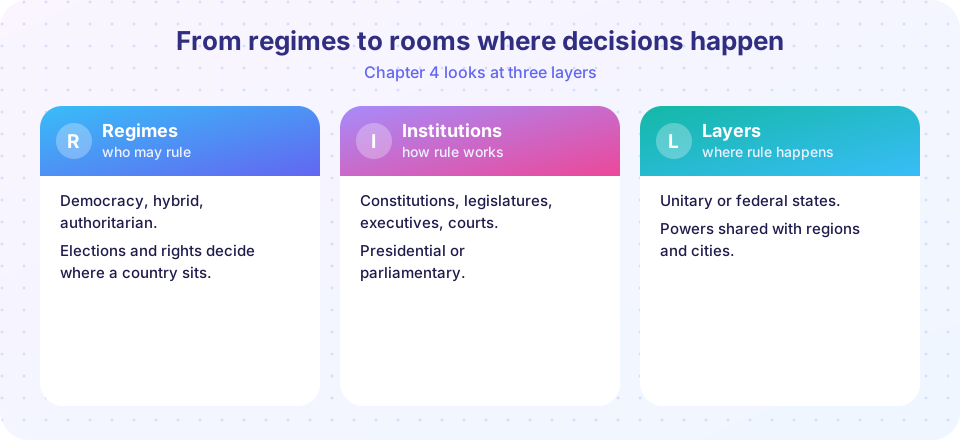
What you will learn
- the three layers of institutional design covered in this chapter
- why institutions matter, with a famous example of how rules change outcomes
- what each lesson covers and how to compare systems
Key terms
Regime: the basic form of government in a country, such as democracy or authoritarian rule.
Institution: a stable set of rules and organizations that shape behavior.
Executive: the part of government that carries out laws.
Legislature: the body that makes laws.
Judiciary: the courts that interpret laws.
Layer one: regimes
Layer two: institutions
Layer three: territory
Each layer shapes the others.
Why institutions matter
Consider the simple story of how a bill becomes a law. In one country the head of government is chosen by the legislature and can be removed by it. In another the president is elected separately and serves a fixed term even if the legislature opposes. In the first, the executive needs a standing majority; in the second, a president and a hostile legislature can block each other for years. Same voters, same issues, different political life. A famous argument by Juan Linz in 1990 on the risks of presidentialism, which you will meet in lesson 4, rests on this kind of difference.
What each lesson covers
- Democracy and Authoritarianism: definitions of democracy from Schumpeter to Dahl, hybrid regimes, types of authoritarian rule, and a model of the median voter.
- Constitutions and Separation of Powers: what constitutions do, Montesquieu, checks and balances, judicial review and the idea of veto points.
- Presidential and Parliamentary Systems: how the two designs work, semi-presidentialism, coalition government and confidence votes.
- Federal and Unitary States: how states divide power vertically and the arguments for and against decentralization.
- Chapter 4 Review: recap and a ten-question quiz.
How to compare systems
When you meet a new country, ask five questions. Who can vote and compete? (the regime). What is the written or unwritten constitution? How are executive and legislature linked? Where do regional governments stand? Who can veto or block a decision? The answers create a quick institutional profile that predicts a surprising amount about how politics will feel on the ground.
Common misconceptions
"Democracy is one single system." There are many democratic designs with real differences.
"A written constitution guarantees freedom." Many authoritarian states have written constitutions. What matters is whether rules are followed and enforced.
"Institutions are neutral." Rules favor some actors and policies over others, which is why fights over them are fierce.
Try it
The first demonstration is a quick profile builder. Describe a country with four institutional facts and the function prints a one-line summary. The countries are real examples, but the one-line summaries are very simplified.
Press Run (or Ctrl + Enter) to see the console output here.
No output.
The second demonstration scores the fit between a design choice and a goal. It is a rough teaching checklist, not a research tool.
Press Run (or Ctrl + Enter) to see the result here.
Program input · what you'd type while the program runs
Type the answers before you press Run, one per line. Each time the program reads a line (with input()), it gets the next line from this box.
Check your understanding
Quick check · 4 questions
of 4 answered You scored / 4 · perfect!
-
1. What is a regime?
Regime refers to the underlying rules of who rules and how. -
2. Which pair of institutions does the executive-legislative question concern?
The link between executive and legislature defines those two types. -
3. Which is a reason to study institutions?
Institutions are the rules of the game and shape outcomes. -
4. Which statement is true about written constitutions?
What matters is whether rules are followed and enforced.
Summary
- Chapter 4 covers three layers of design: regimes, institutions and territorial structure.
- Rules shape outcomes, so institutional choices are political choices.
- Five questions give a quick institutional profile of any country.
Track your progress
Create a free account to tick off lessons and pick up where you left off on any device.
of Political Science lessons completed