


















Lesson 25 of 44 · Elections, Parties and Voting
Voting Behavior: Why People Vote the Way They Do
Compare the Columbia, Michigan and rational-choice explanations of voting, learn about turnout and economic voting, and explore two simple models.
Millions of people make a political choice at election time, and their reasons differ: loyalty to a family tradition, anger about prices, trust in a leader, a single issue, a sense of duty, or simply the habit of voting a certain way. Political scientists study voting behavior to find patterns behind these varied reasons, and to understand two separate decisions: whether to vote at all, and whom to vote for.
This lesson walks through the classic schools of thought, the puzzle of turnout, and the research on whether voters judge governments by results. The ideas are explanations, not rules, and each has strengths and blind spots.
What you will learn
- The main ideas of the Columbia, Michigan and rational-choice schools.
- What party identification is and why it matters.
- Why turnout is called a paradox and how scholars explain it.
- What retrospective and economic voting mean, and where the evidence is mixed.
Key terms
Party identification: a lasting psychological attachment to a party, often formed early in life.
Retrospective voting: judging parties by past performance, such as how the economy did.
Pocketbook and sociotropic voting: voting on one's own finances versus on the nation's economy.
Valence issue: an issue on which nearly everyone shares the same goal, such as prosperity, so voters judge who can deliver it.
Rational ignorance: choosing not to learn much about politics because one vote rarely matters.
The sociological school
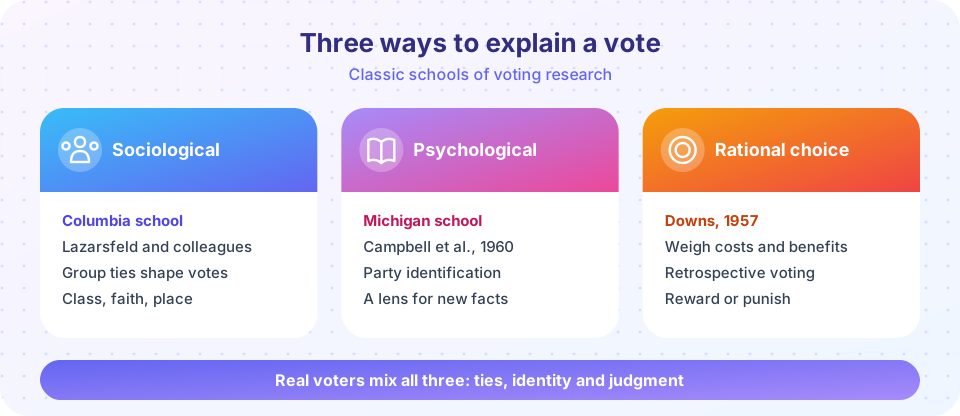
In 1940 Paul Lazarsfeld, Bernard Berelson and Hazel Gaudet followed voters in Erie County, Ohio, through the presidential campaign, and published the findings in The People's Choice (1944). They expected to find that campaigns change minds. Instead, most people's votes matched their social characteristics, such as religion, class and place of residence, and campaigns mostly activated and reinforced existing leanings. This Columbia school treated the vote as an expression of group membership, and highlighted the role of personal networks and opinion leaders.
The psychological school
A team at the University of Michigan, Angus Campbell, Philip Converse, Warren Miller and Donald Stokes, explained votes through attitudes. Their book The American Voter (1960) put party identification at the center. They pictured a "funnel of causality": long-term factors such as family background and party attachment sit at the wide end, and short-term factors, such as candidates and issues of the day, are closer to the vote. Party identification acts as a lens that colors how voters read new information. This is why partisans can look at the same facts and see different stories.
Critics noted that party identification is not entirely fixed, and that many voters respond to events. But the concept proved durable, and surveys in many countries still measure it.
The rational-choice school
Anthony Downs's An Economic Theory of Democracy (1957) imagined voters as people with preferences who choose the party that offers them the most benefit. Information is costly, so it can be sensible to stay poorly informed, which he called rational ignorance. Downs's model also gave rise to the median voter theorem, which you will test in the practice chapter.
The paradox of turnout
If voters are rational, why vote? The chance that one vote decides an election in a large electorate is tiny. William Riker and Peter Ordeshook (1968) wrote the calculus of voting as R = pB − C + D: the reward R from voting depends on the probability p of casting the decisive vote, the benefit B of your side winning, the cost C of voting, and a sense of civic duty or satisfaction D. Since p is usually tiny, the explanation of turnout rests largely on D, and also on how easy or hard voting is.
Press Run (or Ctrl + Enter) to see the result here.
Program input · what you'd type while the program runs
Type the answers before you press Run, one per line. Each time the program reads a line (with input()), it gets the next line from this box.
This model is a simplification: real elections are rarely a coin flip, so the true probability is often even smaller. Scholars respond in several ways. Some add the duty term D, others point to social pressure and habit, and others note that people vote for expressive reasons, to show support for a side. Voting is also easier in some places than others, and Australia and Belgium impose compulsory voting with fines, which lifts turnout sharply.
Retrospective and economic voting
V. O. Key's The Responsible Electorate (1966) argued that voters are not fools: they act as judges of past performance, rewarding success and punishing failure. Morris Fiorina (1981) developed retrospective voting in detail. Voters need not read manifestos; they only need to ask whether things went well under the incumbent. Researchers have found that voters respond to the economy in many democracies, and that sociotropic judgments, based on the whole economy, often predict votes better than pocketbook ones, based on personal finances.
Still, the evidence is mixed. Partisanship colors perceptions: Larry Bartels and others have shown that supporters of the governing party tend to rate the economy more favorably than the opposition's supporters do, even when objective conditions are shared. And voters weigh more than the economy: Donald Stokes (1963) distinguished position issues, on which voters disagree, from valence issues, on which they agree on the goal and judge competence.
The following simulation, not real data, shows how partisan perception can weaken the link between the economy and the vote.
Press Run (or Ctrl + Enter) to see the result here.
Program input · what you'd type while the program runs
Type the answers before you press Run, one per line. Each time the program reads a line (with input()), it gets the next line from this box.
Common misconceptions
"Campaigns decide elections." Research from the Columbia school onward finds that campaigns often reinforce and activate more than they convert, although in close races or among undecided voters they can matter.
"Voters are either fully rational or fully emotional." Most research supports a blend. Even partisan loyalty can be seen as a mental shortcut that helps people decide with limited information, a point argued by Samuel Popkin as "low-information rationality".
"Turnout is just apathy." Turnout depends strongly on rules, such as registration and compulsory voting, on competitiveness, and on age and education.
Check your understanding
Quick check · 4 questions
of 4 answered You scored / 4 · perfect!
-
1. Which school put party identification at the center of voting research?
Campbell, Converse, Miller and Stokes in The American Voter (1960) treated party identification as a long-term psychological attachment shaping other attitudes. -
2. What does the term 'paradox of turnout' refer to?
If p is very small, the expected benefit pB may not exceed the cost C, so other factors such as duty D must help explain voting. -
3. What is retrospective voting?
Voters reward or punish incumbents for how things went, which requires less information than comparing detailed future plans. -
4. Which finding complicates the idea of simple economic voting?
Partisan perception can filter economic facts, weakening the link between conditions and votes.
Summary
- The Columbia school linked votes to group ties, and the Michigan school to party identification.
- Rational-choice theory treats voters as weighing costs and benefits, and raises the paradox of turnout.
- Retrospective voting means judging the past performance of incumbents, though partisanship colors perceptions.
- Real behavior blends habit, identity, group ties and judgment.
Next: Chapter review
Track your progress
Create a free account to tick off lessons and pick up where you left off on any device.
of Political Science lessons completed