


















Lesson 6 of 44 · Core Concepts: State, Power, Legitimacy
The State and Sovereignty
What is a state? Learn Weber's definition, the Montevideo criteria, Westphalian sovereignty, nation versus state, and why the number of states grew after 1945.
You have probably used the words "country," "nation," "state," "government" and "nation-state" as if they were the same. Political scientists keep them apart because the differences matter. A government changes every few years; a state continues. A nation is a community of people who feel they belong together; a state is an organization with territory and authority. Some nations have no state of their own, and some states contain many nations.
The state is the central actor of modern politics. It collects taxes, runs courts and armies, issues passports and signs treaties. Yet it is a surprisingly recent invention. For most of human history, people lived in bands, tribes, city-states, empires and kingdoms with fuzzy borders. This lesson explains what a state is, what sovereignty means, and how the world came to be divided into about 190 of them.
What you will learn
- Weber's definition of the state and what it includes
- the four criteria of statehood in the 1933 Montevideo Convention
- the idea of sovereignty and the Westphalian system
- the difference between nation, state and nation-state
- why the number of states grew sharply after 1945, and what "failed state" means
Key terms
State: a political organization with a government, a territory and a population, claiming final authority.
Sovereignty: supreme authority within a territory and independence from outside rule.
Nation: a community that shares a sense of common identity, such as language, history or culture.
Nation-state: a state whose population largely sees itself as one nation.
Monopoly on legitimate force: Weber's phrase for the state's exclusive right to use violence.
Weber's definition
The German sociologist Max Weber, in a 1919 lecture called "Politics as a Vocation," defined the state as a human community that successfully claims the monopoly of the legitimate use of physical force within a given territory. Three words in that sentence do most of the work.
- Monopoly. Others may use force only when the state allows it, such as in self-defense or police work. If armed groups ignore the state, it is weak.
- Legitimate. The claim must be widely accepted as rightful, or at least not constantly challenged. A gang can use force, but it is not a state.
- Territory. The state governs people in a place. Authority is tied to geography, which is why borders matter.
Weber did not say that force is the only thing states do, only that force is what makes them distinctive. Schools, hospitals and mail services can be run by private firms; making and enforcing binding rules by force is what a state claims for itself.
The Montevideo criteria
International law gives a checklist. The 1933 Montevideo Convention on the Rights and Duties of States says a state should have:
- a permanent population,
- a defined territory,
- a government, and
- the capacity to enter into relations with other states.
Notice what is missing: recognition. Under the declaratory theory, an entity that meets the criteria is a state whether or not others agree. Under the constitutive theory, a state exists only when other states recognize it. In practice, recognition matters a great deal, since without it a state may be unable to join treaties or international bodies. Disputed territories show the difficulty: some governments control a territory and population but are recognized by few other states.
Sovereignty and Westphalia
Sovereignty has an inside and an outside. Internal sovereignty means the state has the highest authority within its territory: no other body can overrule its laws. External sovereignty means it is independent of outside control and is treated as an equal by other states.
The traditional date for this system is 1648, when the Peace of Westphalia ended the Thirty Years' War in Europe. Scholars now argue that the treaties did not create the system overnight and that the story is partly a myth, but the "Westphalian" label stuck as shorthand for a world of territorial states that do not interfere in each other's internal affairs.
Sovereignty is a claim, not a fixed fact. Today states share authority. A member of the European Union follows some common rules and a court above its own. A state that joins a trade agreement gives up some freedom of choice. Scholars sometimes call this pooled sovereignty. Others point out that a state with few resources may be formally sovereign yet unable to resist pressure from stronger ones. Stephen Krasner called this gap between formal claims and real control "organized hypocrisy."
Nation, state and nation-state
A nation is imagined, a term from Benedict Anderson's 1983 book Imagined Communities. Most members will never meet, yet they feel connected through shared language, stories, newspapers and symbols. A state is an organization. When the two roughly match, we speak of a nation-state, such as Japan or Iceland, though even these contain minorities. Many states are multinational (Belgium, India), and many nations lack their own state (the Kurds, for example, are spread across several states).
The idea that each nation deserves its own state is called nationalism, and it reshaped the world map from the 19th century on. You will meet it again in the lesson on ideologies.
How states appeared and multiplied
Charles Tilly argued that in Europe "war made the state, and the state made war." Rulers needed money and soldiers; to get them they built tax offices and bureaucracies, which in turn made them stronger. Other scholars stress trade, religion, agriculture and ideas.
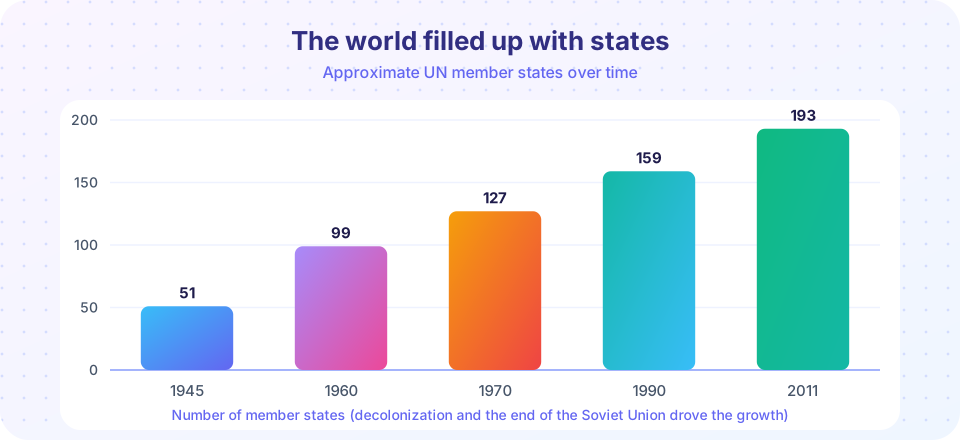
The map has changed a great deal since 1945. The United Nations began with 51 members in 1945 and has 193 today. The main waves were:
- Decolonization in Asia and Africa from the late 1940s to the 1970s, which created dozens of new states.
- The end of the Soviet Union and Yugoslavia around 1991, which added more than twenty.
- Later separations, such as South Sudan in 2011, the most recent member admitted to the UN at the time of writing.
The bar chart above shows this growth approximately. The figures are rounded and the count depends on how you treat observers and territories.
Strong, weak and failed states
States differ in capacity: how well they collect taxes, keep order and deliver services. A weak state struggles in these areas. A failed state, a term used by many scholars though contested, is one whose government no longer controls much of its territory or can provide basic security. Critics warn that the label is used loosely and can justify outside intervention. Many researchers prefer to describe a spectrum of capacity rather than a yes-or-no label.
Common misconceptions
"Nation and state mean the same thing." A nation is a community with a shared identity; a state is an organization with authority over territory. They often overlap but are not identical.
"Sovereign states can do anything inside their borders." Treaties, courts and economic ties limit what states can choose in practice, and international law sets some limits on how they treat people.
"The Peace of Westphalia created the modern state system in 1648." It was a milestone, but the system developed gradually over centuries.
Try it
The first demonstration plots approximate UN membership and shades the growth. The values are rounded and meant for illustration.
Press Run (or Ctrl + Enter) to see the result here.
Program input · what you'd type while the program runs
Type the answers before you press Run, one per line. Each time the program reads a line (with input()), it gets the next line from this box.
The second demonstration is a checker for the four Montevideo criteria. It asks you to describe an entity with true/false facts and tells you which criterion is missing. The entities are invented.
Press Run (or Ctrl + Enter) to see the console output here.
No output.
Check your understanding
Quick check · 6 questions
of 6 answered You scored / 6 · perfect!
-
1. Which phrase best summarizes Weber's definition of the state?
Weber stressed the successful claim to the monopoly of legitimate physical force within a territory. -
2. Which is NOT one of the four Montevideo criteria?
The four criteria are population, territory, government and the capacity for foreign relations; a written constitution is not required. -
3. What does the constitutive theory of statehood claim?
The constitutive theory makes recognition a condition; the declaratory theory does not. -
4. What is a nation-state?
Nation-states roughly match a national community to a state. -
5. What drove the rapid growth of UN membership between 1955 and 1970?
Dozens of former colonies became independent states. -
6. What is pooled sovereignty?
Members of bodies like the European Union share some authority.
Summary
- Weber defined the state by its successful claim to a legitimate monopoly of force over a territory.
- The Montevideo criteria list population, territory, government and capacity for foreign relations; recognition is debated.
- Sovereignty has an internal side (supreme authority) and an external side (independence), and is shared in practice.
- Nations are imagined communities; nation-states match one nation to one state, but most states are mixed.
- The number of states grew from about 51 UN members in 1945 to 193, mainly through decolonization and breakups.
Next: Power and Its Faces
Track your progress
Create a free account to tick off lessons and pick up where you left off on any device.
of Political Science lessons completed