


















Lesson 18 of 44 · Political Systems and Institutions
Constitutions and Separation of Powers
What constitutions do, how they differ, Montesquieu's separation of powers, checks and balances, judicial review and veto players, with an amendment calculator.
A constitution is the set of basic rules that says who holds power, how they get it, what they may do, and what they may not do. Think of it as the rules of the game before the game begins. Most countries have a single written document called the constitution. Some, such as the United Kingdom, rely on a mixture of statutes, court decisions and conventions that make up an uncodified constitution.
Why do societies bother? Because power tends to grow, and people who hold it are tempted to extend it. The old idea of constitutionalism is that rulers should be bound by rules that are harder to change than ordinary laws. The best known design for this is separation of powers: splitting government into branches so that each can check the others.
What you will learn
- the main functions of a constitution and the types of constitution
- Montesquieu's argument for separating powers
- examples of checks and balances, and judicial review
- how amendment rules and veto players affect stability and change
- common misunderstandings about constitutions
Key terms
Constitution: the fundamental rules that establish and limit government.
Constitutionalism: the idea that government power should be limited by law.
Separation of powers: dividing government functions among branches.
Checks and balances: powers that let each branch limit the others.
Judicial review: the power of courts to declare laws or acts unconstitutional.
What constitutions do
Constitutions usually do four things.
- Establish institutions. They create the legislature, executive and courts, and say how members are chosen.
- Distribute and limit power. They divide powers among branches and levels of government, and set limits.
- Protect rights. Many include a bill of rights, such as freedom of speech, equality before the law and the right to a fair trial.
- Set the rules for changing the rules. Amendment procedures say how the constitution itself can be altered.
A constitution also has a symbolic function: it expresses national identity and shared values. But writing a constitution does not guarantee compliance. Many authoritarian states have impressive texts that are ignored. Scholars sometimes distinguish nominal constitutions (on paper) from normative constitutions (actually followed).
Types of constitution
| Feature | Alternative |
|---|---|
| Form | Codified (one document: United States, Germany) or uncodified (United Kingdom, New Zealand, Israel) |
| Amendment | Rigid (hard to change) or flexible (changed as ordinary law) |
| Rights | Entrenched bill of rights, or protected mainly by statute and tradition |
| Review | Strong judicial review, weak review, or parliament has the final say |
The United States Constitution of 1787 is among the oldest written constitutions still in force. Rigid constitutions give stability but can freeze arrangements that no longer fit.
Montesquieu and the separation of powers
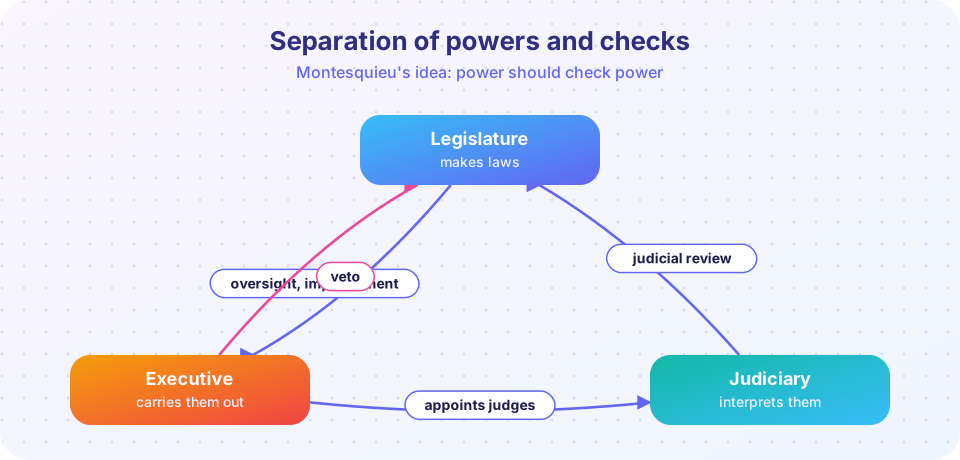
The French thinker Montesquieu, in The Spirit of the Laws (1748), studied England and concluded that liberty is most secure when legislative, executive and judicial powers are held by different hands. If the same person or body makes, enforces and judges the laws, there is nothing to restrain it. He wrote that "power should be a check to power."
The American framers drew heavily on this idea. James Madison, writing in Federalist No. 51 (1788), argued that "ambition must be made to counteract ambition": each branch should have both the means and the motive to resist the others. This gave rise to the system of checks and balances.
Checks and balances in practice
In the American system:
- Congress makes laws, controls the budget, confirms judges and top officials, and may impeach and remove the president and judges.
- The president executes the laws, may veto bills (which Congress can override by a two-thirds vote in each house) and appoints judges.
- The courts interpret laws and, since Marbury v. Madison (1803), strike down laws that conflict with the Constitution.
Not every democracy separates powers this way. In parliamentary systems the executive grows out of the legislature, so the separation is softer, with the main checks between the government and an opposition, a second chamber and courts. Courts too differ: some countries have a special constitutional court (Germany, many European countries) separate from the ordinary courts.
Judicial review and its critics
Judicial review is the power of courts to refuse to apply laws that violate the constitution. Supporters say it protects rights from majorities. Critics, such as Jeremy Waldron, argue it lets unelected judges overrule elected legislatures on questions on which citizens reasonably disagree. A middle road is weak-form review, as in the United Kingdom's Human Rights Act 1998, in which courts may declare a law incompatible with rights but Parliament decides what to do next.
Amendment and veto players
Amending a constitution is meant to be harder than passing a law. In the United States, an amendment needs a two-thirds vote in each house of Congress (or a convention called by two-thirds of the states) and ratification by three-quarters of the states, 38 of the 50. In other countries the rules include referendums, supermajorities in parliament or approval in two successive parliaments.
George Tsebelis proposed a general concept, veto players: actors whose agreement is needed to change the status quo, such as a president, two legislative chambers, a coalition partner or a constitutional court. The more veto players there are, and the more they disagree, the harder it is to change policy. That produces stability and sometimes gridlock. Each extra veto point multiplies the difficulty, as the simulation below shows.
Common misconceptions
"A written constitution is always better than an unwritten one." The United Kingdom and New Zealand have functioned as stable democracies without a single codified document.
"Separation of powers means branches never interact." The point is that they check each other, which requires interaction.
"Constitutions never change." They change through amendment, interpretation, practice and sometimes replacement.
Try it
The first demonstration shows how veto points make change harder. Suppose a policy needs the approval of n independent veto players, and each approves with probability p. The chance that a proposal passes is p raised to the power n. The model is simplified, since real veto players are not independent and bargain.
Press Run (or Ctrl + Enter) to see the result here.
Program input · what you'd type while the program runs
Type the answers before you press Run, one per line. Each time the program reads a line (with input()), it gets the next line from this box.
The second demonstration calculates what an amendment threshold means in votes. It uses the numbers from the United States as an example, and you can try other thresholds.
Press Run (or Ctrl + Enter) to see the console output here.
No output.
Check your understanding
Quick check · 5 questions
of 5 answered You scored / 5 · perfect!
-
1. Who argued in 1748 that liberty is best secured by separating legislative, executive and judicial powers?
Montesquieu's The Spirit of the Laws set out the argument. -
2. What is judicial review?
It is the court power to check laws and acts against the constitution. -
3. Which describes a rigid constitution?
Rigidity refers to the difficulty of amendment. -
4. How many US states must ratify a constitutional amendment?
Three-quarters of 50 states is 38. -
5. What does Tsebelis's concept of veto players suggest?
Each additional veto player with different preferences raises the bar for change.
Summary
- A constitution establishes institutions, divides and limits power, protects rights and sets amendment rules.
- Constitutions can be codified or uncodified, rigid or flexible; compliance matters more than the text.
- Montesquieu's separation of powers and Madison's checks and balances aim to make power restrain power.
- Judicial review protects rights but raises questions about unelected judges.
- Veto players and amendment thresholds shape how easily the rules can change.
Track your progress
Create a free account to tick off lessons and pick up where you left off on any device.
of Political Science lessons completed