


















Lesson 30 of 44 · Public Policy
Chapter 6 Review: Public Policy
Review the policy cycle, agenda setting, implementation, policy tools and evaluation with a summary picture, a recap table and a ten-question quiz.
This chapter followed a policy from the first spark of attention to the last evaluation report. You met models of agenda setting and decision-making, the problems of implementation, the four families of policy tools, and the methods used to judge results. Use this page to pull it all together.
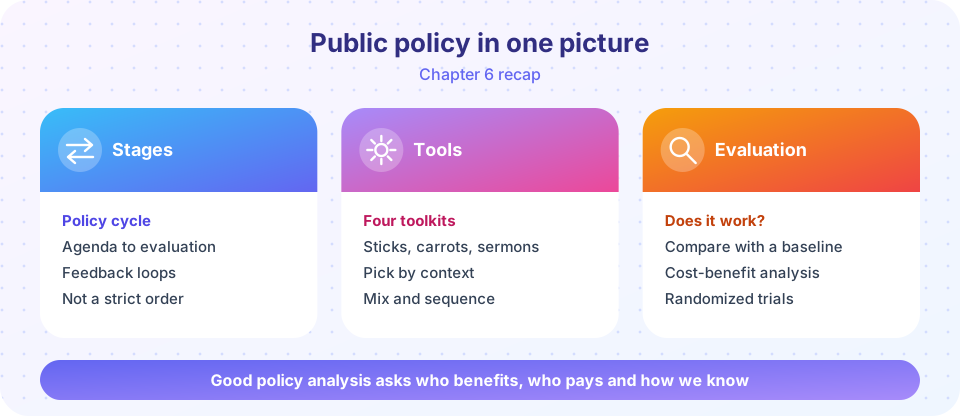
What you will learn
- How the stages, tools and evaluation methods fit together.
- Which names and ideas to connect with which concepts.
- How to apply NATO and cost-benefit thinking to a new example.
Key terms
Policy window: an opportunity when problem, policy and politics streams align (Kingdon).
Incrementalism: policy change through small steps (Lindblom).
NATO: nodality, authority, treasure, organization (Hood).
Counterfactual: what would have happened without the policy.
NPV: net present value, the discounted sum of benefits and costs.
Recap table
| Topic | Core idea | Names and numbers |
|---|---|---|
| Agenda setting | Attention is scarce; windows open when streams align | Kingdon (1984), Baumgartner and Jones (1993) |
| Decisions | Bounded, often incremental, constrained by veto players | Simon, Lindblom (1959), Sabatier |
| Implementation | Delivery reshapes policy; long chains fail more often | Pressman and Wildavsky (1973), Lipsky (1980) |
| Tools | Four toolkits, usually combined | Hood (1983), Vedung, Thaler and Sunstein |
| Evaluation | Needs a counterfactual; methods include RCTs and difference-in-differences | NPV = Σ (B - C) / (1 + r)^t |
Try it
Press Run (or Ctrl + Enter) to see the console output here.
No output.
Press Run (or Ctrl + Enter) to see the result here.
Program input · what you'd type while the program runs
Type the answers before you press Run, one per line. Each time the program reads a line (with input()), it gets the next line from this box.
Chapter quiz
Quick check · 10 questions
of 10 answered You scored / 10 · perfect!
-
1. Which framework explains agenda change as the joining of problem, policy and politics streams?
Kingdon's multiple streams framework says windows open when the three streams align. -
2. What does punctuated equilibrium predict about policy change?
Baumgartner and Jones describe policy as stable for long periods, then changing quickly when attention and framing shift. -
3. Which describes incrementalism?
Lindblom described policy as muddling through small, comparable changes. -
4. Why do long implementation chains tend to fail?
Pressman and Wildavsky's logic: even reliable steps produce low overall success when there are many of them. -
5. Who are street-level bureaucrats?
Lipsky used the term for teachers, police officers, caseworkers and others who deal directly with citizens. -
6. A ban on lead in paint is mainly which NATO tool?
A legal prohibition is an exercise of authority. -
7. What is the purpose of a Pigouvian tax?
Charging the external harm aligns private and social costs. -
8. What is a counterfactual?
Evaluation compares outcomes with the counterfactual to estimate impact. -
9. In difference-in-differences, what assumption matters most?
The method requires that, without the program, the groups would have changed in parallel. -
10. What does raising the discount rate usually do to a project's NPV when costs come first and benefits later?
Later benefits are discounted more heavily, so NPV falls.
Summary
- Policy runs through stages that are a map, not a strict order.
- Agendas, decisions and implementation are shaped by attention, constraints and discretion.
- Governments combine nodality, authority, treasure and organization.
- Credible evaluation uses counterfactuals and states its assumptions.
Track your progress
Create a free account to tick off lessons and pick up where you left off on any device.
of Political Science lessons completed