


















Lesson 13 of 44 · Political Ideologies
Socialism and Marxism
Learn socialism and Marxism: early socialists, Marx and Engels on class and surplus value, reform versus revolution, social democracy, and the record and criticisms.
Socialism is a family of ideas united by one worry: that a society built on private ownership of the main means of production, such as factories, land and finance, produces deep inequality and leaves workers dependent on owners. Socialists differ on what to do about it. Some want to abolish private ownership of large enterprises; others want to tame markets with strong welfare states and workers' rights.
The word entered European debate in the 1820s and 1830s, as industrialization drew people into factories and cities. Its best known theorist, Karl Marx, described a whole theory of history and economics, which millions followed and many others fiercely opposed. This lesson explains the main branches, the central ideas and the debates, without taking a side.
What you will learn
- the core socialist values: equality, solidarity, and shared control of the economy
- Marx and Engels on class, exploitation and historical change
- the split between reform and revolution, and what social democracy is
- how twentieth-century communist states worked and the criticisms they faced
- how to calculate a simple measure of inequality, the Gini coefficient
Key terms
Socialism: a family of ideas favoring greater equality and collective or public control of important economic resources.
Class: a group defined by its relationship to the means of production.
Bourgeoisie and proletariat: in Marx, the owners of capital and the wage workers.
Surplus value: in Marx, the value workers produce beyond their wages, which owners keep as profit.
Social democracy: a reformist socialism that accepts elections and markets while building a strong welfare state.
Early socialists
Before Marx, thinkers such as Henri de Saint-Simon, Charles Fourier and Robert Owen proposed model communities and cooperative production. Owen, a Welsh mill owner, ran a mill at New Lanark in Scotland with better wages, schooling and housing, and tried to found cooperative communities in the United States. Marx and Engels later called these thinkers "utopian" because they relied on example and persuasion and lacked an analysis of how social change happens.
Marx and Engels
Karl Marx and Friedrich Engels published The Communist Manifesto in 1848. Marx's later book, Capital (the first volume appeared in 1867), set out his theory in detail. Four ideas stand out.
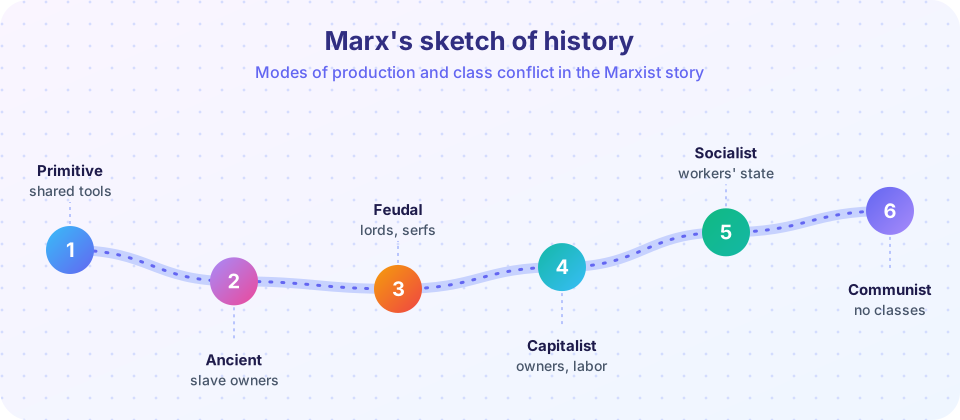
Historical materialism. The way a society produces its goods, its mode of production, shapes its laws, politics and ideas. Marx sketched a sequence: primitive communal societies, ancient slave societies, feudalism and capitalism. Each has a ruling class and a class beneath it.
Class conflict. "The history of all hitherto existing society is the history of class struggles," the Manifesto says. In capitalism, the bourgeoisie own the factories and the proletariat sell their labor to live.
Exploitation and surplus value. Marx argued that workers produce more value in a day than their wages cost. The difference, surplus value, becomes profit. Whether this labor theory of value is sound is hotly disputed; most mainstream economists reject it, while Marxist economists defend or revise it.
Revolution and communism. Marx expected that capitalism's crises and the growing organization of workers would lead to a revolution. A transitional stage, which Marx called the dictatorship of the proletariat, would give way to communism, a classless society. He said little about how communism would be run.
Marx also described alienation: under capitalism, workers feel cut off from what they make, from the work itself and from each other.
Reform or revolution
Socialists have long argued over the path. After Marx's death in 1883 the German Social Democratic Party grew into a mass party that contested elections. Eduard Bernstein argued in the 1890s that capitalism was not collapsing and that socialists should pursue gradual reform by democratic means. Rosa Luxemburg replied, in Reform or Revolution (1900), that reforms were worth fighting for but could not by themselves change the system.
The Russian Revolution of 1917 gave a powerful answer to one side. Vladimir Lenin argued that a disciplined party of professional revolutionaries should lead the workers. The Bolsheviks took power, and Lenin's version of Marxism, Marxism-Leninism, became the doctrine of the Soviet Union and later of states in Eastern Europe, China, Cuba and elsewhere.
Communism in practice
Communist states put the economy under state ownership and central planning, and in most cases one party controlled politics. Their record is mixed and contested. They achieved rapid industrialization, literacy and basic health gains in some places. They also experienced severe repression, famines (such as the Soviet famine of the early 1930s and the Great Leap Forward in China), shortages and the absence of free elections and free speech. Critics argue that these outcomes follow from concentrating political and economic power in one party. Defenders argue that circumstances, war, isolation and the particular leaders explain the failures more than the theory does. Most of the Soviet-bloc governments fell in 1989 to 1991, though China, Vietnam and some others kept one-party rule while introducing markets.
Social democracy
In western and northern Europe, socialist parties accepted democracy and built social democracy: markets and private firms remain, but taxes fund universal health care, education, pensions and unemployment insurance, and unions bargain with employers. The Nordic countries are often cited as examples, along with Germany and the UK in the postwar decades. Supporters credit this model with high living standards and lower inequality; critics argue that high taxes can reduce incentives and that welfare systems face pressure from aging populations. Many social democratic parties have since mixed in more market policies, as in the "Third Way" of the 1990s.
Other strands
- Democratic socialism seeks a socialist economy through democratic means, with public or cooperative ownership of key industries.
- Anarcho-syndicalism wants workers' unions to run the economy without a state.
- Market socialism combines worker-owned firms with markets.
- Eco-socialism links capitalism with environmental damage.
- Marxist feminism, Marxist theories of imperialism and critical theory extend the analysis to gender, global inequality and culture.
Common misconceptions
"Socialism and communism are the same." Communism, in Marx's sense, is a stateless classless society; socialism is a broader family that includes reformist and democratic strands. In everyday speech, the words are used loosely, so check what a speaker means.
"Marx designed the Soviet system." Marx wrote little about how a socialist economy would work; Lenin and Stalin built the Soviet model, and scholars still debate how it relates to Marx's ideas.
"Social democracy means no private business." Social democratic countries have large private sectors; the state mostly redistributes and regulates.
Try it
The first demonstration works through Marx's arithmetic of surplus value with invented numbers. Suppose a worker's wage is equal to the value of 4 hours of the 10-hour day. Marx called these the necessary labor and the remaining 6 hours surplus labor. The rate of surplus value is surplus divided by necessary. This is the mathematics of a theory, not a statement that the theory is correct.
Press Run (or Ctrl + Enter) to see the result here.
Program input · what you'd type while the program runs
Type the answers before you press Run, one per line. Each time the program reads a line (with input()), it gets the next line from this box.
Change necessary to 6 and see how the rate falls. In Marx's story, owners try to raise the rate by lengthening the day or making work more productive, while workers organize to resist.
The second demonstration measures inequality. The Lorenz curve plots the cumulative share of income held by the poorest fraction of households; the Gini coefficient is twice the area between that curve and the equality line (0 is perfect equality, 1 is one household owning everything). The invented incomes of ten households are shown before and after a tax and transfer system, to illustrate what social democratic redistribution does.
Press Run (or Ctrl + Enter) to see the result here.
Program input · what you'd type while the program runs
Type the answers before you press Run, one per line. Each time the program reads a line (with input()), it gets the next line from this box.
The numbers are invented; real Gini figures vary by country and by whether they count taxes, transfers or wealth.
Check your understanding
Quick check · 5 questions
of 5 answered You scored / 5 · perfect!
-
1. Which book did Marx and Engels publish in 1848?
The Communist Manifesto appeared in 1848; the first volume of Capital came in 1867. -
2. What is surplus value in Marx's theory?
Marx argued that this difference becomes the owner's profit. -
3. Which thinker argued for gradual reform by democratic means in the 1890s?
Bernstein's revisionism proposed reform over revolution; Luxemburg replied in Reform or Revolution. -
4. What does social democracy keep?
It combines markets with universal welfare, supported by taxes and unions. -
5. In the Lorenz-curve demo, what does a lower Gini mean?
A Gini near 0 means incomes are close to equal.
Summary
- Socialism favors equality and shared control of economic resources; branches differ on means and ends.
- Marx's key ideas are historical materialism, class conflict, exploitation and revolution toward communism, and each is debated.
- Socialists split between reform (Bernstein, social democracy) and revolution (Lenin).
- Communist states and social democratic welfare states had different records and different critics.
- The Gini coefficient is a simple measure of income inequality.
Next: Other Ideologies
Track your progress
Create a free account to tick off lessons and pick up where you left off on any device.
of Political Science lessons completed