


















Lesson 36 of 44 · International Relations
Theories of International Relations: Realism, Liberalism, Constructivism
Compare realism, liberalism and constructivism, from Thucydides and Kant to Waltz, Keohane and Wendt, and test them against examples with simple models.
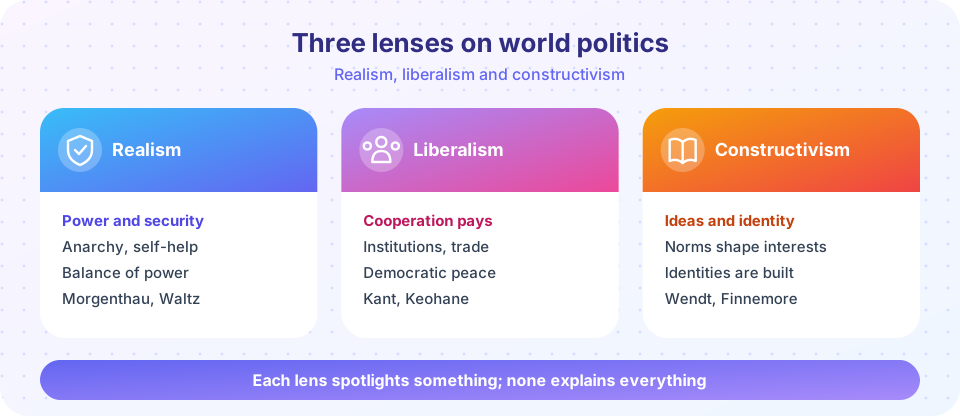
A theory of international relations is a set of ideas that explains why states behave as they do. Because the same event, such as a military buildup, can be read in different ways, theory matters: it tells you what to look for and what counts as an explanation. Three families dominate teaching: realism, liberalism and constructivism. They disagree about what drives states, whether cooperation is easy, and how much ideas matter.
None of the three is "the answer". Each highlights some facts and plays down others, and good analysts move among them.
What you will learn
- The core assumptions of realism, liberalism and constructivism.
- Key thinkers: Thucydides, Morgenthau, Waltz, Kant, Keohane, Wendt.
- How each theory reads the same events differently.
- What the power transition idea predicts, and its limits.
Key terms
Balance of power: a distribution of power in which no state can dominate the others.
Security dilemma: when one state's efforts to feel safer make others feel less safe.
Democratic peace: the finding that democracies rarely fight each other.
Regime (in IR): a set of principles, norms and rules around which expectations converge in an issue area.
Norm: a shared expectation about appropriate behavior.
Realism
Realists see states as the main actors and power as the central resource. The tradition draws on Thucydides, whose account of the Peloponnesian War includes the Melian dialogue, in which Athenian envoys tell the small island of Melos that the strong do what they can and the weak accept what they must. Hans Morgenthau's Politics Among Nations (1948) built a classical realism on human nature and the pursuit of national interest defined as power. Kenneth Waltz's Theory of International Politics (1979) moved the explanation from human nature to the structure of the system: because anarchy leaves each state responsible for its own survival, states act similarly whatever their domestic politics. This neorealism predicts balancing: states ally against dangerous concentrations of power. John Mearsheimer's offensive realism (2001) argues that states seek as much power as they can get, aiming for regional hegemony.
Realists emphasize the security dilemma, a term from John Herz (1950) and developed by Robert Jervis (1978): measures that one state takes for defense can look like threats to others, triggering spirals of mistrust.
Liberalism
Liberals are more optimistic about cooperation. Immanuel Kant's essay Perpetual Peace (1795) argued that peace is more likely among states with republican constitutions, bound in a federation, and open to trade and travel. Modern work identifies three pillars. Democratic peace, supported by research from Michael Doyle (1983), Bruce Russett and others, finds that pairs of democracies rarely go to war, though explanations and measurement are debated. Commercial liberalism holds that trade raises the costs of conflict. Institutionalism argues that institutions reduce mistrust by sharing information and making commitments credible. Robert Keohane's After Hegemony (1984) argued that cooperation can persist even when the dominant power that created it declines, because institutions lower transaction costs and make promises easier to keep.
Constructivism
Constructivists focus on ideas, identity and norms. Alexander Wendt's 1992 article argued that "anarchy is what states make of it": the same structure can produce rivalry, competition or friendship depending on how states see each other. Constructivists study how norms spread, such as bans on slavery or on chemical weapons. Martha Finnemore and Kathryn Sikkink (1998) described a "life cycle" of norms, from emergence through broad acceptance to internalization. For constructivists, interests are not given, but shaped by identity and interaction.
Other perspectives
The English School sees an "international society" with shared rules; Marxist and dependency approaches stress economic exploitation; feminist and postcolonial approaches ask whose experiences and voices the theories leave out. These critical traditions broaden the field and challenge its assumptions.
One event, three readings
Run the little tool below. It prints how each theory might frame a given event. It is a summary device, not a prediction engine.
Press Run (or Ctrl + Enter) to see the console output here.
No output.
Power transition: an example of structural thinking
A. F. K. Organski (1958) proposed that war is most likely when a rising power approaches the strength of the dominant one and is dissatisfied with the order. Graham Allison popularized the idea as the "Thucydides trap" in 2017, and critics note that many rises have been peaceful and that the historical cases are few and disputed. The simulation below uses hypothetical growth rates only to show the arithmetic of catching up.
Press Run (or Ctrl + Enter) to see the result here.
Program input · what you'd type while the program runs
Type the answers before you press Run, one per line. Each time the program reads a line (with input()), it gets the next line from this box.
Common misconceptions
"Realists want war." Realists describe a world of insecurity and often advocate caution and balancing to avoid war.
"Liberals are naive." Liberal theories rest on evidence about trade, democracy and institutions, and many liberals accept that cooperation can fail.
"Constructivism denies material power." Constructivists accept material power but argue that ideas determine what power is used for.
"The theories are rival sports teams." Good analysis often combines insights from each.
Check your understanding
Quick check · 5 questions
of 5 answered You scored / 5 · perfect!
-
1. What did Waltz's neorealism emphasize?
Waltz explained state behavior through the structure of the international system rather than human nature. -
2. What is the democratic peace?
It is about dyads of democracies, not about democracies' behavior toward all states. -
3. Which scholar argued that anarchy is what states make of it?
Alexander Wendt's 1992 article became a founding statement of constructivism. -
4. According to Keohane's institutionalism, why can cooperation continue after a hegemon declines?
Keohane argued that institutions provide information and rules that sustain cooperation. -
5. In the power transition illustration, what determines when the rising power catches up?
A larger gap or a smaller growth difference delays the crossing.
Summary
- Realism emphasizes power and security under anarchy; neorealism looks at structure.
- Liberalism points to democracy, trade and institutions as supports for cooperation.
- Constructivism studies how ideas, norms and identities shape interests.
- Other critical perspectives widen the questions asked.
- Theories give different readings of the same event, and analysts often combine them.
Track your progress
Create a free account to tick off lessons and pick up where you left off on any device.
of Political Science lessons completed