


















Lesson 7 of 44 · Core Concepts: State, Power, Legitimacy
Power and Its Faces
What is political power? Learn Dahl's definition, the second face of agenda control, Lukes's third face of belief shaping, and compute voting power with the Banzhaf index.
Power is the most used and least agreed-upon word in political science. Everyone sees that a president has more of it than a student, but what exactly is it? Is it winning votes? Controlling what gets discussed? Shaping what people want? The three answers correspond to the three "faces" of power, and each leads to a different way of studying who really rules.
The debate has practical stakes. If power is only visible winning, a researcher counts who wins votes and disputes. If power also lies in agenda control and belief shaping, then silence, apathy and "no complaints" may themselves be evidence of power at work. The answer determines whether a society looks open or closed.
What you will learn
- Dahl's definition of power and the pluralist view of who governs
- agenda setting as the second face of power
- Lukes's third face, shaping beliefs and wants
- the difference between power, force, influence and authority
- how to measure voting power with the Banzhaf index
Key terms
Power: the ability to bring about outcomes, especially to get others to do what they otherwise would not.
Pluralism: the view that power is spread among many competing groups.
Agenda setting: controlling which issues are open for decision.
Hegemony: a dominance that works through shared beliefs, associated with Antonio Gramsci.
Veto player: an actor whose agreement is needed for a decision.
The first face: winning decisions
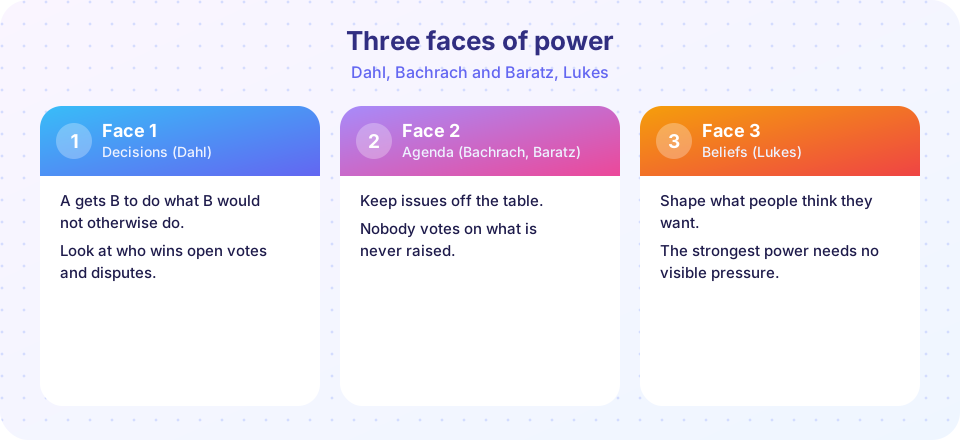
In 1957 the American political scientist Robert Dahl gave a definition that became standard: A has power over B to the extent that A can get B to do something B would not otherwise do. Four years later, in Who Governs?, he applied it to New Haven, Connecticut. He looked at three kinds of decisions, such as urban renewal and school policy, and asked who initiated proposals and whose preferences prevailed. He found that different people won in different areas, and concluded that power was dispersed, not held by one elite. This is pluralism.
The first-face method is clear and testable. You identify a real conflict, find the parties, and see who wins. Its critics raised two objections. First, it counts only visible conflicts. Second, it assumes people can speak up about their interests and that all issues reach decision.
The second face: the agenda
In 1962 Peter Bachrach and Morton Baratz replied that Dahl's approach missed a second face of power: the ability to keep issues from being decided at all. A factory owner might never need to defeat a pollution proposal in a vote if the proposal is never put on the city council's agenda. This is sometimes called non-decision making. It can happen through rules (a committee that never schedules a bill), through anticipated reactions (people do not propose what they know will be punished) or through social pressure.
Studying the second face requires looking at what did not happen and asking why. This is harder to prove, because absence is difficult to observe. Researchers use cases where an issue is suddenly allowed on the agenda and ask who blocked it before.
The third face: beliefs and wants
Steven Lukes's 1974 book Power: A Radical View added a third dimension. The most effective power, he argued, prevents conflict from arising by shaping what people think they want. If people accept an unequal arrangement as natural or inevitable, no one complains and no one needs to be defeated. He drew on Antonio Gramsci's idea of cultural hegemony: rulers rule not only through force but also by making their worldview seem common sense.
Evidence for the third face is controversial. How can you tell that someone's wants have been shaped, as opposed to freely chosen? Lukes suggested comparing what people say they want with what they would choose under conditions of real alternatives and open debate. Critics call this speculative, since it requires deciding which wants are "real." Others, drawing on Michel Foucault, go further and argue that power operates through knowledge, categories and everyday discipline, not only through anyone who holds it.
Power, force, influence and authority
These words overlap, so scholars separate them.
| Term | Meaning | Example |
|---|---|---|
| Force | Physical coercion | Police arrest a protester |
| Coercion | Threat of harm | "Pay or lose your license" |
| Influence | Persuasion or inducement | An advertisement or a donation |
| Authority | Power accepted as rightful | A judge's ruling |
Joseph Nye adds a useful distinction for international politics: hard power (military and economic pressure) versus soft power (attraction and persuasion). A state can get what it wants because others admire its culture and ideals, not because it threatens them.
Structural power
Some power is built into the system. In capitalist democracies, governments depend on private investment. If investors lose confidence, jobs and tax revenue fall, so governments tend to avoid policies that frighten business. Charles Lindblom called this the "privileged position of business." Nobody needs to threaten anyone. The structure itself limits what governments dare to do. Others point to gender, race or caste hierarchies that give some groups advantages that appear neutral on paper.
Measuring voting power: the Banzhaf index
Formal rules in councils and assemblies give actors different weights. But weight is not the same as power. The Banzhaf power index counts how often a voter is critical, meaning that their vote turns a losing coalition into a winning one.
Imagine three parties with seats A = 49, B = 48 and C = 3, where 51 are needed to pass a law. C looks tiny, but C is critical in just as many coalitions as A. A needs one partner, and C is as good a partner as B. The demonstration below computes this. Weights are not power; the rules of combination matter.
Common misconceptions
"Power is a thing someone has." Power is a relationship and depends on context. A general has power over soldiers but not over a court.
"If nobody objects, nobody holds power." Silence can reflect agenda control, fear or shaped beliefs, as the second and third faces show.
"More votes always means more power." The Banzhaf example shows that a tiny party can be as decisive as a large one.
Try it
The first demonstration computes the Banzhaf index. Change the weights and the quota to see how power moves.
Press Run (or Ctrl + Enter) to see the result here.
Program input · what you'd type while the program runs
Type the answers before you press Run, one per line. Each time the program reads a line (with input()), it gets the next line from this box.
Try weights = {"A": 40, "B": 30, "C": 20, "D": 10} with quota 51 and see who matters most. The calculation is exact, but it models only the formal rule, not bargaining, ideology or leadership.
The second demonstration is a small sorter for the three faces. Read each case, decide which face it illustrates, and compare with the printed answer.
Press Run (or Ctrl + Enter) to see the console output here.
No output.
Check your understanding
Quick check · 5 questions
of 5 answered You scored / 5 · perfect!
-
1. Which sentence matches Dahl's definition of power?
This is the classic first-face definition. -
2. What is the second face of power?
Bachrach and Baratz called it non-decision making. -
3. Who wrote Power: A Radical View in 1974?
Lukes added the third face, shaping beliefs and wants. -
4. In the A 49, B 48, C 3 example with quota 51, what is true of the Banzhaf index?
Each party is critical in exactly two of the winning coalitions. -
5. Which is an example of soft power?
Nye defined soft power as getting others to want what you want through attraction.
Summary
- Dahl's first face defines power as winning decisions and finds a pluralist world in New Haven.
- Bachrach and Baratz add agenda control; Lukes adds the shaping of beliefs and wants.
- Power differs from force, influence and authority, and structural power can limit what governments dare to do.
- The Banzhaf index shows that formal weight and real voting power can differ sharply.
- Each deeper face is harder to measure, which is why the debate persists.
Next: Legitimacy and Authority
Track your progress
Create a free account to tick off lessons and pick up where you left off on any device.
of Political Science lessons completed