


















Lesson 32 of 44 · Comparative Politics
Democratization and Regimes: Defining, Measuring and Explaining Change
Learn how political scientists define democracy and autocracy, measure regimes, describe waves of democratization, and explain why regimes change.
"Democracy" is used so often that its meaning can blur. Is a country with regular elections but a muzzled press a democracy? Is a stable one-party state with competitive internal debates an autocracy? Comparative politics needs clear definitions before it can classify regimes or explain why they change. This lesson shows how scholars define regimes, how they measure them, and what they have learned about how democracies arise and decline.
What you will learn
- Minimal and broader definitions of democracy, including Dahl's two dimensions.
- The main types of authoritarian regime and the idea of hybrid regimes.
- How regimes are measured, and why measures disagree.
- Leading explanations for democratization and backsliding, with their limits.
Key terms
Regime: the formal and informal rules that decide who governs and how power is exercised.
Polyarchy: Robert Dahl's term for real-world democracy that combines contestation and inclusion.
Hybrid regime: a regime that mixes democratic and authoritarian features, such as elections that are not fair.
Democratic backsliding: a gradual erosion of democratic institutions.
Consolidation: the stage at which democracy is accepted by all major actors as the only legitimate way to compete for power.
Defining democracy
Joseph Schumpeter (1942) offered a minimal definition: democracy is a method in which leaders gain power through competition for the people's vote. Robert Dahl's Polyarchy (1971) added a second dimension. For Dahl, a regime is characterized by contestation (how freely opposition can compete) and inclusiveness (how many adults may take part). Systems high on both are polyarchies. Dahl listed institutional requirements such as elected officials, free and fair elections, inclusive suffrage, the right to run for office, freedom of expression, alternative sources of information and freedom of association. Broader definitions add checks on power, the rule of law and equality, and the more you add, the fewer cases qualify.
Press Run (or Ctrl + Enter) to see the result here.
Program input · what you'd type while the program runs
Type the answers before you press Run, one per line. Each time the program reads a line (with input()), it gets the next line from this box.
Types of authoritarian rule
Autocracies are not all alike. Barbara Geddes (1999) distinguished personalist regimes, centered on one leader; military regimes, run by officers; and single-party regimes, in which a ruling party controls recruitment and policy. Single-party regimes tend to last longer, she argued, because parties give elites a stake in survival. Steven Levitsky and Lucan Way (2010) described competitive authoritarianism: regimes in which elections occur and opposition parties can compete, but the incumbent abuses state resources, media and courts so heavily that the contest is unfair. Such hybrid regimes blur the democracy-autocracy line, which is why many scholars prefer scales over two boxes.
Measuring regimes
Several projects rate countries every year. Freedom House scores political rights and civil liberties; the Polity project built a scale from regimes' institutional features; and V-Dem, the Varieties of Democracy project, draws on judgments from thousands of country experts and offers several democracy indices. Their definitions differ, so their rankings sometimes differ for borderline cases. Good researchers check whether a finding holds across more than one measure.
Press Run (or Ctrl + Enter) to see the console output here.
No output.
Waves and reversals
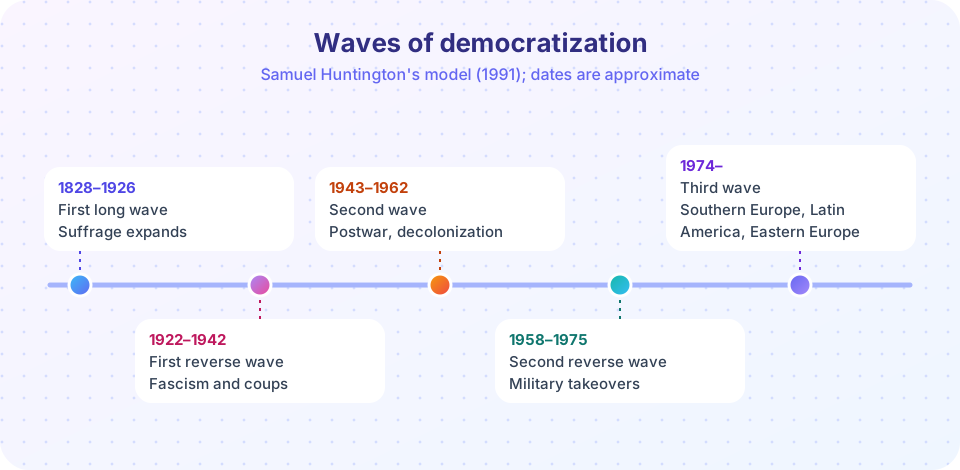
Samuel Huntington's The Third Wave (1991) described democratization as coming in waves. A long first wave (about 1828-1926) widened suffrage in countries such as the United States and Britain; a reverse wave in the interwar years brought fascism and authoritarian takeovers; a second wave followed the Second World War and decolonization; another reverse wave came in the 1960s and 1970s; and a third wave began in Portugal in 1974, spread across Southern Europe and Latin America, and reached Eastern Europe around 1989. His dates are approximate, and others have debated whether recent decades form another reversal.
Explaining democratization
- Modernization. Seymour Martin Lipset (1959) argued that wealthier countries are more likely to be democratic. Later work by Adam Przeworski and colleagues (2000) found that wealth does not much increase the chance that dictatorships turn into democracies, but democracies in wealthy countries rarely collapse. Both findings matter: wealth is better at sustaining democracy than creating it.
- Class and structure. Barrington Moore (1966) traced different routes to modernity and argued that a strong, independent urban middle class helped democracy. Dietrich Rueschemeyer, Evelyne Stephens and John Stephens (1992) emphasized the working class.
- Elite bargaining. Daron Acemoglu and James Robinson (2006) model democratization as a bargain: elites concede democracy when the threat of revolt is credible and promises to redistribute without it are not.
- International and cultural factors. Neighbor effects, external pressure and shared norms can also matter. Claims about culture, such as links between religion and democracy, have fared poorly in careful tests.
None of these explanations is complete, and most scholars treat them as complementary. They also remind us that causes of democratic survival can differ from causes of democratic emergence.
Backsliding and consolidation
Juan Linz and Alfred Stepan argued that democracy is consolidated when it is "the only game in town": no significant actors seek to overthrow it, citizens accept it, and conflicts are settled by democratic rules. Yet even long-established democracies can erode. Nancy Bermeo (2016) observed that modern backsliding is less often a coup than a gradual process in which elected leaders weaken checks on their power, a pattern some call executive aggrandizement. Scholars disagree about its causes, including polarization, economic anxiety and institutional design, and about how to measure it.
Common misconceptions
"Elections equal democracy." Elections are necessary but not sufficient. The quality of the contest and the protection of rights matter.
"Rich countries become democratic because they are rich." The evidence suggests wealth helps democracy survive more than it triggers transitions.
"Democratization always moves forward." Waves have been followed by reversals, and some countries have repeatedly switched.
Check your understanding
Quick check · 5 questions
of 5 answered You scored / 5 · perfect!
-
1. Which two dimensions did Robert Dahl use to describe regimes?
Dahl's polyarchy combines public contestation with the share of citizens who may participate. -
2. What did Przeworski and colleagues find about income and democracy?
Their study separated democratic emergence from democratic survival. -
3. What is competitive authoritarianism?
Levitsky and Way used the term for hybrid regimes where competition exists but the field is unfair. -
4. How do modern cases of democratic backsliding typically unfold, according to Bermeo?
Bermeo described incremental erosion through legal and institutional changes rather than classic coups. -
5. Why do different democracy indices sometimes rate borderline countries differently?
Indices differ in concepts, sources and aggregation methods, so researchers check robustness.
Summary
- Democracy can be defined minimally or broadly; Dahl's two dimensions are contestation and inclusiveness.
- Autocracies vary, and hybrid regimes blur the boundary.
- Indices such as Freedom House, Polity and V-Dem measure regimes differently.
- Huntington described waves and reversals; wealth seems to help democracy survive more than to create it.
- Backsliding is often gradual and hard to measure.
Next: The comparative method
Track your progress
Create a free account to tick off lessons and pick up where you left off on any device.
of Political Science lessons completed